
What zeroing a red dot actually sets
A red dot is a non-magnifying sight that projects a lit dot you put on the target. Zeroing moves that dot until it sits where the gun actually hits at one distance, called the zero distance. Before you work out how to zero a red dot scope, settle two choices that are yours, not ours: the distance and the ammunition you'll zero with. Rifle dots and handgun dots follow the same loop, though handgun dots are often zeroed closer. This guide covers the loop, the click math, and the record that keeps the result useful long after the range day.
How to zero a red dot scope in six steps
Most of the work is the same as with any sight: shoot, measure, adjust, repeat. A dot adds two wrinkles. Its clicks are usually coarser than a magnified scope's, and there's no magnification to hide a sloppy hold, so a steady rest matters even more. The steps assume the sight is already mounted and tightened the way its manual says, and that you're testing the gun and the sight from a rest, not your offhand shooting.
The red dot sight-in loop
Read the sight's manual first
Find the click value, which way each adjuster turns, and what tool it takes. Many dots use 1 MOA or 0.5 MOA per click.
Set a crisp dot and a steady rest
Turn the brightness down until the dot looks sharp, not blooming, and keep the same comfortable head position every shot.
Get on paper close
Start at a short distance so the first group is easy to find, then move back to your zero distance.
Shoot a group and find its center
Three to five shots at the same aim point. Measure the center of the whole group, not your best or worst shot.
Turn inches into clicks
Work out how big one click is at that distance, divide the offset by it, and dial in the direction marked on the sight.
Repeat, then confirm
Fire another group of the same size. Once its center sits inside your tolerance, fire one more group to confirm.
Keeping the dot centered in the window helps more than people expect. A red dot is often described as nearly parallax free, but it's only truly free of parallax at infinity, so at shorter distances the dot can drift a little as your eye moves around the window. A consistent head position takes that out of the groups. The tolerance is your stopping rule: how far the group's center may sit from the aim and still count as zeroed. Pick one your groups can actually hold, or you'll chase noise.
The click math at 25 yards, worked out
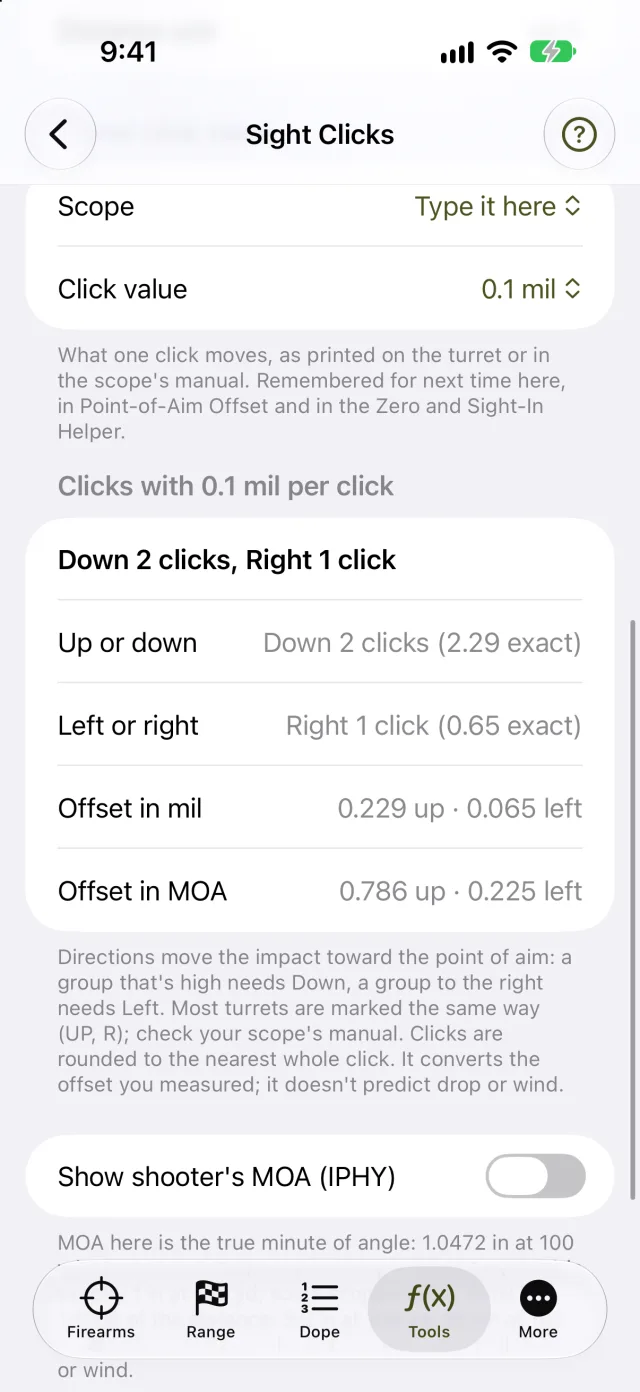
One MOA is about 1.047 inches at 100 yards, so at 25 yards it covers only about 0.26 inches. Say you're sighting in a dot with 1 MOA clicks at 25 yards, and the group's center measures 1.5 inches low and 0.5 inches left. Divide 1.5 by 0.26 and you get about 5.7, so dial 6 clicks Up. Divide 0.5 by 0.26 and you get about 1.9, so dial 2 clicks Right. The same group on a dot with 0.5 MOA clicks would need about 11 Up and 4 Right. These are arithmetic examples, not a zero for your gun.
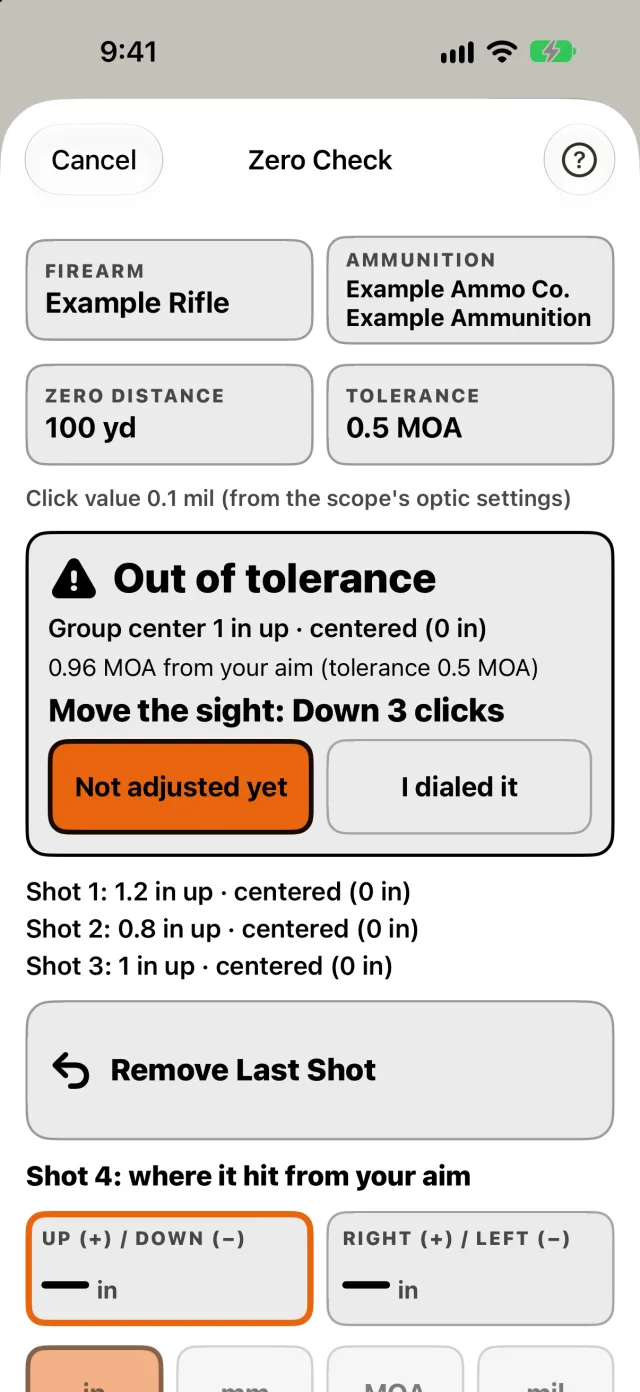
That quarter-inch click is why a dot can seem not to move at short distances: a few clicks barely shift the group. Gun Diary's free Sight Clicks calculator does the division for you in the right direction; pick 1 MOA, or a custom click value, for a dot. The screen shows the app's demo numbers from a scoped rifle in mil, and the same math works for a dot. The Zero and Sight-In Helper takes one shot per line, finds the center and says when you're within tolerance. Both sit with the other shooting calculators on the Tools tab.
Groups on target photos.
Red dot zeroing mistakes that waste ammunition
Most wasted rounds come from a handful of habits, and none of them is about the dot itself. Each one sends you dialing for a problem the sight doesn't have. They're worth a quick look before the first shot, because a mistake made in the first group gets repeated in every group after it until someone notices.
Where people go wrong learning how to zero a red dot on a rifle
Chasing single shots
One flyer moves the center of nothing. Adjust only from a group.
The wrong click value
A 1 MOA dot moves about four times as far per click as a 1/4 MOA scope. Use your own sight's value.
Turning the wrong way
The arrow on the adjuster shows where the impact moves. A low group needs Up.
A dot that's too bright
A blooming dot looks bigger and fuzzier, and the aim point wanders with it.
Switching ammunition mid-zero
Finish with the same box you started with, and note its lot.
What to write down after you zero a red dot
A zero is a fact about one day: one gun, one sight on one mount, one box of ammunition, one distance. Change any of those and the dot may no longer sit where the gun hits, even though nothing looks different. That's why the record matters as much as the clicks. It's also the honest answer to anyone asking how to zero a red dot scope so it stays useful: write it down while you're still at the bench, and you'll know next season whether a quick check is enough.
Worth writing down after every dot zero
Date and zero distance
The distance where the dot now matches the impact, with its unit.
Ammunition and lot
What you zeroed with, down to the lot number on the box.
The sight and mount
Which dot, which mount, and the sight's click value.
The groups and the clicks
Where each group landed and what you dialed between them.
The result
The last group's offset from the aim and the tolerance you held it to.
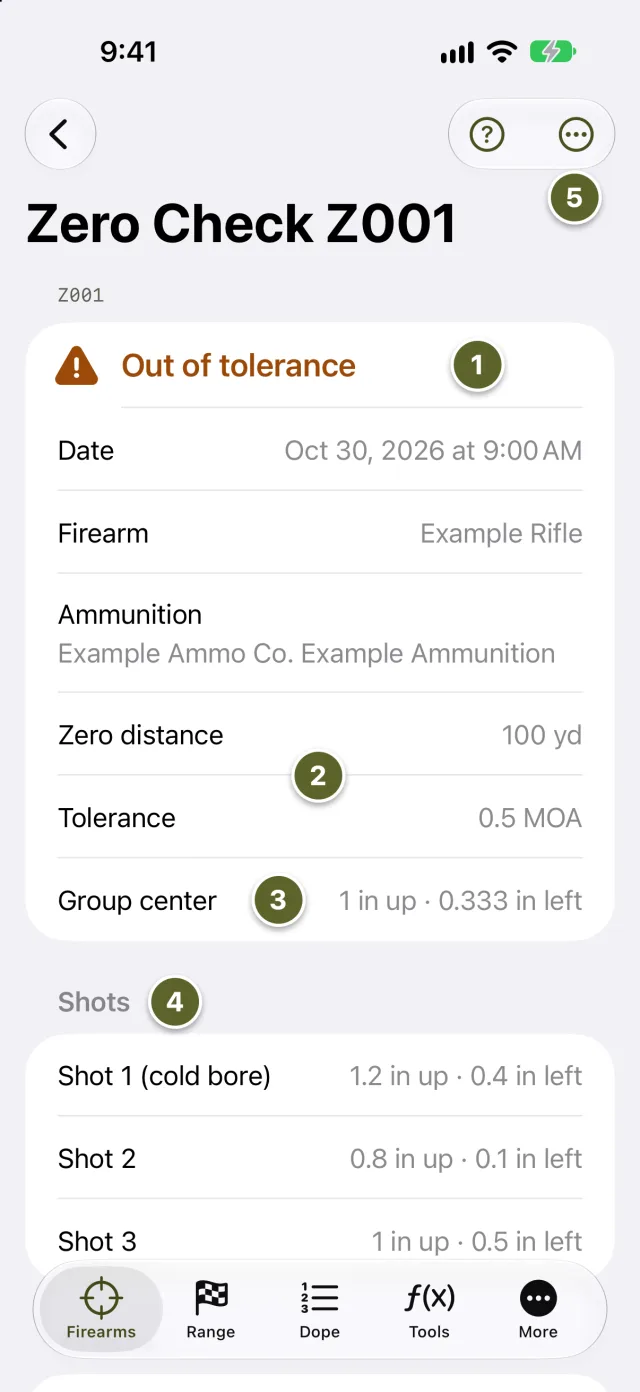
In Gun Diary, a red dot is a piece of equipment on the firearm in The Garage, the firearm's history. Add it with the category Optic, then set its click value in the optic settings, and every click count in the app uses it. A Zero Check saves the shots, the result, the ammunition and the setup the gun had that day. Zero Check is free; tapping the shots on a target photo is part of Gun Diary Pro. Your records stay on your iPhone or iPad and in your own iCloud, with no account and nothing sent to us.
Why a dot zero needs a date and a setup
One zero tells you about today; a history tells you about the gun. The zero history lists every check a firearm has had, grouped by the setup it had on the day, so moving the dot to a new mount starts a new group and older checks stay with the old one. The steps are the same idea as how to zero a scope with turrets, just with coarser clicks, and the units are explained in mil vs MOA. If you also run a magnified scope, see what a zero stop on a scope does to its elevation turret.
The bottom line
So, how to zero a red dot scope you can trust later?
Read the manual for the click value, set a crisp dot and a steady rest, get on paper close, then shoot groups at your zero distance and turn the center's offset into clicks. Remember how small a click is at short distances, dial the way the arrows say, and confirm with one more group. That's how to zero a red dot scope; what makes the zero worth trusting is the record beside it. Write down the date, the distance, the ammunition lot and the setup, and the next check starts from a fact instead of a memory.
Gun Diary keeps the records you enter. It never predicts bullet drop, wind or a trajectory; your dope is what you proved on paper. Always follow safe firearm handling.
Is it still zeroed?
Zero Check takes a few shots before the hunt and says "Still zeroed", or the clicks to dial, and keeps each check as a record. Free for one firearm.
See Zero CheckComing soon to the App Store