
What zeroing a scope actually does
Zeroing sets the scope so the point of impact matches the point of aim at one distance, called the zero distance. Every other number you'll ever dial is measured from that setting, which is why the zero comes first. Before you work out how to zero a rifle scope on the bench, it helps to settle what you're zeroing with: the distance and the ammunition are your call, and this guide doesn't pick either for you. It covers the loop itself, the math between the target and the turret, and the record that keeps the result useful long after the range day.
How to zero a rifle scope in six steps
Most explanations of how to zero a scope stop at the last click, but the loop is the same at 25, 50 or 100 yards: shoot, measure, adjust, repeat. People get lost in it by chasing single shots, turning the turret the wrong way, or not knowing when to stop. Each step below fixes one of those habits. The steps assume the scope is already mounted and you're shooting from a steady rest, since you're testing the rifle and the sight, not your offhand shooting. A red dot follows the same loop with coarser clicks, and our guide on how to zero a red dot scope covers its own steps.
The sight-in loop, one group at a time
Get on paper first
A bore-sighted rifle is easy to find on the target at a close distance like 25 yards; then move back to your zero distance.
Shoot a group, not a shot
Three shots is the least worth trusting, and five is better. One shot tells you very little.
Find the group's center
Measure how far the center of the whole group sits up or down and right or left of your aim, not your best or worst shot.
Turn the offset into an angle
Divide it by the distance. One MOA is about 1.047 inches at 100 yards, and one mil is 3.6 inches.
Divide by your click value
A 1/4 MOA scope moves 0.25 MOA per click, not 4. Clicks move the impact toward the aim, so a high group needs Down.
Dial, repeat, then confirm
Fire another group of the same size and check again. Once it's within your tolerance, fire one more group to confirm.
The tolerance is the stopping rule: how far the group's center may sit from your aim and still count as zeroed. Pick one you can actually shoot. If your groups run around 1.5 MOA, a 0.25 MOA tolerance will have you chasing noise all afternoon, dialing for shots that were never going to land in the same hole. A tolerance that matches your real groups ends the loop when the rifle is on, instead of when the ammunition runs out. If your scope has a zero stop, it's set on a confirmed zero like this one; our guide to the scope zero stop explains how it's generally set.
The math between the target and the turret
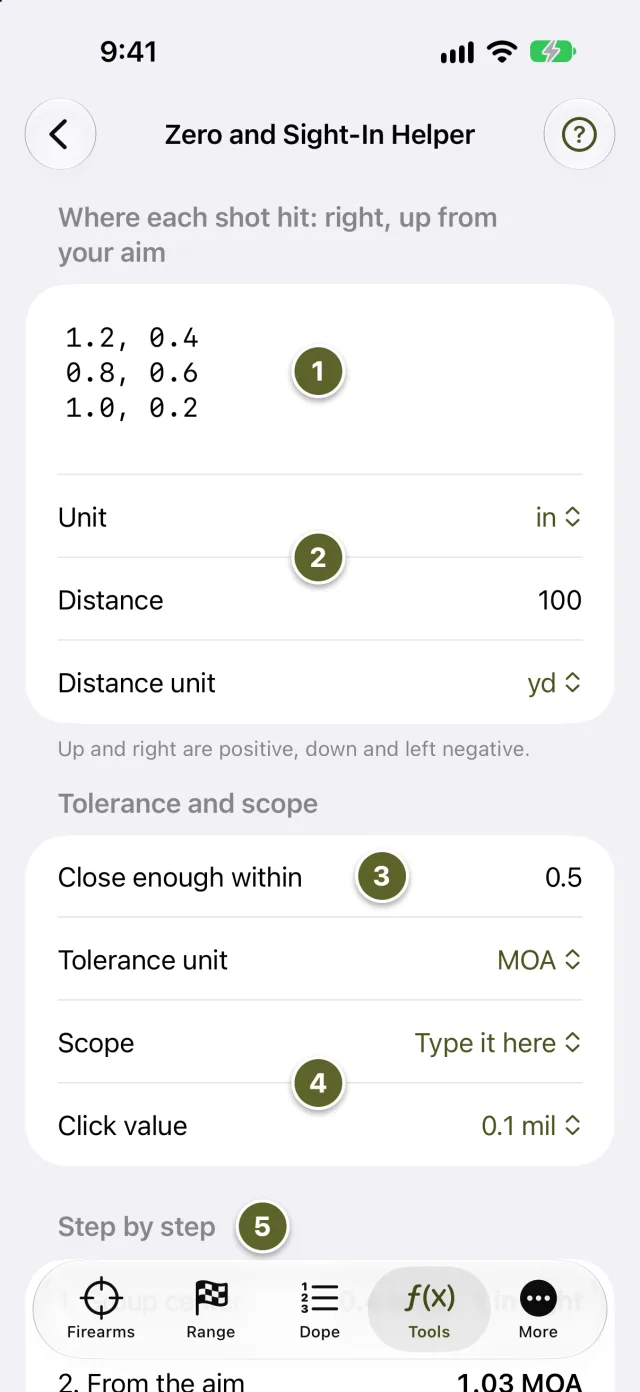
Here's a common one, using the numbers from the app's demo diary. A new scope goes on the Mountain Rifle, a made-up rifle in the demo, with 1/4 MOA clicks at 100 yards. The first group's center measures 1 inch up and 0.4 inches right, which works out to about 1.03 MOA from the aim. Divided by the click value and rounded, that's Down 4 clicks and Left 2. After dialing, the second group sits 0.07 MOA from the aim, well inside a 0.5 MOA tolerance, and one more group confirms it. Our guide on what 1 MOA is at 100 yards explains the 1.047 inches behind that math.
None of that needs a calculator, but it's easy to slip on a unit or a direction when you're cold and the wind is up. Gun Diary's free Zero and Sight-In Helper on the Tools tab takes one shot per line, finds the center, says whether you're zeroed within the tolerance you set, and gives the clicks if not. It's plain geometry from your own numbers, the same math a minute of angle stands for, as explained in this overview of minutes of arc and MOA. Knowing how to zero a rifle scope by hand still matters; the helper just keeps the arithmetic honest.
27 calculators, your numbers.
What to record so your scope zero means something later
A scope zero is only as good as what you know about it. The day you shot it, the rifle had a particular scope, mount and ammunition lot, and any of those can change without the turret looking any different. Writing the details down is what lets you tell, next season, whether the rifle is still on or whether you're trusting a setting from a setup that no longer exists. The list is short, and most of it is already in front of you at the bench.
Worth writing down after every sight-in
Date and zero distance
The distance the rifle now hits the aim at, with its unit.
Ammunition and lot
What you zeroed with, down to the lot number on the box.
The setup
Which scope and mount were on the rifle, and the scope's click value.
The groups and the clicks
Where each group landed and what you dialed between them.
The result
The last group's offset from the aim and the tolerance you held it to.
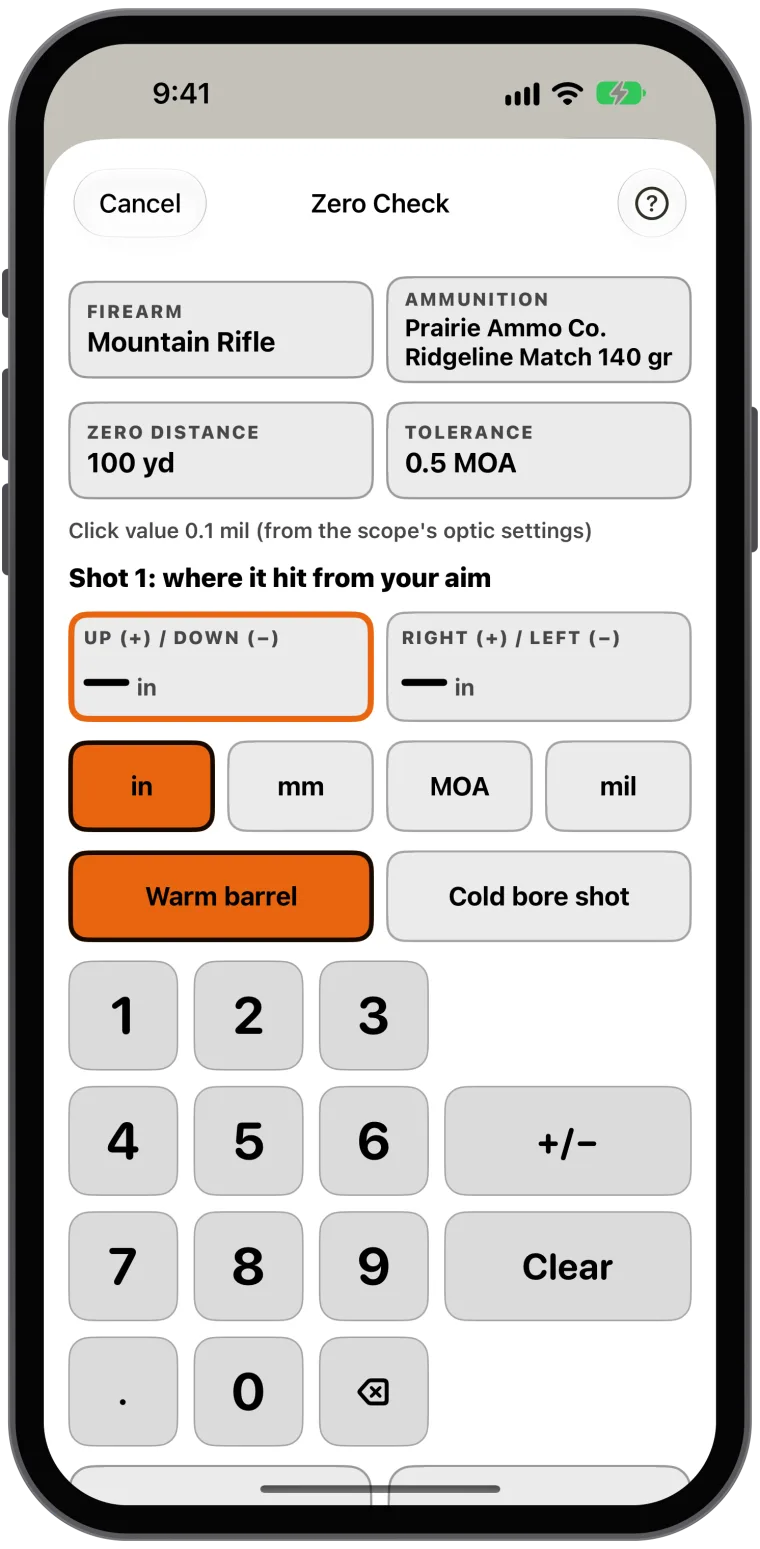
In Gun Diary, that record is a Zero Check and zero record. You type where each shot hit, or tap the shots on a target photo with Pro, and it saves the shots, the result, the ammunition and the setup the rifle had that day. The clicks come from the scope's optic settings in The Garage, so the click value is set once and used everywhere. Zero Check is free. Your records stay on your iPhone or iPad and in your own iCloud, with no account and nothing sent to us.
Why the history matters more than one zero
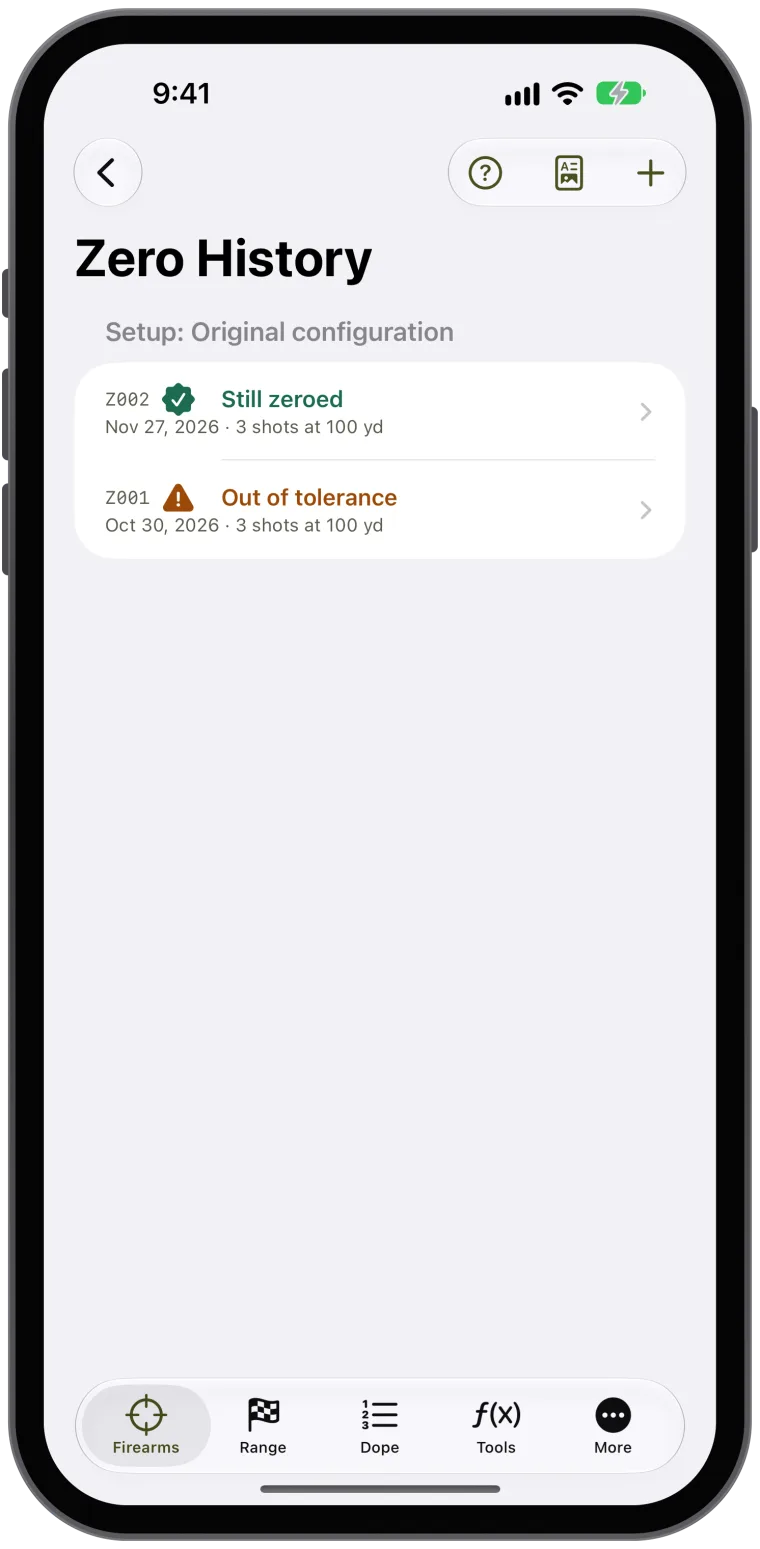
One zero tells you about today; a history tells you about the rifle. The zero history lists every check a firearm has had, grouped by the setup it had on the day, so a scope swap starts a new group and older checks stay with the old scope. If every check over two years says Still zeroed, you've learned something about that mount. If the zero moved twice, both times after the rifle travelled, you've learned something about the case. The learning path on sighting in a new scope walks through the whole setup in order.
The bottom line
So, how to zero a rifle scope you can trust later?
Get on paper close, then shoot groups at your zero distance, measure the center, turn it into clicks with your scope's real click value, and repeat until the center sits inside a tolerance you can shoot. Confirm with one more group. That's how to zero a rifle scope; what makes the zero worth trusting is the record you keep next to it. Write down the date, the distance, the ammunition lot and the setup, and you'll know next fall whether a quick check is enough or the whole loop starts again.
Gun Diary keeps the records you enter. It never predicts bullet drop, wind or a trajectory; your dope is what you proved on paper. Always follow safe firearm handling.
Every group remembers the rifle it was shot with
Dated setups, barrels, cleanings, repairs and paperwork, and round counts that add themselves up.
See The GarageComing soon to the App Store