
What a mil and an MOA actually measure
Both units measure an angle, not a distance. A mil, short for milliradian and also written mrad, is 1/1000 of the distance: 3.6 inches at 100 yards, or 10 centimeters at 100 meters. A minute of angle (MOA) is 1/60 of a degree, which works out to 1.0472 inches at 100 yards. Because both are angles, the size they cover grows with distance, so 1 mil covers 7.2 inches at 200 yards and 36 inches at 1,000. The radian is the SI unit of plane angle, as NIST's guide to SI units lists it, and a mil is a thousandth of one.
Mil vs MOA at 100 yards
At 100 yards the comparison is easy to picture. One mil covers 3.6 inches and one MOA covers about 1.05 inches, so a mil is roughly three and a half times bigger. Many mil scopes click in 0.1 mil, about 0.36 inches at 100 yards, and many MOA scopes click in 1/4 MOA, about 0.26 inches. The click sizes are close, which is why mil vs moa is mostly a question of the reticle you know and the people you shoot with. Neither unit makes a rifle shoot any better. Our guide to the exact size of 1 MOA at 100 yards covers the 1.047 inches and the 1-inch shorthand.
Three numbers worth remembering
1 mil = 3.4377 MOA
Round it to 3.44 for quick math in your head.
1 MOA = 0.2909 mil
About 0.29: multiply an MOA number by it to get mils.
1 MOA = 1.0472 IPHY
True MOA is a little bigger than shooter's MOA, which is exactly 1 inch at 100 yards.
True MOA vs shooter's MOA (IPHY)
There's a second MOA, and it trips people up. Shooter's MOA, also called IPHY (inches per hundred yards), is exactly 1 inch at 100 yards, while true MOA is 1.0472 inches. The gap is under 5%, which sounds small until it adds up: at 1,000 yards, 10 true MOA is about 104.7 inches and 10 IPHY is 100. Most scopes sold in MOA use true MOA, but some use IPHY, so the scope's manual is the place to check, and any mil vs moa conversion starts with knowing which MOA you have. Gun Diary's MOA is always true MOA, and IPHY is a separate option you turn on when you need it.
Proof, not predictions.
1 mil vs 1 MOA when the units are mixed
Here's a common one: a friend's dope card for the same cartridge says 8.6 MOA at 500 yards, and your scope dials in mil. Multiply by 0.2909, or divide by 3.4377, and 8.6 MOA comes out to about 2.50 mil. The same math works for a scope with MOA turrets and a mil reticle, where a number you read in the reticle has to become a dial on the turret. Treat a borrowed number like that as a starting point only. Your own rifle's come-up is whatever you prove at the range, written down with its unit and the date.
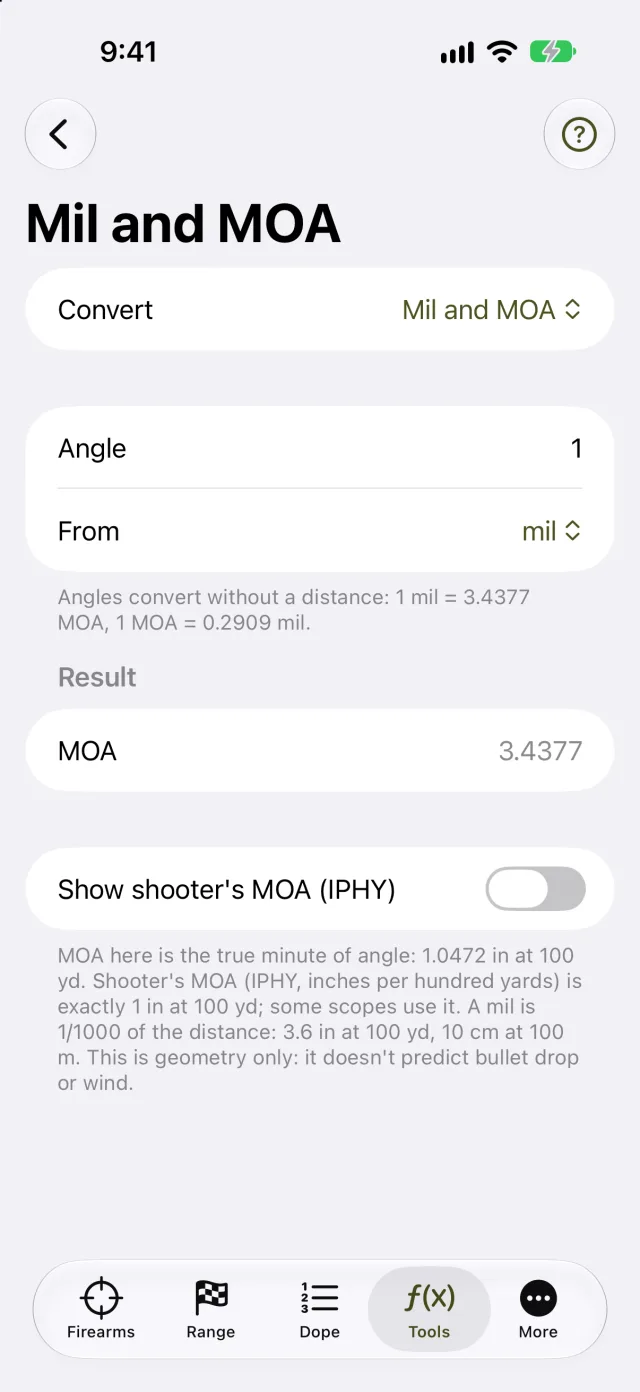
Converting mil and MOA in Gun Diary
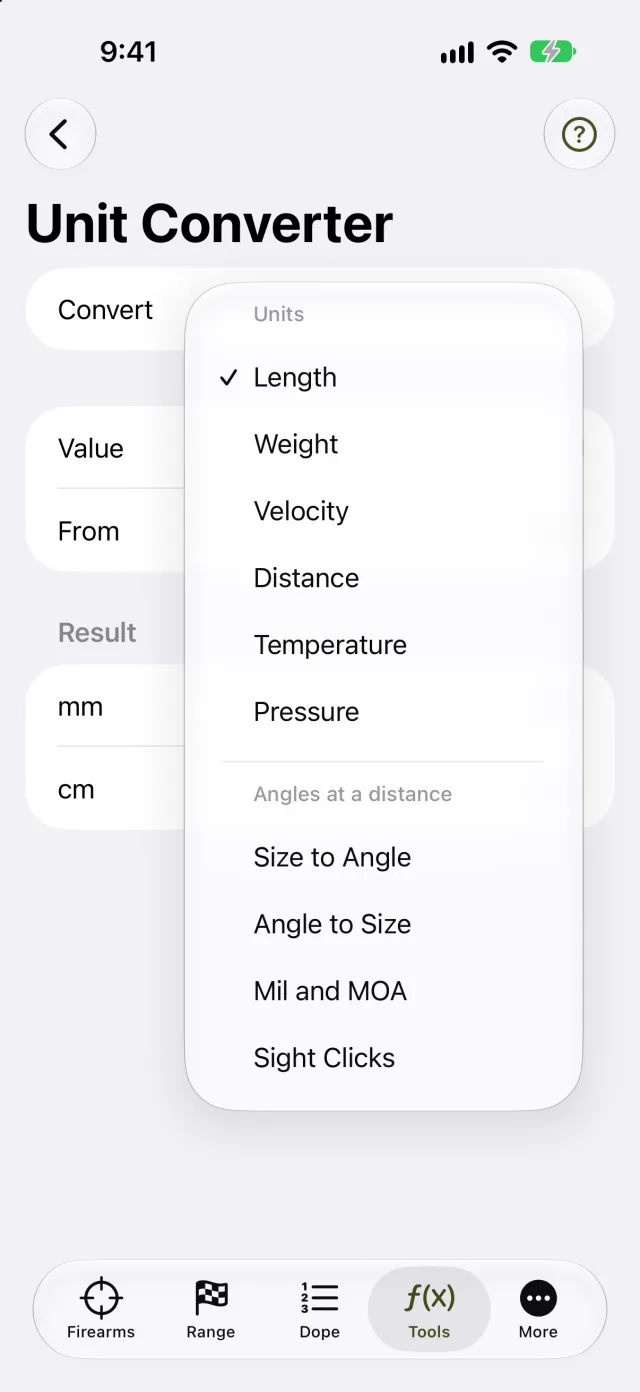
Gun Diary's shooting calculators include Mil and MOA, calculator #3 of 27, which converts an angle without a distance. Type the number, pick mil or MOA, and read the other unit to four decimals; turn on Show shooter's MOA (IPHY) and the IPHY value appears as well. The help article on the Mil and MOA calculator has the steps, and the Unit Converter reaches the same angle tools from one Convert menu. Like all 27 calculators, it's free with typed numbers and works with no signal. The screens shown here come from the app's demo diary, with made-up numbers.
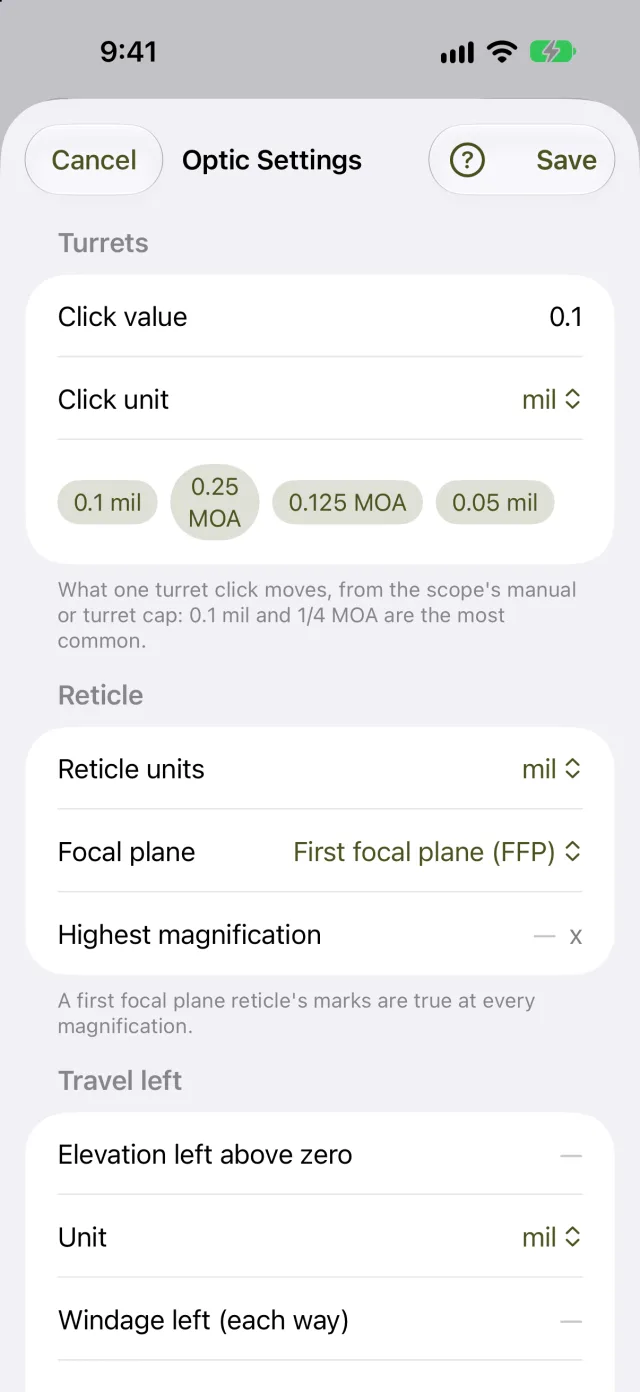
Clicks are a separate question, because a click's size depends on the scope. Set each scope's click value, reticle units and focal plane once in its optic settings, and the click counts on groups, Zero Check and dope tables come out in that scope's own terms. To turn an angle into turret clicks, the Sight Clicks calculator uses that saved click value. Your records stay on your iPhone or iPad and in your own iCloud, with no account and nothing sent to us.
Mrad vs mil vs MOA: clearing up the names
Mrad, mil, milliradian and mil-dot all name the same unit, so a question about mrad vs mil vs moa is really a two-way comparison. Minute of angle, minutes and MOA are likewise one unit. The only real split is inside MOA, true MOA against shooter's MOA. When you read someone else's numbers, a published reticle drawing or a video, check which of those three units it uses before you convert anything. Once you know your own units, our guide on ranging with a mil reticle puts the mil to work, and first vs second focal plane scopes explains when the marks read true.
The bottom line
So, mil vs MOA: what matters more than the unit
Neither unit is more accurate; they're two ways of writing the same angle, and 1 mil is always 3.4377 MOA. Use the unit your scope uses, and keep the turret, reticle and dope for that rifle in it. When a number arrives in the other unit, convert it, then confirm it on paper before it goes on your card. Write every come-up with its unit beside it, and the mil vs moa question stops being a source of mistakes.
Gun Diary keeps the records you enter. It never predicts bullet drop, wind or a trajectory; your dope is what you proved on paper. Always follow safe firearm handling.
One firearm free, forever
Every diary unlimited, all 27 calculators, the pocket dope card and free export. Add Pro when you add a firearm.
See pricingComing soon to the App Store