
Where the reticle sits, and why it matters
The focal plane is where in the scope the reticle sits: in front of the magnifying lenses (first focal plane, FFP) or behind them (second focal plane, SFP). Reticle marks are spaced in mil or MOA so you can measure with them, and that spacing only means what it says when the marks are true at the power you're on. That is the whole first vs second focal plane question in one line. The reticle focal plane section of Wikipedia's telescopic sight article has diagrams of both if you'd like to see the optics.
What is a first focal plane scope?
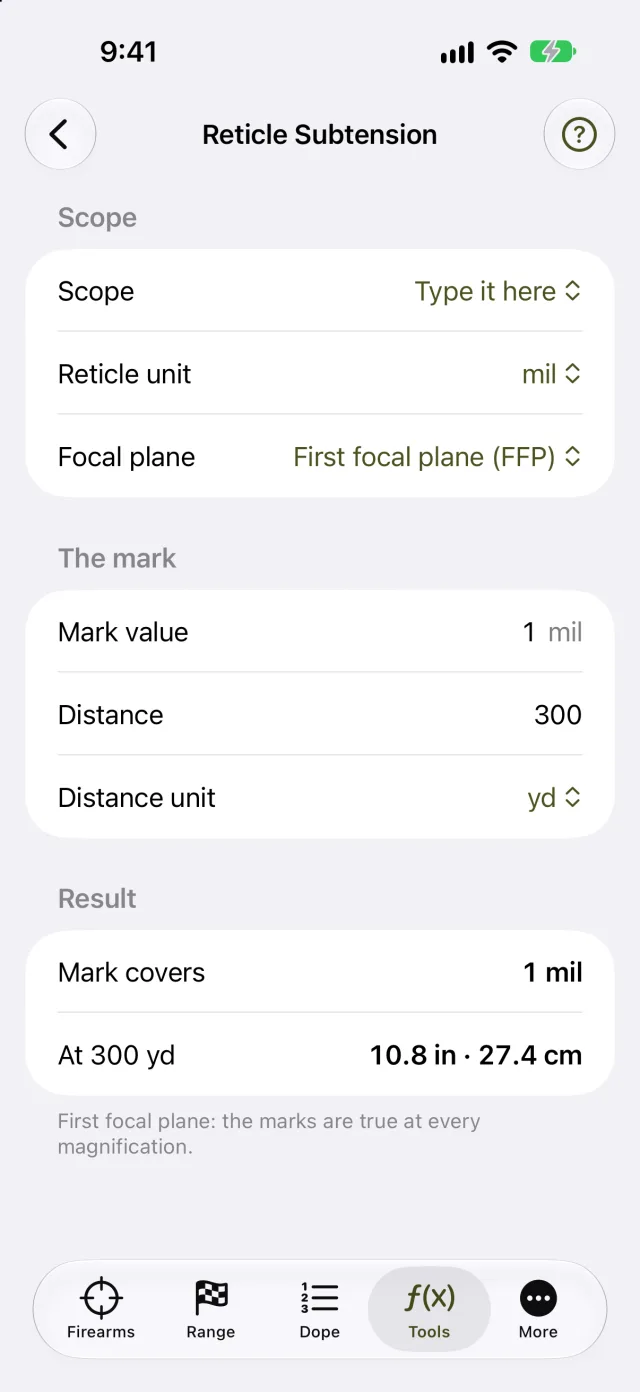
In a first focal plane scope, the reticle grows and shrinks along with the image as you zoom. Because the marks scale with the target, a 1 mil mark covers 1 mil at 4x, at 10x and at any power in between. At 300 yards that 1 mil gap covers 10.8 inches whatever the magnification ring says. That's what makes an FFP reticle handy for quick size checks at any distance and any power: there's nothing to convert, whatever the setting.
What is a second focal plane scope?
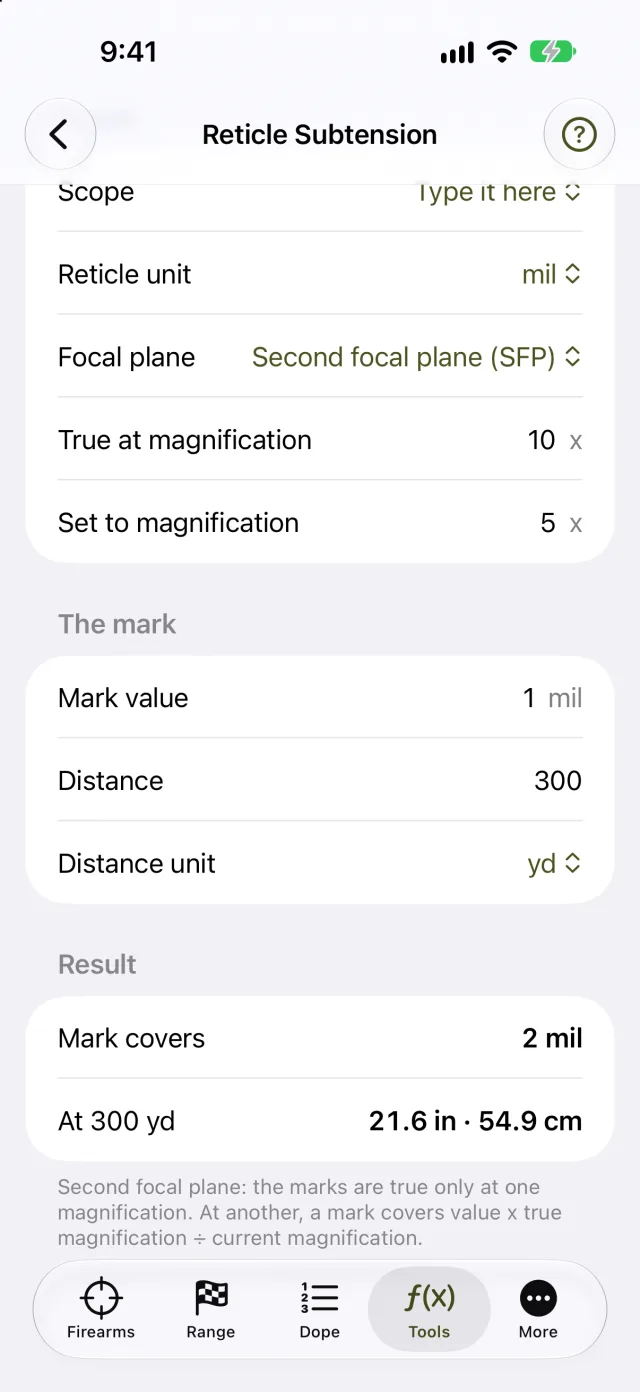
In a second focal plane scope, the reticle stays the same size on your eye while the image zooms behind it. The marks are true at one magnification only, often the highest, and the scope's manual says which one. Turn the power down and every mark covers more of the target than its printed value; turn it up past the true power and each mark covers less. Most hunting scopes are SFP, so this is the design many hunters already own.
What does second focal plane mean for your marks?
The math is a single ratio: what a mark covers equals its printed value times the true magnification, divided by the magnification you're set to. Halve the power, and the mark covers twice as much. Take an SFP mil scope whose marks are true at 10x, set to 5x for a wide view: each 1 mil mark now covers 2 mil, or 7.2 inches at 100 yards instead of 3.6. A reading of two marks at that setting is really 4 mil, not 2. The same trap catches ranging, since a target measured at the wrong power gives the wrong distance.
Questions? See the Help Center.
First vs second focal plane: where each one fits
The difference between first focal plane and second isn't accuracy: neither design is more accurate. They differ only in when the marks can be read as printed, and each has its own habits. With FFP, the marks are true at every power, so quick size checks work anywhere in the zoom range. With SFP, the habit is to read the reticle at its true magnification whenever you can, or to work out the scaling when you can't. Whichever you have, the important part is knowing it for certain and writing it down, so a reading from last season still makes sense next year.
Keeping your scope's facts in Gun Diary
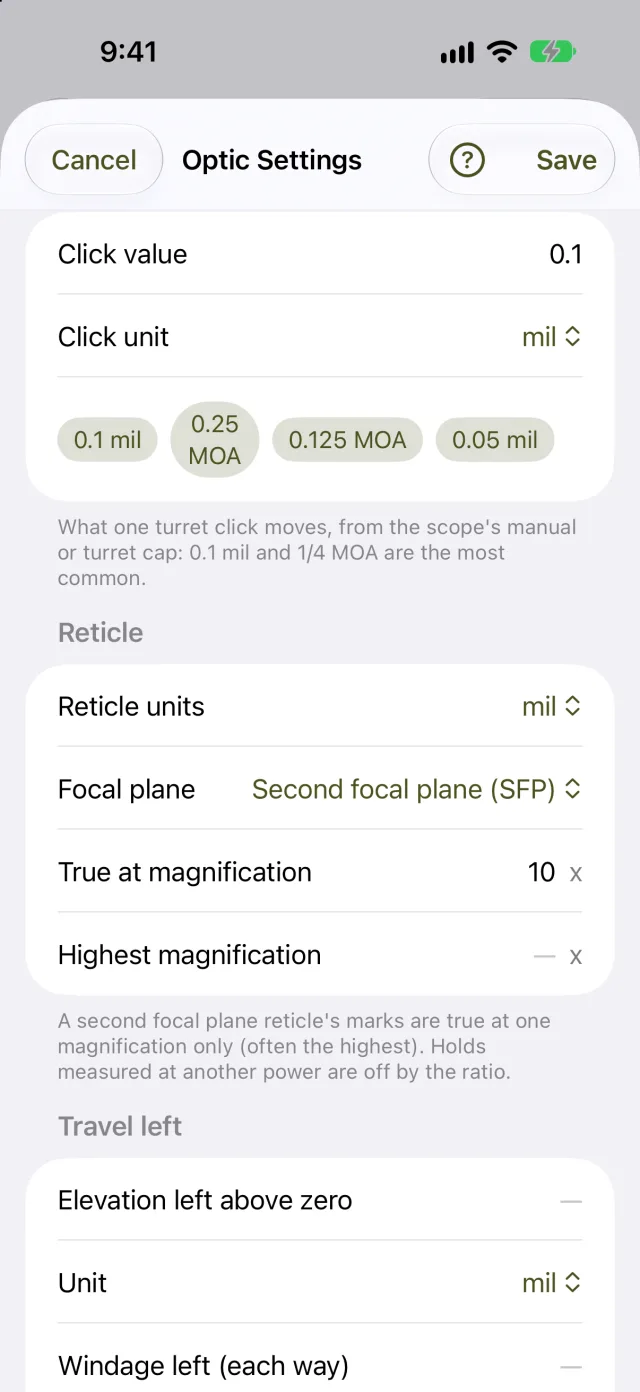
Each scope in Gun Diary has its own optic settings: the click value, the reticle units, first or second focal plane, and, for an SFP scope, the magnification its marks are true at. Set them once and the tools that use that scope start from the right facts. The Reticle Subtension calculator shows what a mark covers at any distance, in its own unit and in inches and centimeters, including an SFP scope set to another power. The screens shown here come from the app's demo diary, with made-up numbers.
Reticle Subtension is one of the app's 27 calculators from your own numbers, and the help article on Holdover from Your Dope explains how a proven come-up becomes reticle marks, asking the magnification first on an SFP scope. If the units themselves are new to you, our mil vs MOA explainer starts there, and the guide to reading a mil dot reticle for distance uses the same marks. Your records stay on your iPhone or iPad and in your own iCloud, with no account and nothing sent to us.
The bottom line
So, first vs second focal plane: which one is on your rifle?
Check the manual or the maker's listing for your exact scope, and if it's SFP, find the magnification its marks are true at. A first focal plane reticle reads the same at every power; a second focal plane reticle reads true at one power and scales everywhere else. That's the honest answer to first vs second focal plane: it's not which is better, it's which one you have and whether you read it at the right setting. Record that once with the scope's other details, and every measurement you take with the reticle has a fact to stand on.
Gun Diary keeps the records you enter. It never predicts bullet drop, wind or a trajectory; your dope is what you proved on paper. Always follow safe firearm handling.
Your dope, proven on paper, with the proof attached
Confirmed dope tables keep the distance, the come-up, the date and the groups that proved each row; in-between rows say est.
See confirmed dopeComing soon to the App Store