
What is a mil dot reticle?
A mil dot reticle has dots or hash marks spaced one mil apart, and a mil is 1/1000 of the distance: 3.6 inches at 100 yards. Because the spacing is a known angle, the reticle works as a ruler. Measure something whose real size you know, and the number of mils it covers tells you how far away it is. That is called mil ranging, and learning how to range with a mil dot reticle is mostly learning to measure carefully. The milliradian article's range estimation section shows the same relation with diagrams.
Ranging with mil reticle marks: the formula
The whole method is one line: distance equals the target's size divided by the mils it reads, times 1,000, with the answer in the same unit as the size. Shooters who think in yards and inches use a shortcut: distance in yards equals size in inches times 27.78, divided by the mils read. The 27.78 is just 1,000 divided by the 36 inches in a yard. In meters it's even simpler, because a size in centimeters times 10, divided by the mils, gives meters.
The formula in the units you use
Yards from inches
Size in inches x 27.78 ÷ mils read.
Meters from centimeters
Size in centimeters x 10 ÷ mils read.
Yards from an MOA reticle
Size in inches x 95.5 ÷ MOA read, since one true MOA is 1.0472 inches at 100 yards.
A worked example
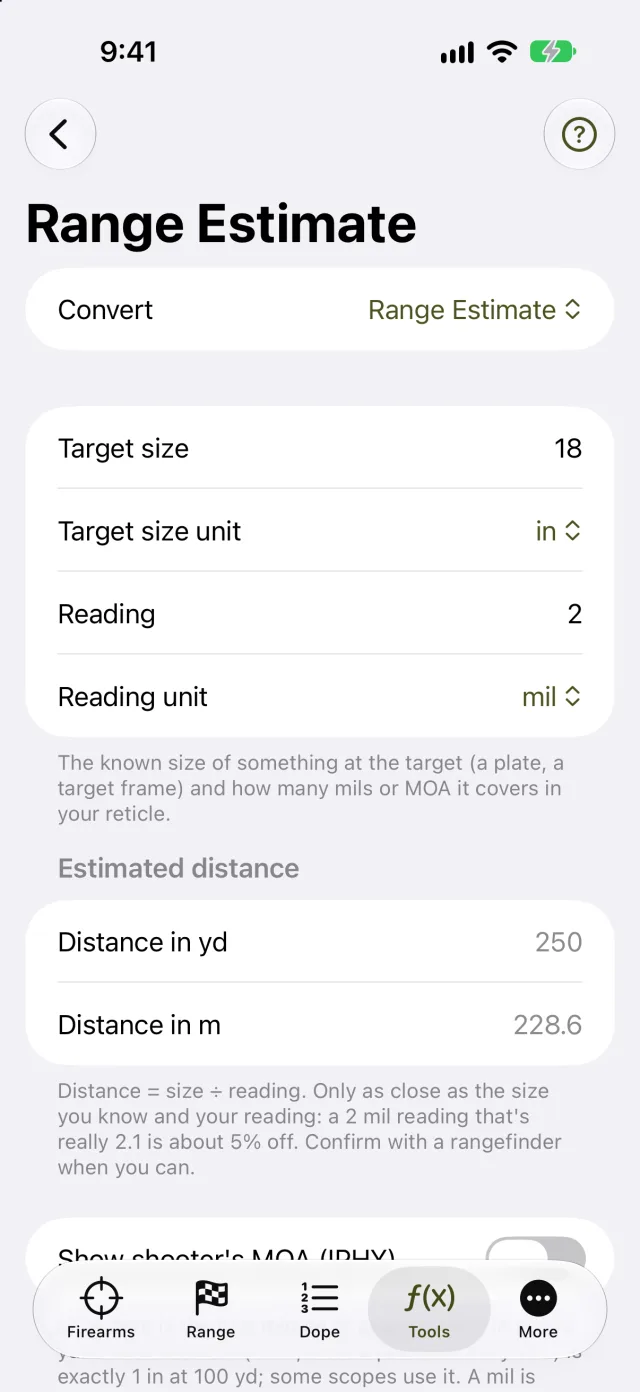
Say a steel plate you know to be 18 inches tall reads 2 mil in your reticle at a match. Eighteen times 27.78 is 500, and 500 divided by 2 is 250, so the plate is about 250 yards away, or 228.6 meters. An MOA reticle works the same way with its own number: a 10 inch plate reading 2 MOA comes out to 477.5 yards. Notice that nothing about the rifle or the ammunition enters the math. It's geometry, and only as good as the two numbers you give it.
How to read a mil dot reticle for distance
Put one edge of the known dimension on a mark and count to the other edge, reading the gap to the tenth of a mil if your reticle allows it. Brace the rifle so the reticle isn't wandering while you count, and measure the dimension you actually know, such as the plate's height rather than its width. On a second focal plane scope, read at the magnification where the marks are true, often the highest, or every reading comes out wrong; our guide to first and second focal plane reticles explains why. If your reticle is in MOA, read in MOA and use the MOA number.
Where the error comes from
A small reading error becomes a big distance error. That 18 inch plate reading 2 mil is 250 yards, but if the true reading is 2.1 the plate is about 238 yards away, roughly 5% off. The effect grows as readings shrink: an 18 inch target at 1,000 yards reads only 0.5 mil, so a tenth of a mil is a fifth of the whole reading there. Size errors pass straight through as well, because "about 18 inches" only ever gives "about 250 yards". Anyone learning how to range with a mil dot reticle should practice on targets at known distances and see how close their readings land.
Dope cards in every size.
That practice is also the honest way to use the method. A reticle reading is a second opinion, useful when a rangefinder won't read or to check one that gives a doubtful number, and the help text in the app says the same thing: confirm with a rangefinder when you can. Keep a note of how your readings compared with the known distances, and you'll learn how far to trust your own eye on that reticle.
Mil ranging in Gun Diary
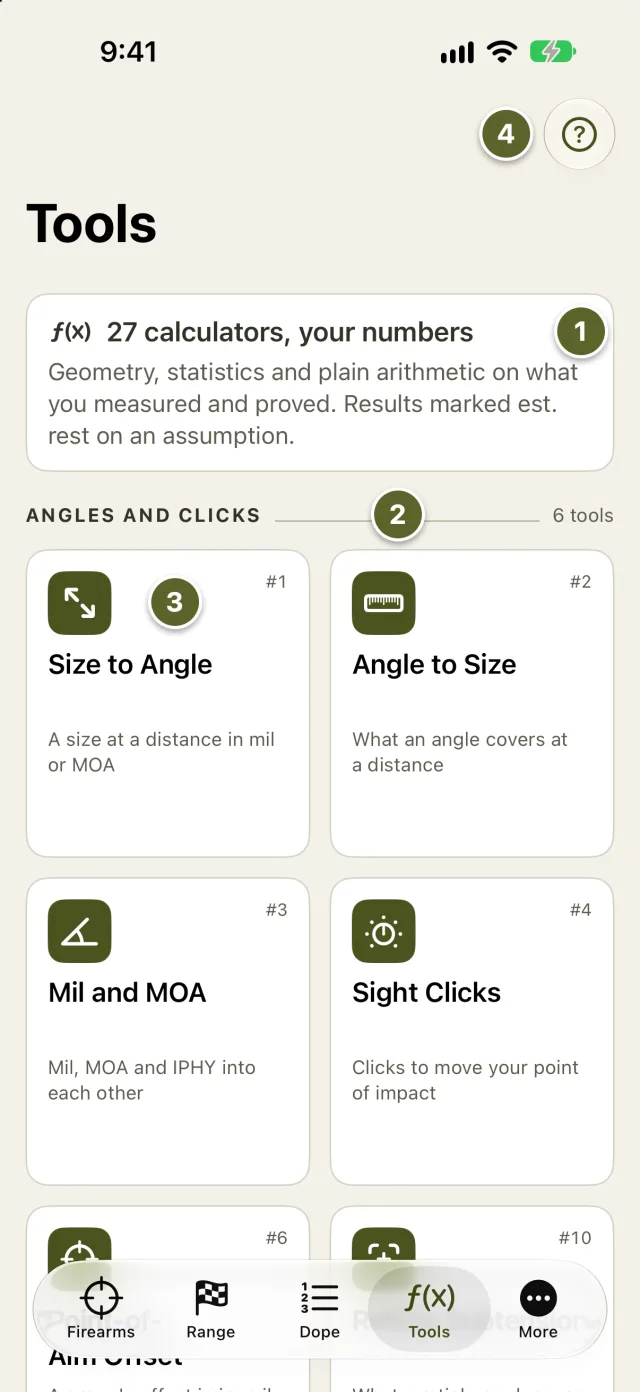
Gun Diary's Range Estimate calculator, #5 of 27, does the arithmetic. Type the target size and its unit (inches, centimeters, millimeters, feet or meters) and the reading in mil or MOA, and it shows the distance in yards and meters. The help article for the Range Estimate calculator has the steps. It's free with typed numbers, works with no signal, and saves nothing, so it's a quick check rather than a record. The screens shown here come from the app's demo diary, with made-up numbers.
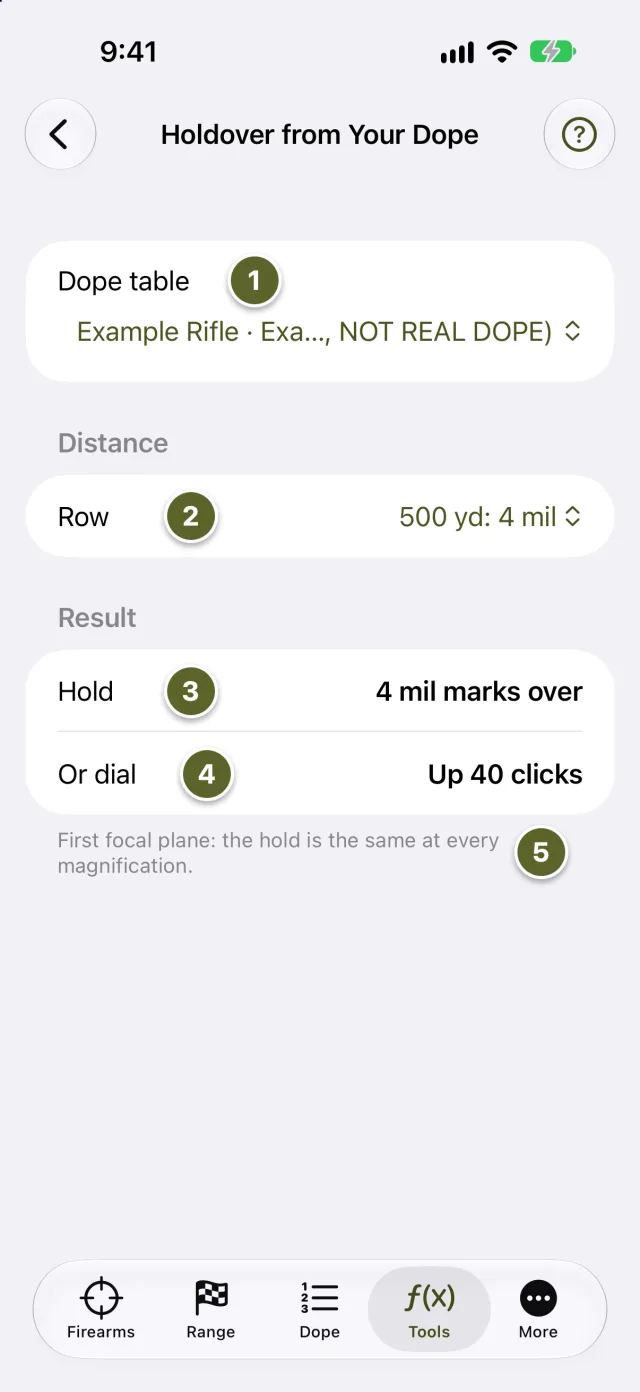
A distance is only half the job. The Holdover from Your Dope help article shows how a come-up you've already proven at the range, saved in a dope table, can be read as reticle marks or turret clicks for that scope. If mils and MOA still feel muddled, the mil vs MOA guide sorts out the units first. Your records stay on your iPhone or iPad and in your own iCloud, with no account and nothing sent to us.
The bottom line
So, how to range with a mil dot reticle you can trust
Know the target's real size, read the marks carefully at the right magnification, and run the formula: size in inches times 27.78, divided by the mils. That's all there is to how to range with a mil dot reticle. The trust comes from the inputs, so measure your plates, read to the tenth, and check your eye against known distances. When a rangefinder is available, use the reticle as a second opinion and write down how the two compared.
Gun Diary keeps the records you enter. It never predicts bullet drop, wind or a trajectory; your dope is what you proved on paper. Always follow safe firearm handling.
27 calculators that start from your own numbers
Clicks, mil and MOA, mil-ranging, holdover from your dope, re-zero shift, hit factor, pattern % and more; anything estimated says est.
See the calculatorsComing soon to the App Store