
The exact answer: 1.047 inches
One MOA, short for minute of angle, is 1/60 of one degree. It's an angle, the same minute of arc that NIST lists among the units accepted for use with the SI, not a length. At 100 yards, which is 3,600 inches, that angle covers 1.0472 inches, usually written 1.047 or 1.05. So the precise answer to what is 1 moa at 100 yards is a little more than an inch, about one and one-twentieth. Because MOA is an angle, the inches it covers grow in step with distance: twice as far, twice the inches.
Why shooters say "1 inch" (and when that's fine)
Round 1.047 down to 1 and you get the everyday answer to what is 1 moa at 100 yards: about an inch, then 2 inches at 200 and 3 at 300. That shorthand even has a name, shooter's MOA or IPHY (inches per hundred yards), and a few scopes are built to it, so the scope's manual is worth a look. At 100 yards the two differ by 0.047 inch, far smaller than any bullet hole. For sighting in, checking a zero or describing a group at that distance, "about an inch" does the job. Our guide to converting between mil and MOA covers true MOA and shooter's MOA side by side.
When the 4.7% gap starts to matter
The gap is always 4.7%, so in inches it grows as the distance and the number of MOA grow. Say a group lands 30 inches high of your aim at 600 yards, where one true MOA covers 6.28 inches and one 1/4-MOA click moves about 1.6 inches on the target. Work the miss out both ways and the two answers land one click apart. It's small, but it's exactly the kind of difference that keeps a number worked out one way from matching the paper.
The same 30-inch miss at 600 yards, two ways
True MOA
Divide 30 by 6.28 and you get 4.78 MOA, about 19 clicks of 1/4 MOA.
The 1-inch shorthand
Divide 30 by 6 and you get 5 MOA, exactly 20 clicks of 1/4 MOA.
MOA at 100 yards and at every other distance
Because MOA scales with distance, the 100-yard figure is the only one worth memorizing: multiply 1.047 by the distance in hundreds of yards. The same scaling explains clicks. Many MOA scopes adjust in 1/4 MOA per click, so one click moves a quarter of whatever 1 MOA covers at that distance. Here are the common distances worked out in true MOA, with the shooter's shorthand in brackets.
What 1 MOA covers at common distances
1 MOA at 25 yards
Covers 0.262 in (0.25). A 1/4-MOA click moves about 0.065 in, so moving 1 inch takes about 15 clicks.
1 MOA at 50 yards
Covers 0.524 in (0.5). A click moves about 0.13 in; 1 inch takes about 8 clicks.
1 MOA at 100 yards
Covers 1.047 in (1). A click moves about 0.26 in; 1 inch takes about 4 clicks.
1 MOA at 200 yards
Covers 2.094 in (2). A click moves about 0.52 in; 1 inch takes about 2 clicks.
1 MOA at 300 yards
Covers 3.142 in (3). A click moves about 0.79 in.
1 MOA at 1,000 yards
Covers 10.47 in (10). A click moves about 2.6 in.
The long-distance lines answer the questions people search for most. What is 1 moa at 1000 yards? About 10.47 inches, nearly half an inch more than the shorthand's 10, which is the 4.7% in plain view. And 1 moa at 200 yards is 2.094 inches, close enough to 2 for most notes. Keep in mind that this list is geometry for the angle only. It says nothing about where a bullet goes at those distances; that depends on the firearm and the ammunition and is only known by shooting it.
Your proven dope, on a card that fits your rifle.
Is sighting in at 25 yards the same as 100?
The angle part has a clear answer, and it starts from what is 1 moa at 100 yards. One MOA is the same angle at every distance, but at 25 yards it covers only a quarter of the 1.047 inches it covers at 100, so moving a group 1 inch on a 25-yard target takes about four times as many clicks as moving it 1 inch at 100. Whether a rifle that hits the mark at 25 yards also hits it at 100 is a separate question about the bullet's path, and the honest way to know is to shoot at 100 and look. Our guide on zeroing a rifle scope and keeping the record covers that side.
Working out MOA at a distance in Gun Diary
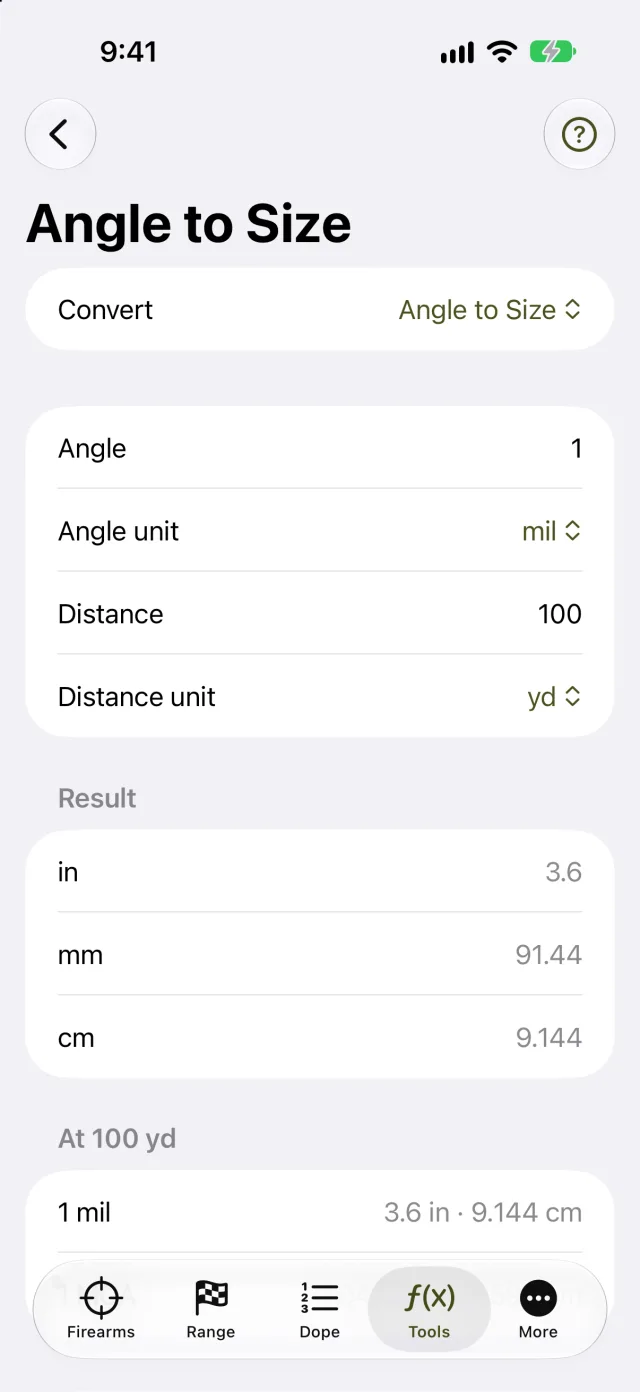
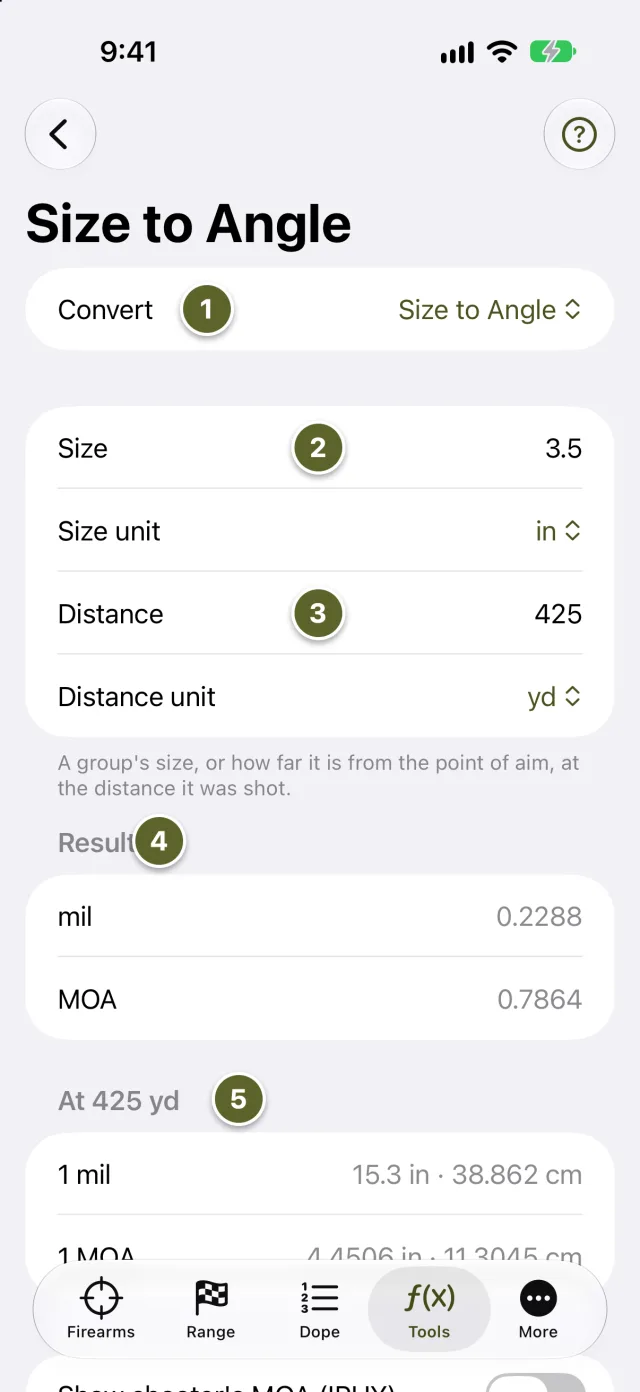
Gun Diary, a logbook app for shooters on iPhone and iPad, does this geometry in its 27 shooting calculators. Angle to Size shows what an angle covers at a distance in inches, millimeters and centimeters: type 1 MOA and 100 yards and it reads 1.0472 inches. Size to Angle goes the other way, turning a group or a miss you measured on paper into MOA and mil. Both work with typed numbers at no cost, need no signal, and have a Show shooter's MOA (IPHY) switch for scopes built to the shorthand. The Angle to Size help article has the steps; the screens shown come from the app's demo diary.
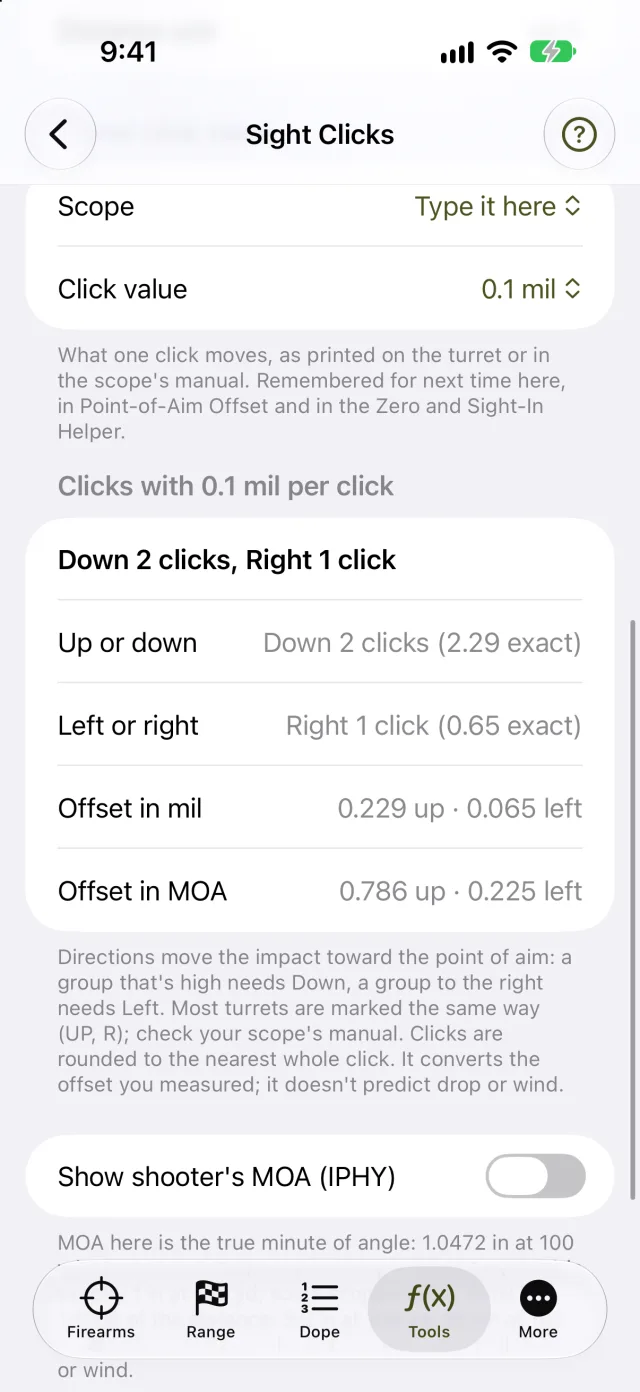
For clicks, Sight Clicks takes how far a group's center sits from your aim, the distance and your scope's click value (1/4 MOA, 1/8 MOA, 0.1 mil and more), then shows the whole clicks to dial and which way, with the exact value beside them. The Sight Clicks calculator guide walks through it. These tools are plain geometry, not estimates. Seven of the 27 calculators do rest on an assumption, and their results carry the note "Est. = estimated, not proven. Confirm at the range." The page on how Gun Diary marks estimates lists all seven. Your numbers stay on your device and in your own iCloud.
Keep the unit with every number
A note that says "moved 4 clicks" or "group was 1.5" is hard to trust a year later, because it doesn't say at what distance, in which unit, or on which scope. Write the distance, the unit (true MOA, shooter's MOA or mil) and the scope's click value with every group and every correction. In Gun Diary each group record keeps its distance and size, shows the size in inches, mil and MOA together, and each scope's click value lives in its optic settings. For what else belongs beside each group, see our guide on how to shoot and measure a shot group.
The bottom line
So, what is 1 MOA at 100 yards?
Exactly 1.0472 inches, which shooters round to 1.047, 1.05 or simply "an inch". That's the honest answer to what is 1 moa at 100 yards, and the shorthand is fine for most work up close. Multiply by the distance in hundreds of yards for any other range, and divide by four for a 1/4-MOA click. The rounding only shows when the distance and the number of MOA get large, so when you work at long range, use true MOA unless your scope's manual says otherwise, and write the unit beside every number.
Gun Diary keeps the records you enter. It never predicts bullet drop, wind or a trajectory; your dope is what you proved on paper. Always follow safe firearm handling.
Your firearms. Your range days. Your proven dope.
Log every range trip, group and target photo for each firearm, prove your dope and print it as a dope card, all yours in iCloud. One firearm free, forever.
Get startedComing soon to the App Store