
"Calculator #20: Scaled Wind Holds"
Take a wind hold you proved at one distance and see what it becomes in a stronger or weaker wind, or from another direction, at that same distance.
Scaled Wind Holds (calculator #20) starts from a wind hold that worked for you at one distance and scales it to the wind you have now: a different speed, a different direction, or both. A 0.6 mil hold in a 10 mph full-value wind becomes 0.9 mil in 15 mph. It works at that same distance only, and the result is an estimate, marked est.
Steps
- Open it one of two ways:
- Tools tab > under Your dope, tap Scaled Wind Holds; or
- Dope tab > a dope table > Calculators for This Table > Scaled Wind Holds (the table is picked for you).
-
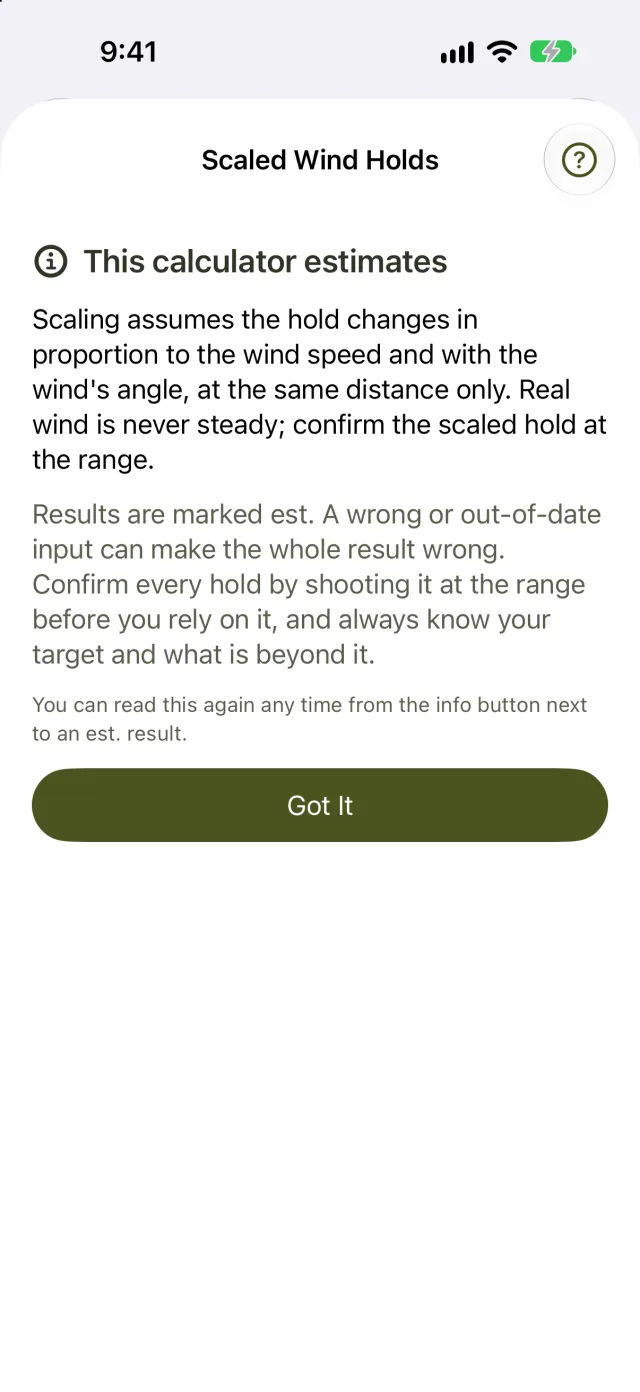
The first time, a note titled This calculator estimates explains the assumption. Read it and tap Got It. It’s also in About estimates.
-
In A hold that worked, check the Dope table. If that table has wind holds, pick one in Proven hold: its hold, unit, wind speed, wind value and distance fill in below (the distance shows as At). Or leave Typed below and type them yourself.
- Check or type the Hold, its Unit (mil or MOA), the Wind speed it was proven in, and Its wind value: Full, Half, No value or Angle (then type the Wind angle (°)). Picking a proven hold fills these in from the hold.
-
In The wind now, type the Wind speed now and pick the Direction: Full value (3 or 9 o’clock), Half value, No value, or Clock hour (then type the hour in From (o’clock)).
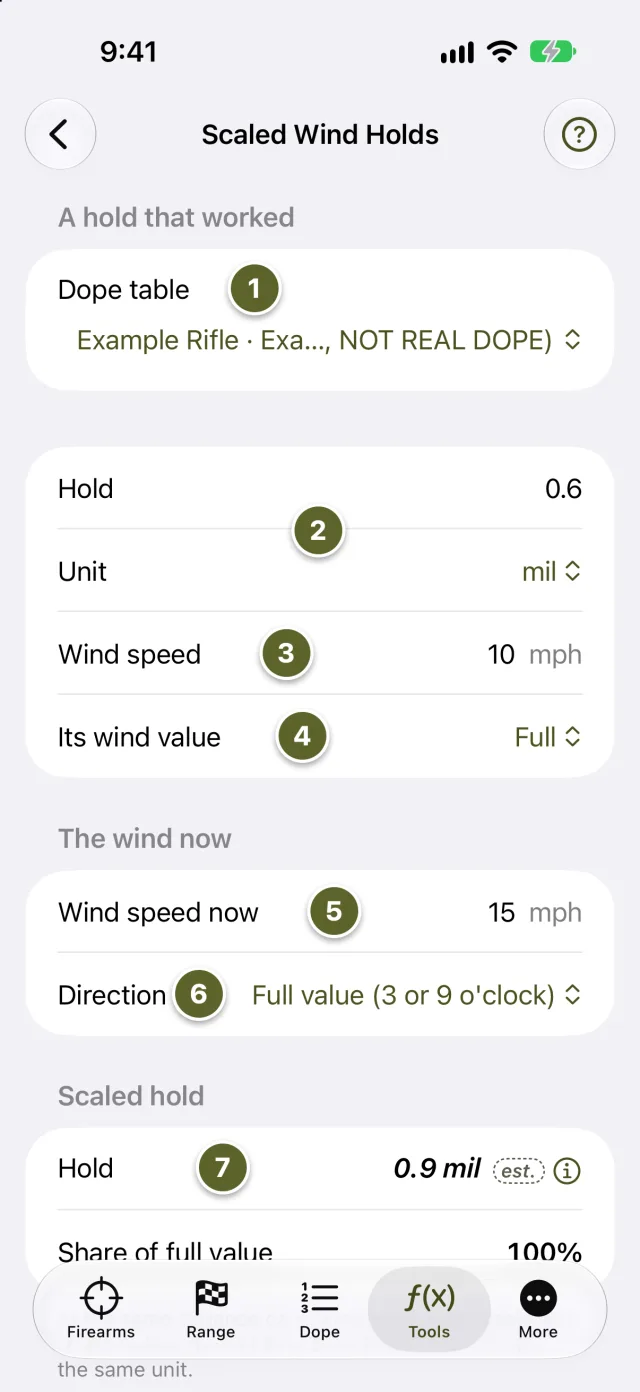
Numbers on the picture: 1 Dope table, 2 Hold and Unit, 3 Wind speed, 4 Its wind value, 5 Wind speed now, 6 Direction, 7 the scaled Hold.
-
Read Scaled hold: the new Hold (est.) and the Share of full value the wind now has.
Nothing is saved; your proven hold is unchanged.
Why it’s useful
Wind is the hardest part of shooting at distance, and the best wind data is your own: a hold you actually shot and hit with. But the wind is rarely the same twice. The usual field method is to scale a known hold: half again as much wind, half again as much hold; a wind from 1 o’clock pushes about half as much as one from 3 o’clock. This calculator does that arithmetic from your proven holds.
Who uses it, and how:
- Long-range and PRS shooters: build a wind “bracket” from one proven hold: what it is at 5, 10, 15 and 20 mph, for full and half value, at each distance you’ve proved.
- Hunters: prepare a short wind table for your usual distances before the season, from holds proven at the range.
- F-Class and target shooters: check a wind call change between relays.
- New shooters: learn the clock system: how direction changes the value of the same wind.
Write the useful results on your dope card as wind holds, then confirm them on the range.
What each option means
How it works: new hold = proven hold ÷ (proven speed x its value) x new speed x new value. Full value counts 1, half 0.5, none 0; a clock hour counts the sine of its angle (1 o’clock = 50%, 2 o’clock = about 87%, 3 o’clock = 100%). “Half value” for 1-2 and 4-5 o’clock is the field rounding; the exact share is 50% at 1, 5, 7 and 11 o’clock and about 87% at 2, 4, 8 and 10. For the exact share of a 2 o’clock wind, pick Clock hour instead of Half value.
What it assumes (the one-time note): scaling assumes the hold changes in proportion to the wind speed and with the wind’s angle, at the same distance only. Real wind is never steady; confirm the scaled hold at the range. The footnote adds why the distance must stay the same: wind holds don’t scale with distance in a straight line. Gun Diary never predicts wind drift for another distance.
Example
- The screen opens with the app’s tested example: 0.6 mil proven in 10 mph full value; the wind now is 15 mph full value. Hold shows 0.9 mil est., Share of full value 100%.
- Change Direction to Clock hour and type 1 in From (o’clock): Share of full value becomes 50% and Hold 0.45 mil.
- Your Mountain Rifle’s table has a proven hold “Wind 10 mph half value: 0.3 mil left at 400 yd”. Pick it in Proven hold: Hold 0.3, Its wind value Half, At 400 yd. With Wind speed now 10 and Full value (3 or 9 o’clock), the hold is 0.6 mil: a full-value wind pushes twice as much.
Tips
- Scale from your best hold. A hold proven on a steady day with several hits beats a one-shot guess.
- Stay at the proven distance. For another distance, prove a hold there; don’t scale across distances.
- Keep the speeds in the same unit. Both fields show the proven hold’s unit (km/h for a hold saved in km/h); type the wind now in that unit too, so the ratio stays right.
- Round to what you can hold. A 0.45 mil hold is about half a mil mark; call it in the reticle you have.
- Record what works. When a scaled hold hits, save it as a new proven hold.
What it affects
Nothing. The proven hold and the dope table stay unchanged. Save a new hold yourself on the dope table.
If something goes wrong
- “Type the proven hold, its wind speed and the wind now.” Hold, Wind speed and Wind speed now all need numbers, and the proven wind speed must be above zero.
- There’s no Proven hold picker. The chosen table has no wind holds. Add one in Proven holds, or type the hold below.
- “A hold proven with no wind value has nothing to scale. Pick a hold proven in a crosswind.” A 12 or 6 o’clock hold has nothing to scale from. Use a hold proven in a full-value, half-value or angled wind.
- My proven hold was recorded at an angle. Picking it sets Its wind value to Angle with its angle, and the share of full value comes from that angle (30° = 50%). Check the angle if the result looks off.
- The result seems too big or too small. Check Its wind value: a half-value hold scaled to full value doubles.
Related
- Next: Hold-On Distances.
- Proven holds, A dope table, Make a dope card.
- Lead for Moving Targets, Hold-On Distances.
- About estimates, What confirmed dope is, The Tools tab.
- Words used here: hold, wind value, clock system, proven hold, mil, MOA.
Gun Diary keeps records you enter and does arithmetic on them. It never predicts a trajectory; confirm every hold by shooting it at the range, and always know your target and what is beyond it.
Still stuck? In the app, open More > Help > Contact Support, or More > Settings > Support, which also has Send Error Log (the error log helps us find the problem), or email contact@setriksoftware.com. You can also browse the Help Center or the messages the app can show.