
What rifle zero distance means
Your rifle zero distance is the distance at which the rifle hits the point of aim with the sight set to zero, like 100 yards or 100 meters. Shooters also call it the zero range, or say the rifle is zeroed at a distance. It's the starting line for everything else you dial: every come-up on a dope table is how far you turn the turret from that zero to hit at another distance. Change the starting line and every measurement taken from it changes too, even though the rifle and the ammunition haven't.
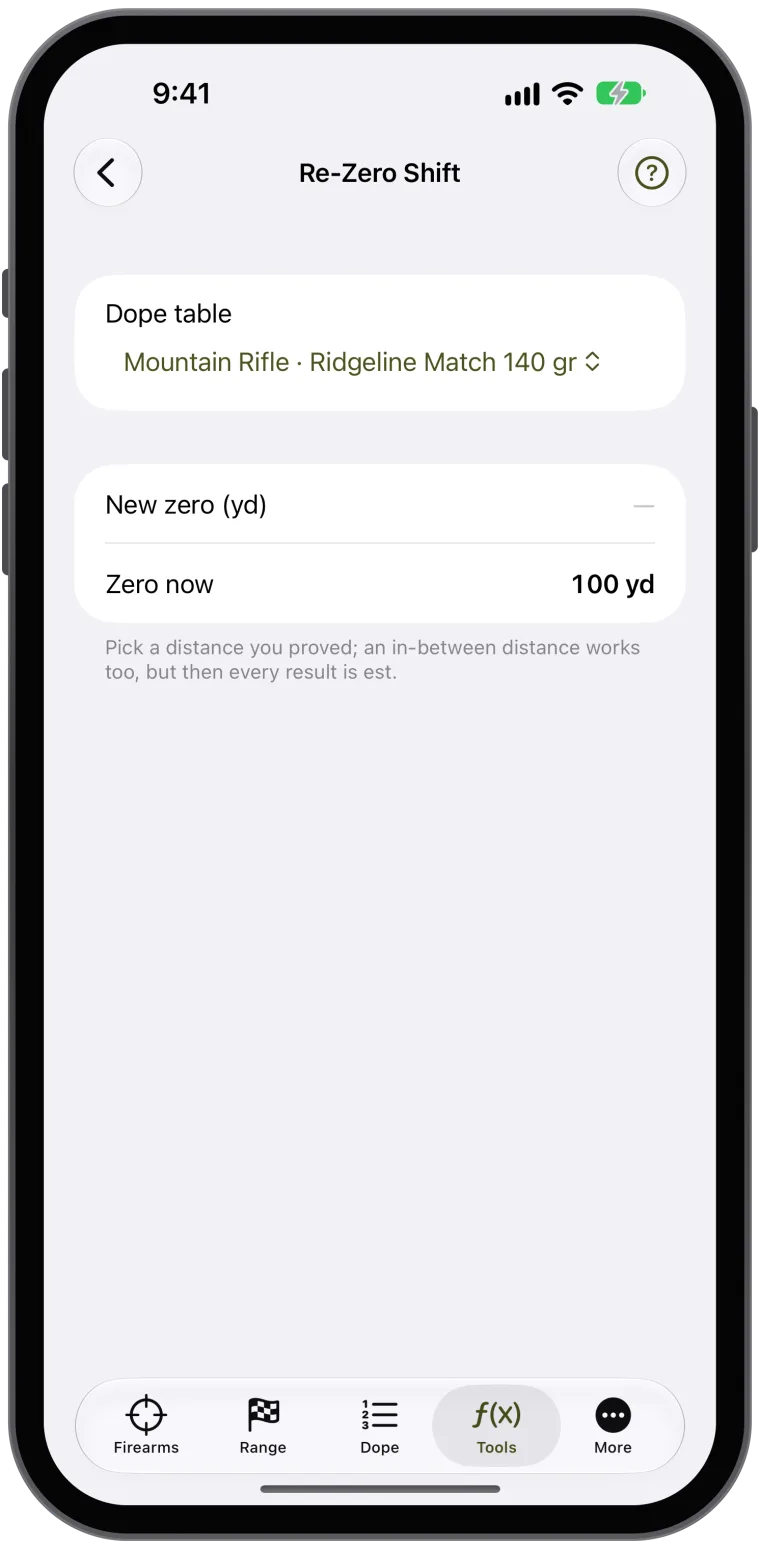
A rifle zero at 100 yards is a common starting point, and many shooters never move it. Others do. A hunter may move from a 100 yard zero to 200 so a center hold works farther out, and a long-range shooter may move to a 100 meter zero when changing ranges. Those are their reasons, not rules, and the right distance for your rifle is a decision this guide leaves to you. What matters here is what happens to your records the day you move it, because that's where good dope quietly goes wrong.
Why every come-up shifts by the same amount
The math is one subtraction: the new come-up at any distance is the old come-up minus the old come-up at the new zero distance. Take the app's built-in Example table, demo data marked EXAMPLE, NOT REAL DOPE: 0 mil at 100 yards, then 1, 2, 3 and 4 mil out to 500. Move the zero to 200 and every row drops by 1 mil, so 100 yards becomes -1, 200 becomes 0, and 500 becomes 3. A negative number simply means you'd dial down from the new zero for that closer distance. The same works in MOA; a mil is just an angle, as this explainer on the milliradian lays out.
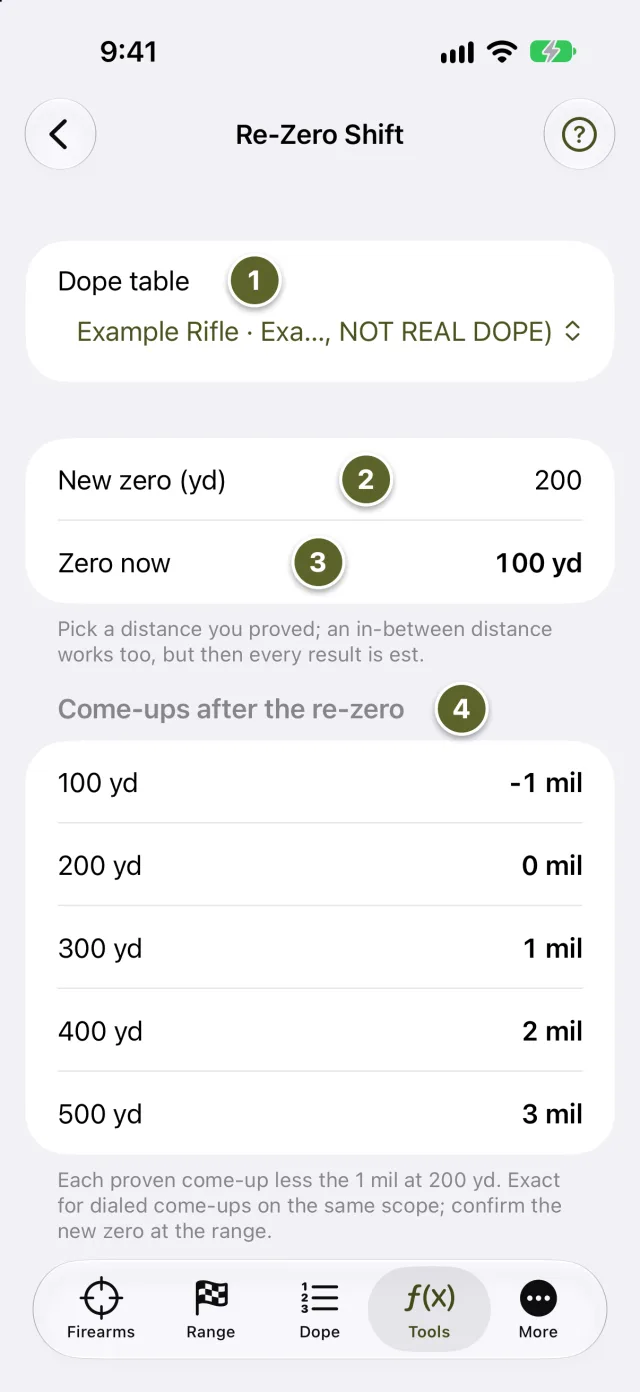
How to zero a rifle at 200 yards without losing your dope
Before you spend any ammunition, see what the move does to the numbers you already proved. Gun Diary's free shooting calculators include Re-Zero Shift, which takes the proven come-ups on one of your dope tables and shows each one after the change. Open it from the Tools tab, or from a dope table's Calculators for This Table, type the new rifle zero distance, and read the shifted rows. Nothing is saved and your table isn't touched; the Re-Zero Shift steps show each screen.
Moving your zero, in order
Pick a distance you proved
Then the shift is exact arithmetic for dialed come-ups on the same scope, not an estimate.
Re-zero at the range
Shoot groups at the new distance and confirm it with a Zero Check, which saves the result as a zero record.
Prove a few distances again
Shoot the rows you rely on before you trust the shifted numbers on a card.
Update the table yourself
Set the table's new zero and add the proven rows on the dope table.
Check the far end
Far rows now need less dialing, so check the scope's travel with Elevation Left.
Before and after the hunt.
When the new zero falls between proven rows
Take the demo diary's Mountain Rifle, a made-up rifle with a table of 0 mil at 100 yards, 0.5 at 200 and 1.4 at 300. Set the rifle zero distance to 200, a proven row, and the rows become -0.5, 0 and 0.9 mil, exact and with no est. A new zero at 150 falls between two proven rows, so its come-up is an in-between estimate of 0.25 mil, and every shifted row is marked est.: -0.25, 0.25 and 1.15. Ask for a zero at 400, past the last proven row, and the app says there's no proven or in-between value there. It never estimates past your last proven distance.
In-between values only come from two proven rows of the same table at most 200 yards or 200 meters apart, and they always say so. Est. = estimated, not proven. Confirm at the range. The note on estimates explains where the app estimates and why it marks every one. One more detail: holds in the reticle shift the same way on a first focal plane scope, while second focal plane holds depend on the magnification, so check those against your scope's manual before you lean on them.
What to record when you change your zero
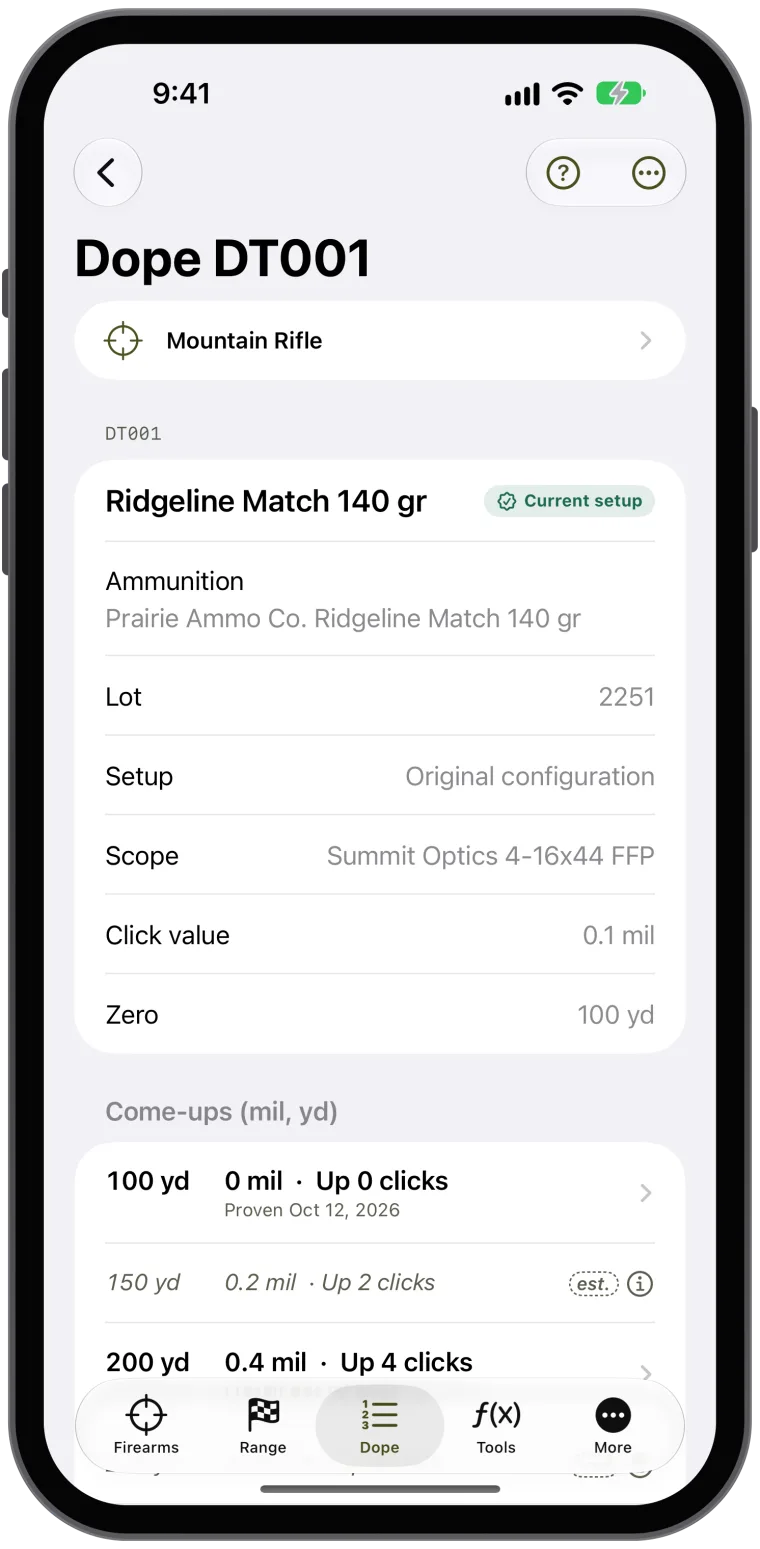
Write the rifle zero distance on every dope table and every card, even when it seems obvious, because it's the one number that makes all the others make sense. When you re-zero, the confirming Zero Check becomes a new entry in the rifle's zero history, and the next check starts at that new distance. Keep the old table's numbers out of your pocket the same day the new zero is proven, so you never dial a come-up measured from a zero the rifle no longer has. Your records stay on your iPhone or iPad and in your own iCloud, with no account and nothing sent to us.
The bottom line
So, does your rifle zero distance matter?
To the rifle, any zero distance is just a turret setting. To your records, the rifle zero distance is everything, because every come-up is measured from it and every one moves when it does. Work out the shift from dope you proved, re-zero and confirm at the range, prove the rows you rely on, and only then print a new card. Which distance you choose is up to you; keeping the numbers honest when you change it is what the record is for.
Gun Diary keeps the records you enter. It never predicts bullet drop, wind or a trajectory; your dope is what you proved on paper. Always follow safe firearm handling.
Your dope, proven on paper, with the proof attached
Confirmed dope tables keep the distance, the come-up, the date and the groups that proved each row; in-between rows say est.
See confirmed dopeComing soon to the App Store