
What does dope mean in shooting?
Dope is the shooter's word for the scope settings that actually hit at each distance, for one rifle with one ammunition. Past your zero distance, the scope has to point a little higher for every step farther out, and the amount you turn the elevation turret is that distance's come-up. Write those come-ups down, distance by distance, and you have your dope. Some shooters call it data, come-ups or a dope book, and the card they carry is a range card or dope card. The words change, but the idea is the same: these are the numbers that worked. Our guide on what goes in a rifle dope book covers what each entry should hold.
What does dope stand for in shooting?
Ask what does dope stand for in shooting and you'll usually hear "data on previous engagements." Whether it started as an acronym or not, the important word is previous. Dope is a record of what already happened, not a forecast of what might. It's usually written as an angle, in mil or MOA, which is why it travels well from one distance to the next: a mil is a milliradian, a thousandth of the radian that the International System of Units uses for plane angles. Your scope's click value then turns that angle into clicks on the turret.
The shooter's words that go with dope
Come-up
How far you turn the elevation turret up from your zero to hit at a distance.
Hold
Aiming off with the reticle's marks instead of turning the turret.
Click value
How far one turret click moves the impact, such as 0.1 mil or 1/4 MOA.
Zero
The distance where the bullet hits where the crosshair sits, with the turret at 0.
Proven dope vs numbers worked out at home
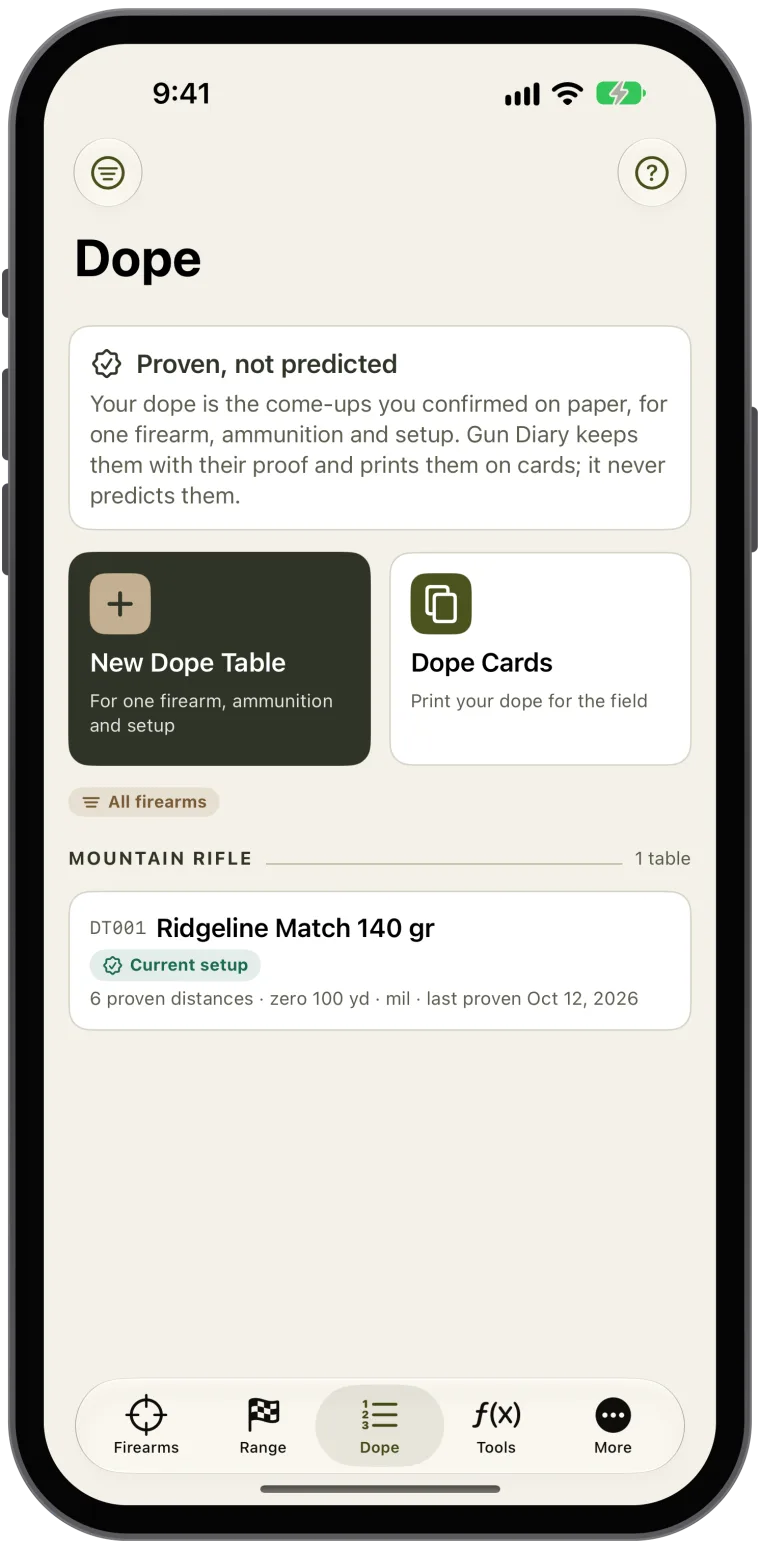
Plenty of shooters start with numbers from a chart or a phone app that works from published bullet figures. Those can be a reasonable place to start, but they're still a guess about your rifle until you shoot them. Proven dope is different: you dialed a setting, shot a group at a known distance, and the group landed where you aimed. That's the honest answer to what is dope in shooting, and it's why we built Gun Diary to keep only what you proved. It keeps your numbers and does arithmetic on them; it never works out a come-up for you.
Five things every proven dope row should keep
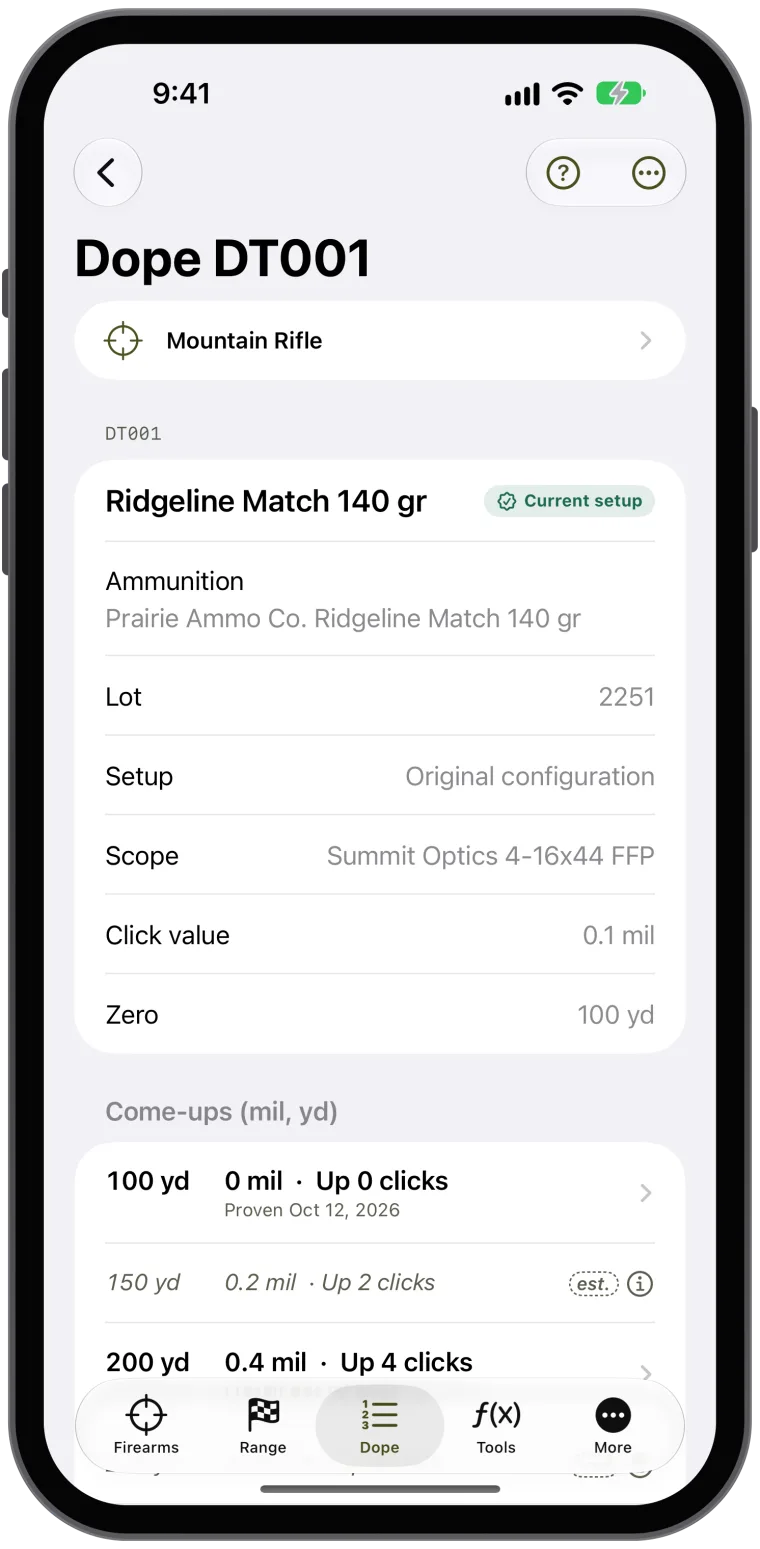
Distance and come-up
The distance you shot and the setting that hit, in mil or MOA.
Date proven
So you know how old the number is before you trust it.
Ammunition and lot
The factory ammunition, by maker, product and lot number.
Setup
The scope, mount and barrel the rifle wore that day.
Proof
The group that showed it, with the conditions if you noted them.
Why the date and the ammo lot matter
A come-up belongs to the rifle, the ammunition and the setup it was proven with. Change one of them, such as a new lot of the same factory ammunition or a different scope, and the old number may no longer land where it did. The date matters for a quieter reason: a row proven three seasons ago with a barrel you've since replaced isn't the same record as one proven last month. Writing all of it down, every time, is what lets you look at a row and know whether it still applies or needs shooting again.
In Gun Diary, every dope table is stamped with the firearm's scope, mount and barrel when you start it. Swap the scope later and the old table is marked earlier setup and set aside, with every value and date kept, so a stale number never slips onto a card you'd carry. And when a new case of ammunition arrives, Duplicate for a New Lot starts a matching table, so each lot keeps its own proven rows.
Before and after the hunt.
How dope gets proven, one distance at a time
The quickest way to see what is dope in shooting is to build some. Say you hunt with a rifle zeroed at 100 yards and want a card for November. In September you shoot 200, 300 and 400 yards, dialing each one and adding it only when the group lands on your aim. Every come-up you write down is measured from your zero, which is why a quick Zero Check before the season comes first: if the zero moved, every row moves with it. Back home, open the group's record and use Save as Confirmed Dope, which allows for how far the group sat from your aim and shows the proven come-up to confirm.
Keeping your dope where you can find it
Gun Diary's confirmed dope tables and dope cards live on the Dope tab, every table grouped by firearm. A proven row shows the distance, the come-up, the clicks for your scope and the date, with "proof attached" when a group is linked. The screens here are from the app's demo diary, so the firearm, maker and numbers are made up. Your records stay on your iPhone or iPad and in your own iCloud: no account, and nothing is sent to us.
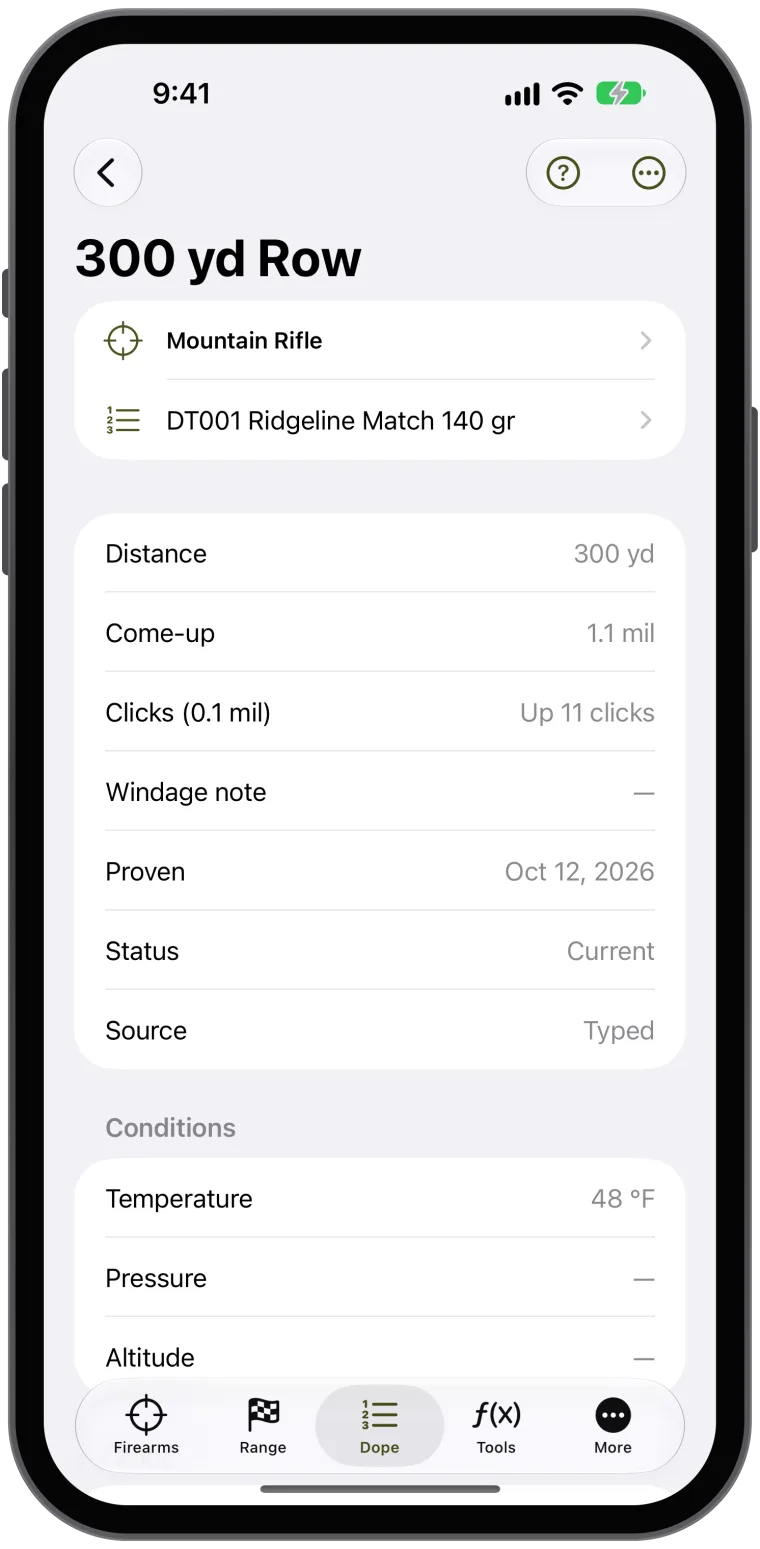
Between two proven rows, the app can show in-between rows as a straight line, always in italic with the word est., and never past your first or last proven distance. They're there to help you plan which distance to prove next, not to stand in for it. Est. = estimated, not proven. Confirm at the range. When you're ready to carry your rows, our guide on how to make a dope card walks through printing one that fits your rifle.
The bottom line
So, what is dope in shooting?
If you've been wondering what is dope in shooting, it's the record of what worked: the come-up or hold that put a group on target at a known distance, with one rifle, one ammunition and one setup. The number matters, but so does everything written beside it, from the date and the lot to the scope it was proven with. Keep that together and your dope stays something you can trust, season after season. Anything you haven't shot yet is still an estimate, and the honest thing is to call it one until you prove it.
Gun Diary keeps the records you enter. It never predicts bullet drop, wind or a trajectory; your dope is what you proved on paper. Always follow safe firearm handling.
Your firearms. Your range days. Your proven dope.
Log every range trip, group and target photo for each firearm, prove your dope and print it as a card, all yours in iCloud. One firearm free, forever.
See how to get startedComing soon to the App Store