
What is a dope card?
If you're asking what is a dope card, it's your dope table printed small enough to tape to a stock, tuck inside a scope cap or carry in a pocket. Each row gives a distance and the come-up that hit there, and often the clicks and a wind hold. Some shooters call it a range card or a dope sheet. Whatever the name, the card is what you read in a stand or behind the rifle, so it has to hold only numbers you trust. Our guide to what dope is in shooting covers where those numbers come from.
How to make a dope card, step by step
The steps below work whether you write your card by hand or print it from an app. The first two happen at the range, and they're the ones that make the card worth carrying. A row you haven't shot belongs in your notes as a plan, not on the card as a fact. The rest is about getting the right rows onto the right size of paper, then making sure the paper came out the size it should.
Six steps from the range to your pocket
Prove the distances
Dial, shoot a group at a known distance, and keep the setting only when the group lands on your aim.
Record each come-up with its proof
The distance, the setting, the date, the ammunition and lot, and the group.
Choose what to print
Units, clicks, wind holds, and only the distances you'd really shoot.
Pick the size
Pocket, stock, scope cap or wrist coach, by where the card will live.
Print at 100 percent
Actual size, never fit to page.
Check the line, then protect it
Measure, cut, and laminate or sleeve the card.
What to put on a rifle dope card
A good rifle dope card starts with what the numbers belong to: the firearm, the factory ammunition and its lot, the zero distance, the units and the scope's click value. Then come the rows, nearest first, with the come-up and, if you dial, the clicks. Add a wind hold if you've proven one, and the dates the rows were proven, so an old card looks old. Fewer rows read better on a small card. Five to eight distances are plenty for a pocket card, so list the ones you'd shoot and leave the rest in the table at home. Our guide to keeping a dope book covers what else belongs with each row.
A hunter's pocket card might cover 100 to 400 yards with the clicks column on and one wind hold, printed four times: one for the pack, one for the truck and two spares. A steel shooter might want every hundred yards out to the farthest distance they've proven, on a bigger card. Neither is wrong. What matters is that every row on the card came from your own rifle and ammunition, and that you can still tell a proven row from anything else on it.
Questions? See the Help Center.
Is a dope card template enough?
A blank dope card template works fine if you fill it in carefully by hand. The trouble shows up later. Copying numbers from a notebook to a card invites a typo, and a hand-filled card doesn't know when the rifle changed. Swap the scope and the old card still looks current. That's why Gun Diary prints the card straight from your dope table, so the card always matches the table. A table proven with a scope or barrel the rifle no longer has is marked earlier setup, and any card printed from it says EARLIER SETUP at the top.
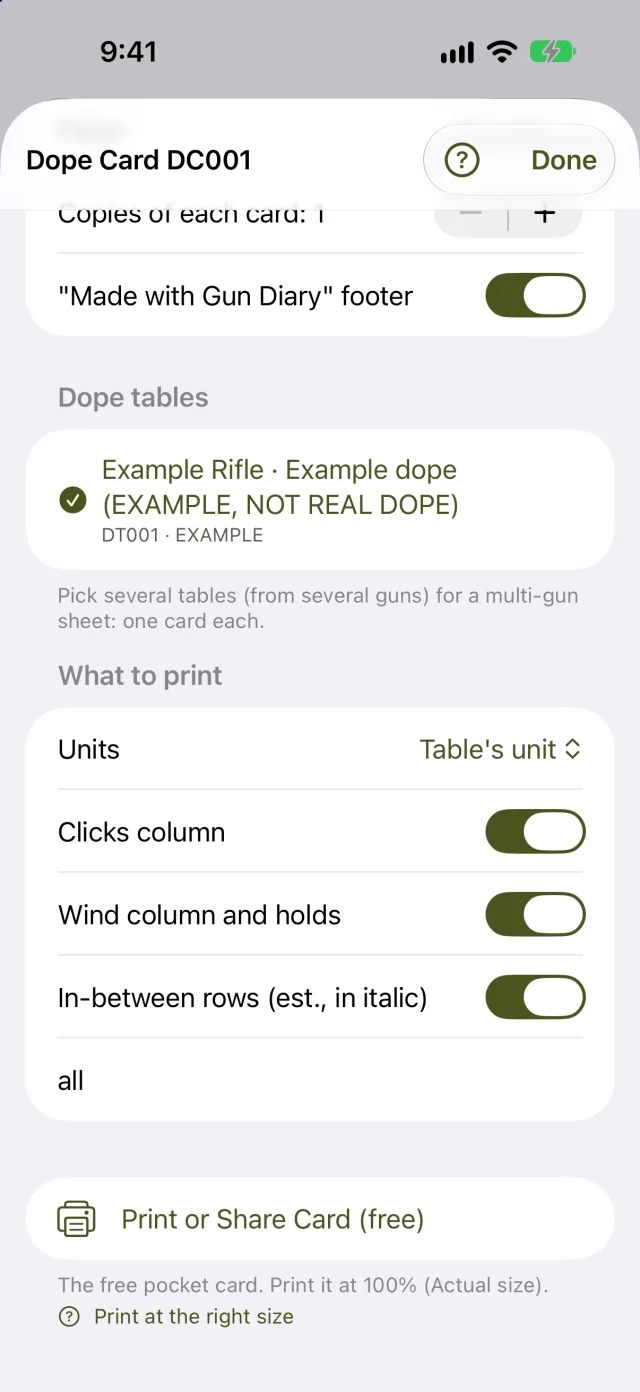
In-between rows are the other trap. It's tempting to fill a gap between 300 and 400 yards with a number halfway between them, and on a hand-written card it looks just like the proven rows. Gun Diary only draws in-between rows between proven rows at most 200 yards apart, never past your first or last proven distance, and prints them in italic with est. You can leave them off the card entirely. Est. = estimated, not proven. Confirm at the range.
Print it at its real size
Printers love to shrink a page to fit, and a card a few percent small won't fit its sleeve or scope cap and gets harder to read. Every sheet Gun Diary prints says to print at 100% (Actual size), not Fit to page, and has two check lines at the bottom: one 1 inch long and one 2.5 cm long. Lay a ruler on them before you cut anything. An inch is exactly 2.54 cm by NIST's conversion table, so the two lines check the scale whether you print on Letter or A4.
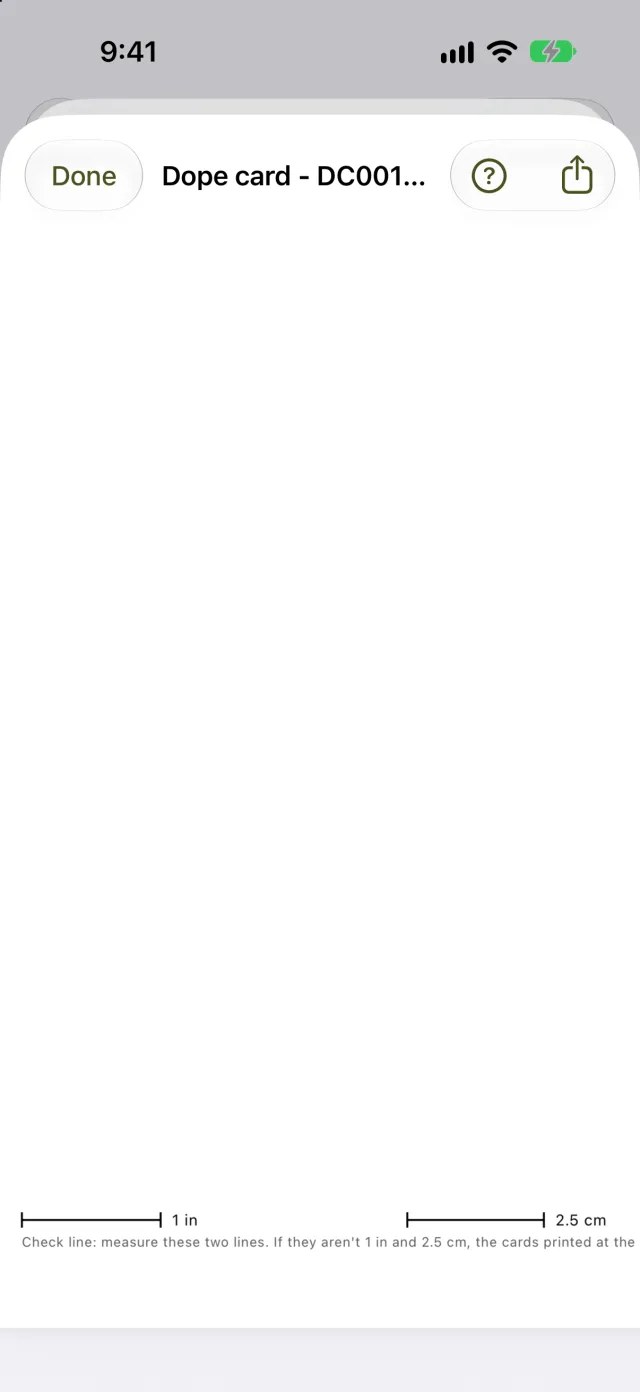
It often goes like this: the first sheet from a home printer measures 15/16 of an inch on the check line, because the page was scaled to about 94%. Sending the PDF to a computer, setting the scale to 100% and turning off fit to page fixes it. The help article on printing a card at the right size covers iPhone, iPad and computer printing. Card stock and a laminate or clear sleeve help a card live outdoors, since a damp card smudges.
Making the card in Gun Diary
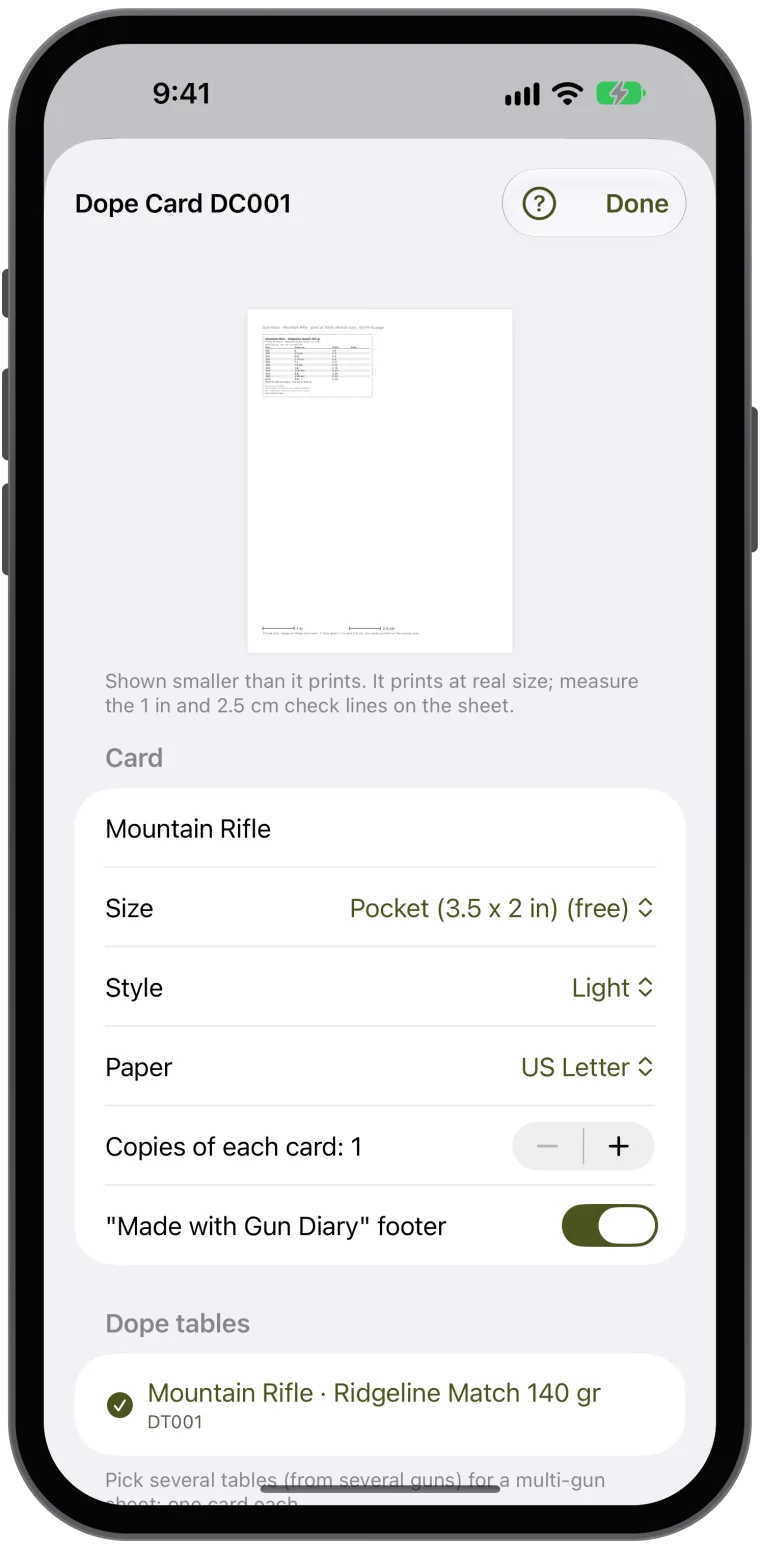
In the app, you open a dope table and tap Make Dope Card, or start one from the Dope tab. You pick the size, paper and copies, turn the clicks and wind columns on or off, list the distances, and the preview shows the sheet as it will print. The pocket card is free; other sizes, high contrast and several guns on one sheet come with Pro. The feature page on printable cards shows every option, our guide to scope cap and other card sizes compares where each one fits, and the screens here are from the app's demo diary. Your tables and cards stay on your device and in your own iCloud, with no account.
The bottom line
So, how do you make a dope card you can trust?
Prove the distances first, record each one with its date, ammunition, lot and group, and print only the rows you'd really shoot. Pick the size for where the card will live, print it at 100%, measure the check line, and protect it from the weather. Then treat the card as a copy of your table, not a separate record: when a row changes or the rifle's setup changes, print a fresh one. A card made that way is a short, honest summary of what your rifle has already done.
Gun Diary keeps the records you enter. It never predicts bullet drop, wind or a trajectory; your dope is what you proved on paper. Always follow safe firearm handling.
Swapped the scope?
The old dope is marked "earlier setup" and set aside, never passed off as current. Start a new table and prove it again. One firearm free.
See how to get startedComing soon to the App Store