
What power factor measures
Power factor is a competition number for how much push a round carries: the bullet's weight times its speed. In USPSA it does two jobs. Every competitor's ammunition has to reach the minor floor for their scores to count, and in the divisions that offer it, ammunition that reaches the higher major floor earns more points for hits outside the center of the target. So USPSA power factor isn't trivia; it sits underneath every score on the results sheet. The screens in this guide come from Gun Diary's demo diary, so the numbers on them are made up.
How USPSA power factor is worked out
The formula is in the rulebook's chronograph appendix: bullet weight in grains, times the average velocity in feet per second, divided by 1,000. There's one twist that matters more than people expect. The final result ignores every decimal place, so a figure of 124.9999 counts as 124, not 125. A calculator that rounds will flatter you by a point now and then, and a single point is exactly the margin that decides whether ammunition clears a floor.
What goes into the number
Bullet weight
In grains, as weighed at the match or as printed on the box for your own records.
Velocity
The average speed of a few shots over a chronograph, in feet per second.
Divide by 1,000
Weight times velocity gives a big number; dividing by 1,000 makes it readable.
Drop the decimals
USPSA counts only the whole number, never a rounded one.
Here are three worked examples with made-up numbers. A 124 grain bullet averaging 1,100 fps gives 136,400, divided by 1,000 is 136.4, and the match counts 136. A 147 grain bullet at 1,110 fps works out to 163.17, counted as 163. A 180 grain bullet at 930 fps gives 167.4, counted as 167. None of these is the speed of any real product; they show how the arithmetic runs, and how close a result can sit to a floor once the decimals are gone.
The USPSA major power factor and minor floors
The floors are set division by division in the rulebook's Appendix D. When we checked in November 2026, Open and Limited Division listed a minor floor of 125 and a major floor of 165. Production and Carry Optics listed the same 125 for minor but no major at all, so everyone in those divisions is scored minor. Some divisions add their own conditions for major, too: Limited sets a minimum caliber, and Open a minimum bullet weight. Floors and conditions can change from one rulebook to the next, so check the current rulebook for your division before you rely on any number here.
How a match checks your ammunition
At a match with an official chronograph, the USPSA chronograph procedure runs like this. Match officials collect eight rounds from you. One bullet from that sample is weighed, and three rounds are fired over the chronograph. The USPSA power factor is worked out from the average of those three speeds. If it falls short, more rounds are fired, up to six, and the average is taken from the top three speeds. At a match with no official chronograph, the power factor you declare can't be challenged.
What happens if it falls short matters as much as the math. Ammunition declared major that doesn't make major has the whole match rescored as minor, as long as it makes minor. Ammunition that doesn't make minor can keep shooting, but not for score or match recognition. That's why the number on the box isn't much comfort. The maker measured it in a test barrel that's often longer than yours, and the match chronograph reads your rounds, from your gun, on that day.
27 calculators, your numbers.
Why major and minor change your score
On a cardboard target, an A hit scores 5 points either way. A C hit scores 4 points for major and 3 for minor, and a D hit 2 for major and 1 for minor. Say a run has 10 A hits, 4 C and 2 D. Scored major, it's 50 plus 16 plus 4, or 70 points; scored minor, 50 plus 12 plus 2, or 64. Shot in 10 seconds, that's a hit factor of 7.0 against 6.4, and only the USPSA power factor changed. Our guide to hit factor scoring shows how points and time combine, and the one on the size of each USPSA scoring zone shows where the A, C and D lines sit.
What to record for your factory ammunition
Your own chronograph won't read exactly like the match's, but a careful record still tells you where a box stands on USPSA power factor before the match does. The trick is keeping enough detail that the number means something a year later. A notebook line reading "9mm, 1,080 fps" can't tell you which lot, which gun or how many shots went into the average. Write it down at the bench, while the readings are still on the screen, and keep each lot separate. Our guide on why the ammo lot number matters covers finding and recording it.
A power factor record worth keeping
The ammunition
The product and its bullet weight, as printed on the box.
The lot number
Printed on the box or its flap; a new lot can run at a different speed.
Every reading
Each shot's speed, not just the average you remember.
The gun and the day
Which firearm fired the string, the date and the temperature.
The result
The power factor with its decimals dropped, the way the match counts it.
Keeping the readings in Gun Diary
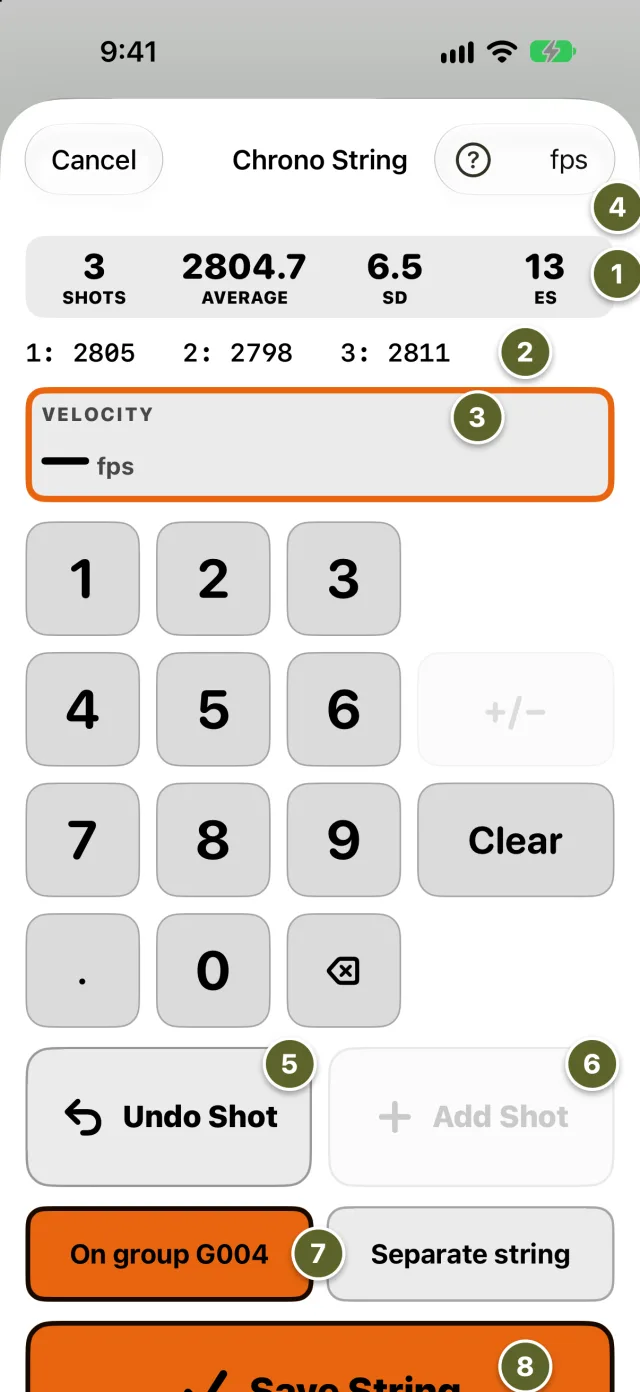
In Gun Diary, the readings can go straight onto a group record as you shoot: type the chronograph's speeds on the group and it keeps the shot count, average, extreme spread and SD with the ammunition and lot (the help on recording a group has the steps). With Gun Diary Pro, Range Mode's chrono string pad takes one speed per shot on a big number pad, without the phone keyboard. Each box goes into the ammo library by product and lot, so next season you can see which lot gave which numbers.
Working out the number from your own string
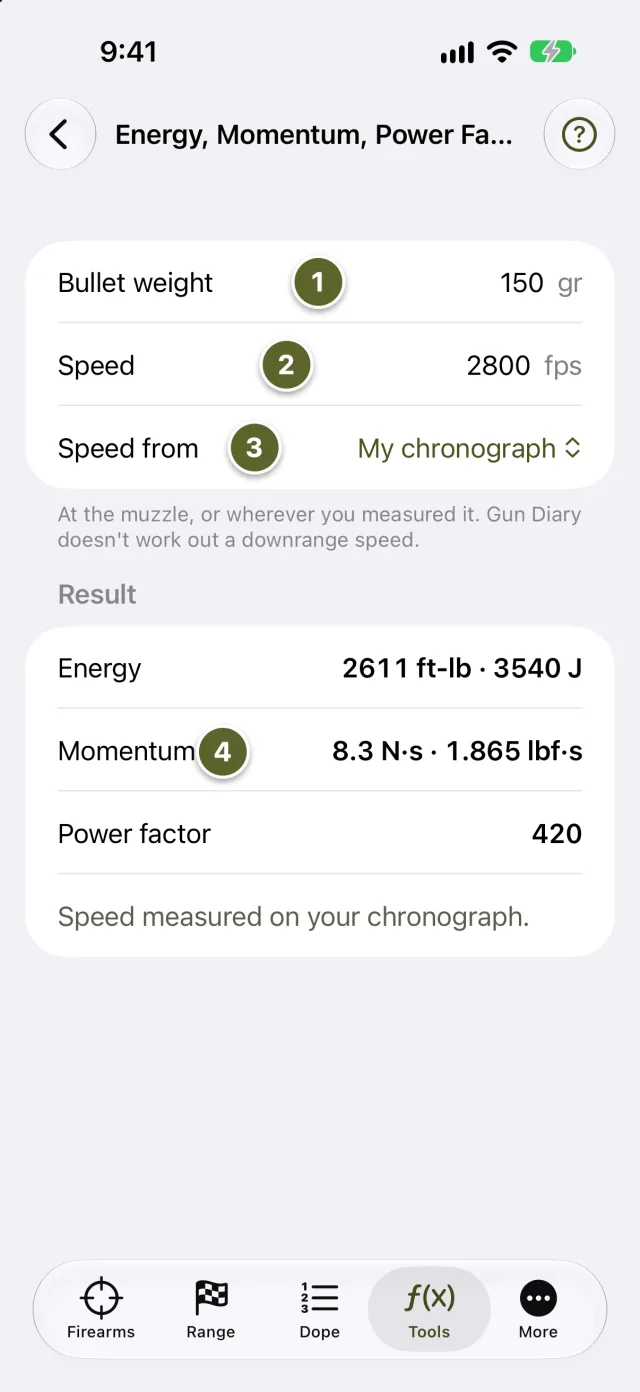
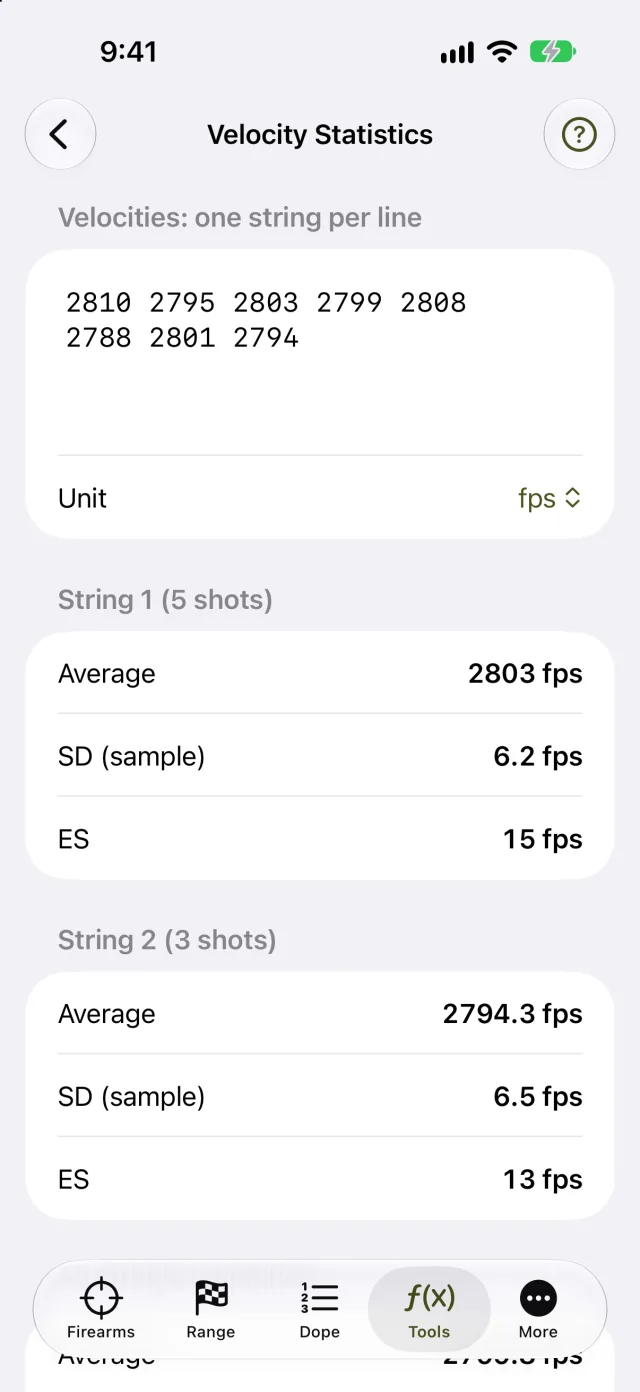
Plenty of people search "power factor calculator uspsa" when what they need is two short steps. In Gun Diary, the Velocity Statistics calculator on the Tools tab takes your string and gives its average, SD and extreme spread. Type that average and the bullet weight into the Energy, Momentum, Power Factor calculator and it shows the power factor to one decimal, with energy and momentum beside it; drop the decimal to match USPSA's count. Both are plain arithmetic and free.
Set Speed from to My chronograph when you measured the speed yourself. Pick The box and every result is marked est., because the box speed comes from the maker's test barrel, not your gun. Est. = estimated, not proven. Confirm at the range. The help page about estimates explains the mark. Your records stay on your iPhone or iPad and in your own iCloud, with no account and nothing sent to us, and match scores and drill runs sit in the same diary as your match and drill records.
The bottom line
So, what is USPSA power factor?
It's bullet weight in grains times average velocity in fps, divided by 1,000, with the decimals dropped. Reach the minor floor and your scores count; reach major in a division that offers it, and your C and D hits are worth more. The number that decides it is the one the match chronograph reads from your rounds on the day, not the box's. Keeping your own readings by lot, with every shot and the gun that fired it, is how you know where you stand before you get there. For the exact floors, the current USPSA rulebook is the final word on USPSA power factor.
Gun Diary keeps the records you enter. It never predicts bullet drop, wind or a trajectory; your dope is what you proved on paper. Always follow safe firearm handling.
Your firearms. Your range days. Your proven dope.
Log every range trip, group and target photo for each firearm, prove your dope and print it as a dope card, all yours in iCloud. One firearm free, forever.
See how to get startedComing soon to the App Store