
What insurers usually ask for
Say you're adding a firearms rider to a homeowner's policy and the agent asks for a list. What they want is enough to identify each gun and back up its value, and the same details matter after a theft or a fire. A good gun inventory sheet answers those questions one firearm at a time, with nothing left to memory. Policies differ, so ask your agent exactly what they need; most lists end up holding the same core details. Whether a homeowner's policy covers a collection at all is a separate question, covered in general terms in our guide to gun collection insurance.
Details for every firearm on the sheet
Maker and model
As stamped on the gun, not a nickname.
Serial number
Copied from the firearm itself, character by character.
Kind and cartridge or gauge
Rifle, handgun, shotgun, rimfire, muzzleloader or other, and what it's chambered for.
Finish and distinguishing marks
Engraving, scratches, a custom stock, a repair: anything that tells it apart from another of the same model.
Purchase date, price and seller
Where it came from and what you paid.
Insured value
What it's insured for or worth today, updated when that changes.
Photos
The whole gun, plus close-ups of the serial number and any marks.
Receipts and appraisals
A photo or PDF of the bill of sale or appraisal letter.
The first four lines identify the gun, and the last four back up its value. A firearm inventory sheet that only has names and rough prices is a start, but it leaves the hard part for later, when the receipts may be gone too. Fill in the serial numbers and marks first, since they're the details nobody can look up for you. Values and paperwork can be added a gun at a time as you find them.
Paper, spreadsheet or app: picking a gun inventory sheet
Any format works if it holds those eight details and you'll actually keep it up. A printed firearm inventory form is easy to start and easy to hand an agent, but photos and receipts end up in a separate folder, and every update means a fresh copy. A spreadsheet is easy to sort and total, and our guide to the gun inventory spreadsheet covers the columns that matter. An app can keep the photos, receipts and values attached to each gun, so the gun inventory sheet is built from records you already keep instead of typed again.
Questions? See the Help Center.
Keep copies away from the guns
A gun inventory sheet kept in the same safe as the guns can be lost with them in a fire or a burglary. Keep one copy at home where you can update it and at least one somewhere else: iCloud Drive, a safe-deposit box, or a family member you trust. Minnesota's insurance regulator gives the same advice for any home inventory: note model and serial numbers, keep receipts or appraisals, store the list safely and share a copy with your insurer. Because the sheet holds serial numbers, be careful about where the shared copies go.
Making the sheet in Gun Diary
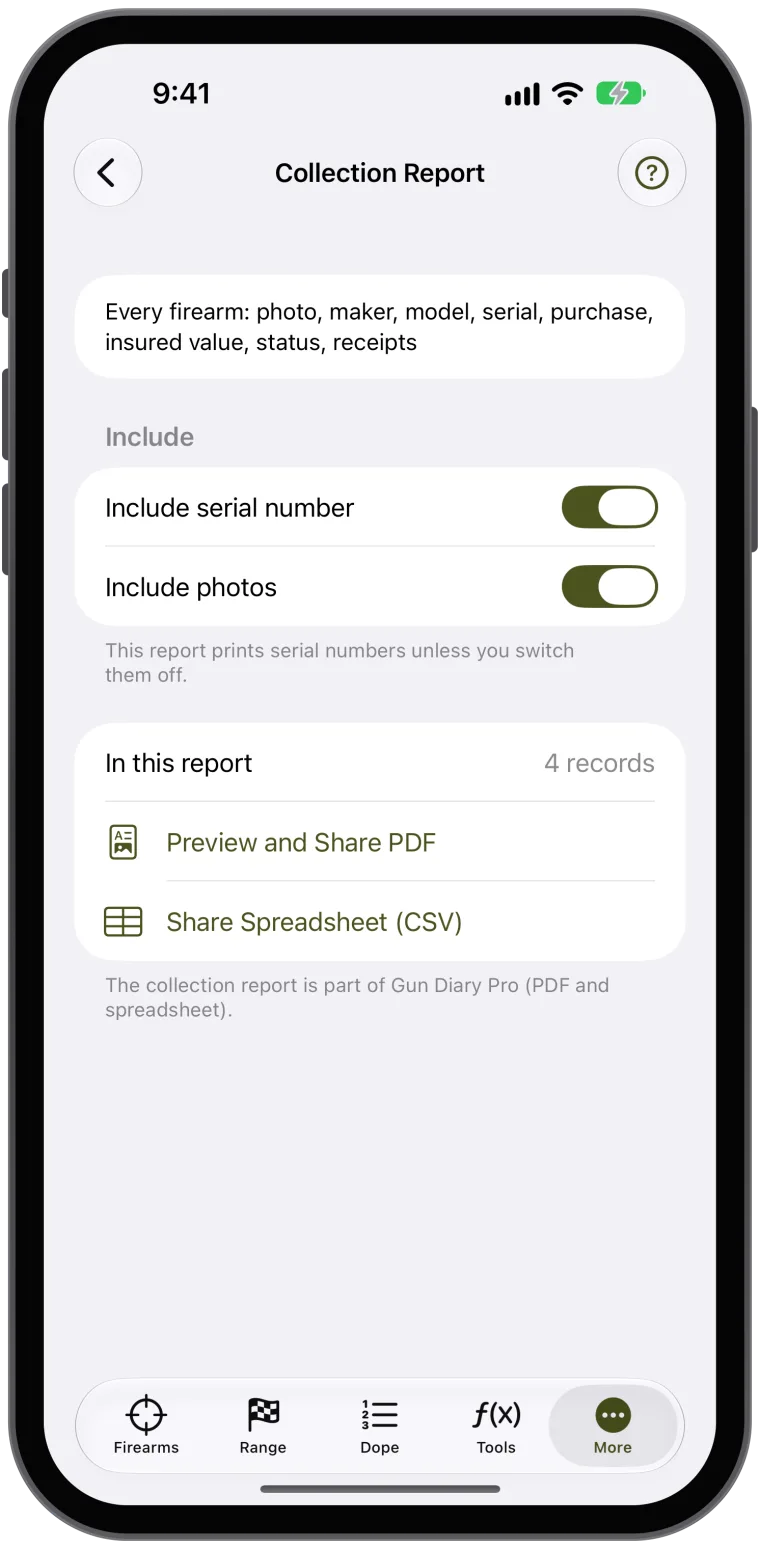
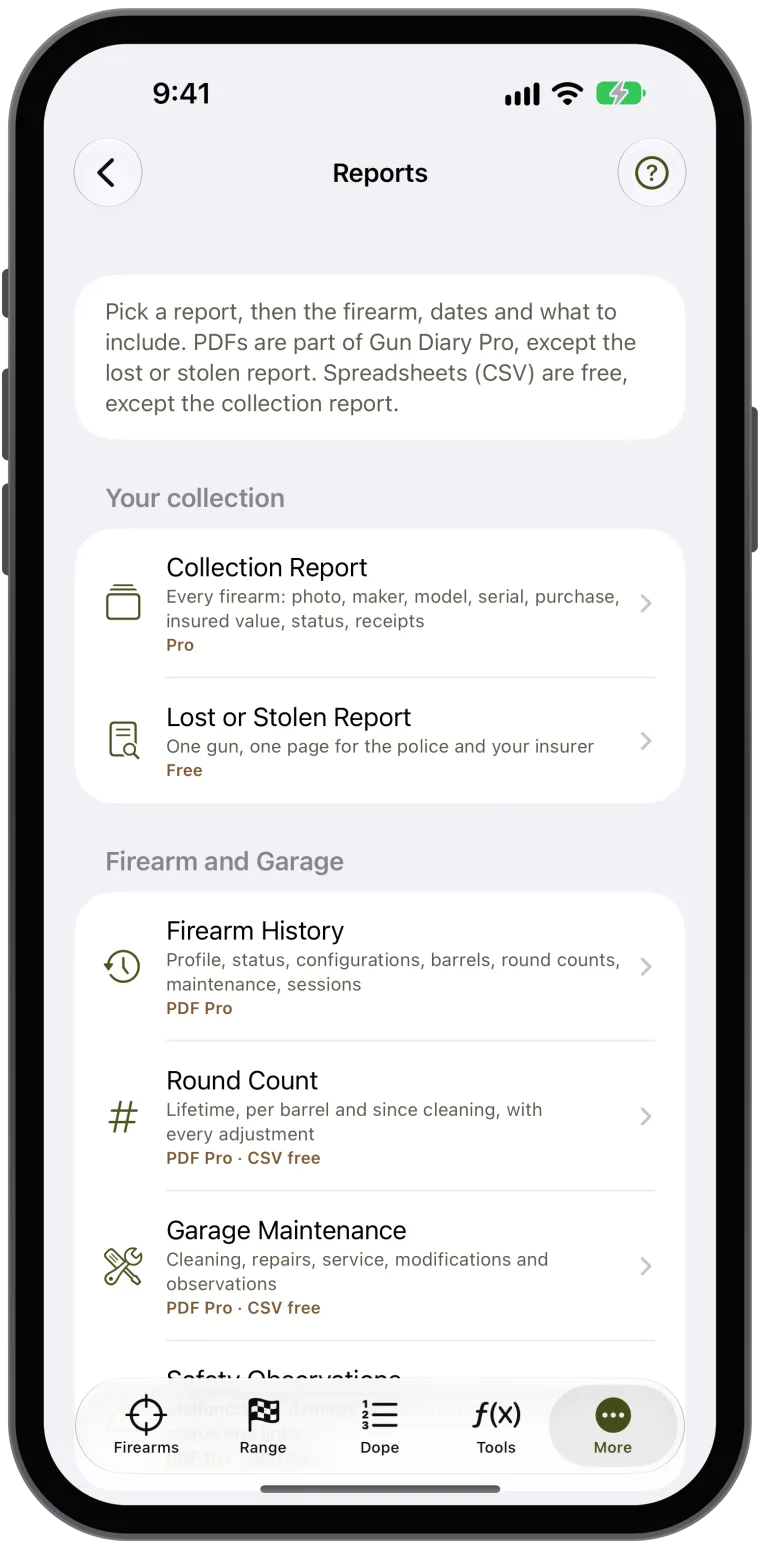
In Gun Diary, each firearm's edit screen has a Details section for the serial number, finish, purchase date and price, who you bought it from, the insured value and distinguishing marks, and a profile photo. Receipts and appraisals can be attached to the gun as firearm documents. Then the collection report for your firearm inventory builds the whole list in one tap: totals for what you paid and what it's insured for, a table of every gun, then a section per firearm with its photo, details and the documents on file. The screens shown here are the app's demo diary, with made-up firearms and makers.
The collection report is part of Gun Diary Pro, as a PDF and as a spreadsheet, and the collection report help has the steps. Serial numbers and photos are on by default, and either can be switched off for a copy you'll share more widely. On the free version, the same details come out in Export All Data as spreadsheets. Either way, the records stay on your iPhone or iPad and in your own iCloud: no account, and nothing is sent to us.
Keeping your gun inventory sheet current
An inventory is only as good as its last update. Add a gun the week you buy it, while the receipt is still in the truck, and update the values once a year or when the agent asks. Don't delete a gun you sold; mark it sold with the date and the buyer, so the history of the collection stays whole. If a gun ever goes missing, the same details become the report for the police and your insurer, which our guide on what to do if your gun is stolen walks through.
The bottom line
So, what goes on a gun inventory sheet?
For each firearm: the maker, model, serial number, kind, cartridge or gauge, finish and marks, the purchase details, the insured value, photos and receipts. Copy the serial number from the gun, keep a copy of the gun inventory sheet somewhere other than the safe, and update it after every purchase or sale. Ask your agent what the policy needs, since that's their call, not ours. The sheet's job is simple: when someone asks what you had, you can show them.
Gun Diary keeps the records you enter. It never predicts bullet drop, wind or a trajectory; your dope is what you proved on paper. Always follow safe firearm handling.
Pro, once
Unlimited firearms, every dope card size, Range Mode and PDF reports: $69.99 once, never renews.
See pricingComing soon to the App Store