
What a dope book is, and what it isn't
A dope book is a notebook for one rifle that records the scope settings that put your shots on target at each distance, and how you found them. Long-range and precision shooters have kept them for decades, and hunters keep smaller ones, but the idea behind dope book shooting is the same at any distance. It isn't a table of numbers someone worked out for you. Every line in a good book was shot on paper, on a date, with one ammunition. If you're new to the word itself, our guide to what dope means in shooting covers the basics first.
What goes in a rifle dope book
Blank books sold for this have dozens of boxes, and most of them get left empty. A rifle dope book that you'll actually keep needs six kinds of page, and the first three are written once and updated rarely. The rest grow every time you shoot. Come-ups are given in the angle unit your scope uses, mil or MOA; a mil is a thousandth of a radian, the angle unit described in the NIST guide to the International System of Units. Write the unit at the top of the page so nobody mixes the two.
Six pages every dope book needs
The rifle and scope
The rifle, barrel, scope, mount and click value, like 0.1 mil per click.
The ammunition
The maker, product and lot number from the box, because a new lot can shift your numbers.
The zero
The zero distance and the date you last confirmed it, since every come-up is measured from it.
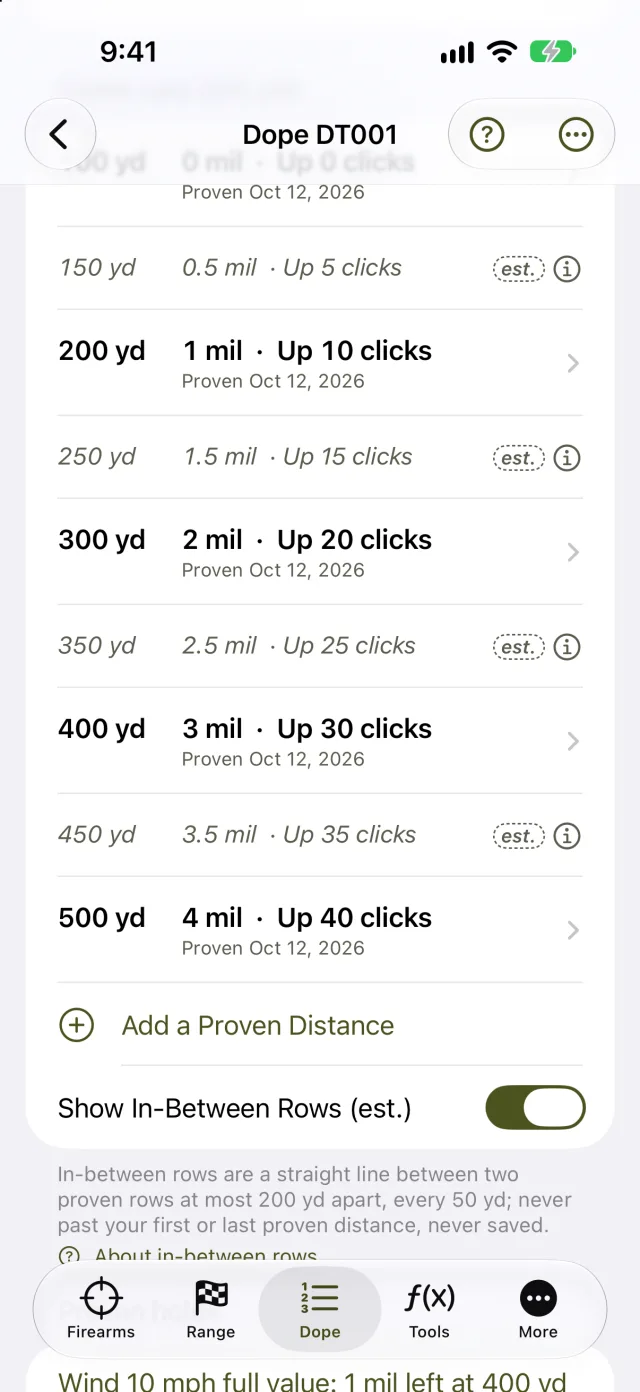
The come-up table
Each proven distance with its come-up and clicks, nearest first.
Session pages
One per range trip: date, place, temperature, pressure, altitude, wind and each group.
Notes and calls
Cold bore shots, called flyers, light, position and anything odd about the day.
The come-up table is the page you'll turn to most, and it's the one that goes wrong most quietly. A number gets written in pencil, the scope gets moved to another rifle, and a year later nobody remembers whether 300 yards was proven or copied from a buddy. That's why the proof matters more than the number. Write the date and the lot beside every come-up, and cross out a row instead of erasing it, so the old value stays readable with its date.
How to fill in your dope book shooting at the range
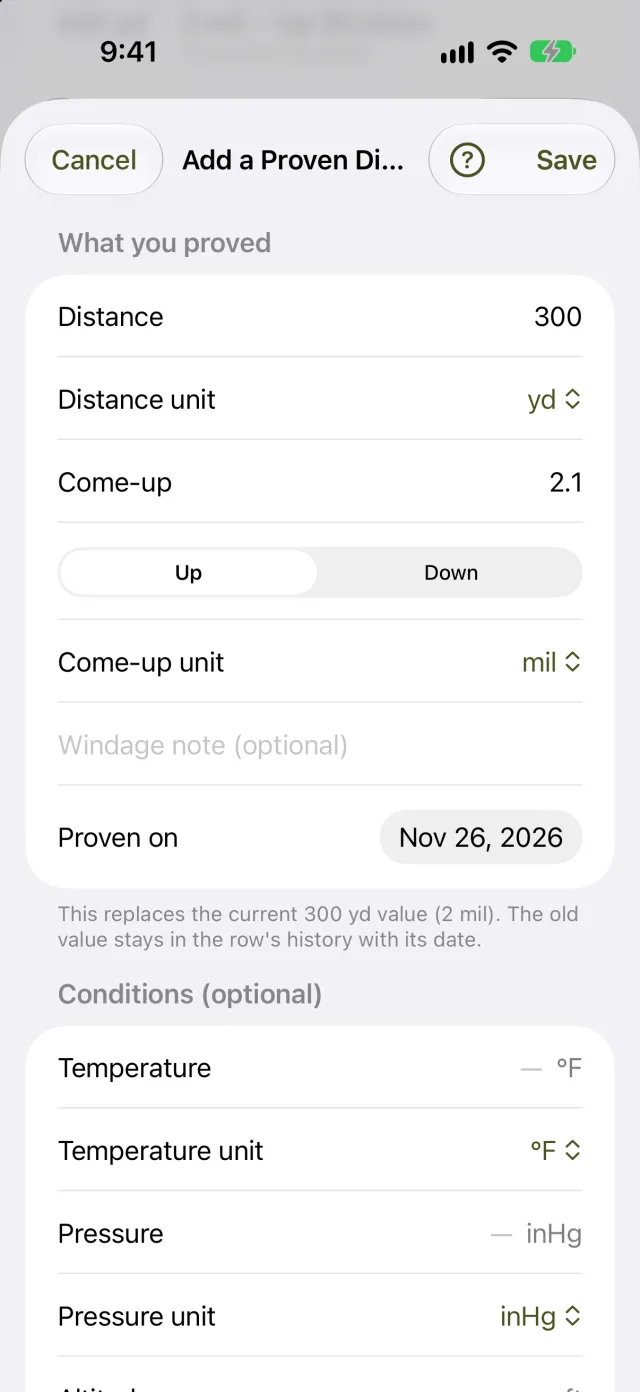
At the bench, write only what you'll forget: the distance, what you dialed, where the group landed against your aim, and the conditions. Most people start a dope book shooting at their zero distance and work outward one distance at a time, so each new row rests on one already proven. When a group lands on your aim with a certain amount dialed, that distance and that come-up become a proven row. Tidy the book at home the same day, while the target is still in your bag.
Say you proved 300 yards in spring with 1.2 mil dialed, then bought a new lot of the same ammunition in the fall. The honest move is a fresh page for the new lot, proving 300 again instead of carrying the old row across. If the new value differs, the old one isn't wrong; it belonged to the other lot. The same goes for a scope swap: the old table becomes history from an earlier setup, not your current dope. We won't tell you what your come-ups should be; that's what the range is for.
Know it's still zeroed before the season opens.
A paper book or a dope book on your phone?
Paper works, and plenty of good shooters swear by it. The trouble shows up later: a paper dope book shooting in the rain gets soggy, pencil smudges, and finding every 500-yard row from three seasons means reading every page. A long range shooting dope book also fills fast once you shoot several rifles or lots, and the notebook is rarely with you when you want it. If you're moving years of pages over, our guide to a long range shooting notebook on your phone walks through it.
Gun Diary's dope tables do the same job
Gun Diary is a shooting logbook for iPhone and iPad, and its confirmed dope tables are a dope book with the proof attached. Each dope table belongs to one firearm, one ammunition and lot, and one setup, with the scope's click value and your zero at the top. You add a proven distance with its come-up, date, conditions and the groups that proved it. Replace a row later, and the old value stays in its history with its date.
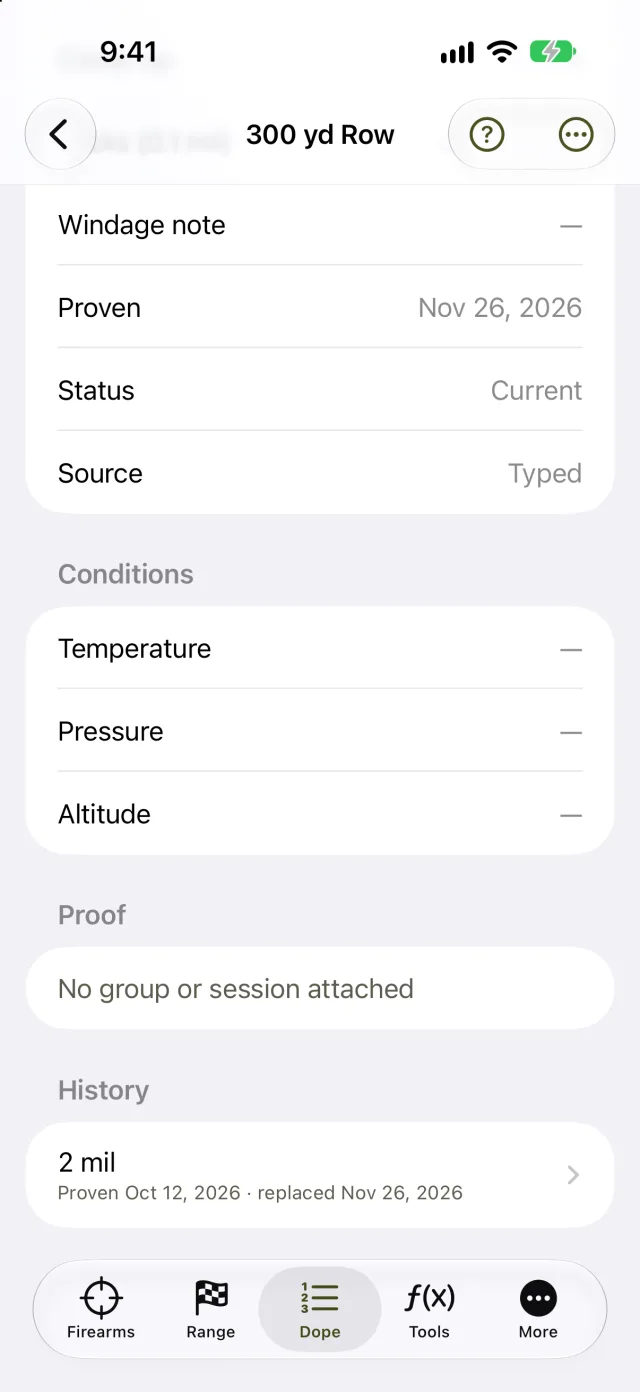
A new lot gets its own table with one tap (Duplicate for a New Lot), with no rows carried over, so you prove each distance again. After a scope swap, the old table is marked earlier setup and set aside, never shown as current. In-between rows are italic and marked est., because they weren't shot. From any table you can print a card, as in our guide on how to make a dope card. Your tables live on your iPhone or iPad and in your own iCloud, with no account and nothing sent to us. The screens on this page are the app's demo diary, with made-up numbers.
The bottom line
So, what goes in a dope book?
The rifle and scope, the ammunition and lot, the zero, a come-up table of proven distances, a page for each range trip and the notes that explain a strange day. Above all, a date and a lot beside every number, so you can tell a fresh row from a stale one. That's dope book shooting done honestly, on paper or on a phone. Gun Diary keeps the same pages for every firearm, the dope tables are free, and one firearm is free forever.
Gun Diary keeps the records you enter. It never predicts bullet drop, wind or a trajectory; your dope is what you proved on paper. Always follow safe firearm handling.
Still writing your dope card in pencil?
Save the come-ups you proved, with the date and the groups that proved them, then print a card that fits the stock, the scope cap or your pocket. The pocket card is free.
See how to get startedComing soon to the App Store