
"Calculator #21: Hold-On Distances"
For a target of a given size, see at which distances on your dope table a center hold still lands on it, with the sight set for one distance.
Hold-On Distances (calculator #21) answers “how far can I aim dead center and still hit?” Pick a dope table, type the target’s size and the distance your sight is set for, and it lists every distance on the table with how far above or below center a center hold would land, and whether that stays On target. It uses only your proven come-ups (and in-between rows, marked est.), never a predicted trajectory.
Steps
- Open it one of two ways:
- Tools tab > under Your dope, tap Hold-On Distances; or
- Dope tab > a dope table > Calculators for This Table > Hold-On Distances (the table is picked for you).
- Check the Dope table; tap it to pick another.
- Type the Target size (the width of what you must hit, like a deer’s vital zone or a steel plate) and pick the Size unit (in or cm).
-
Sight set for starts on the table’s zero distance. Tap it to pick another row if you dial for a different distance before the shot.
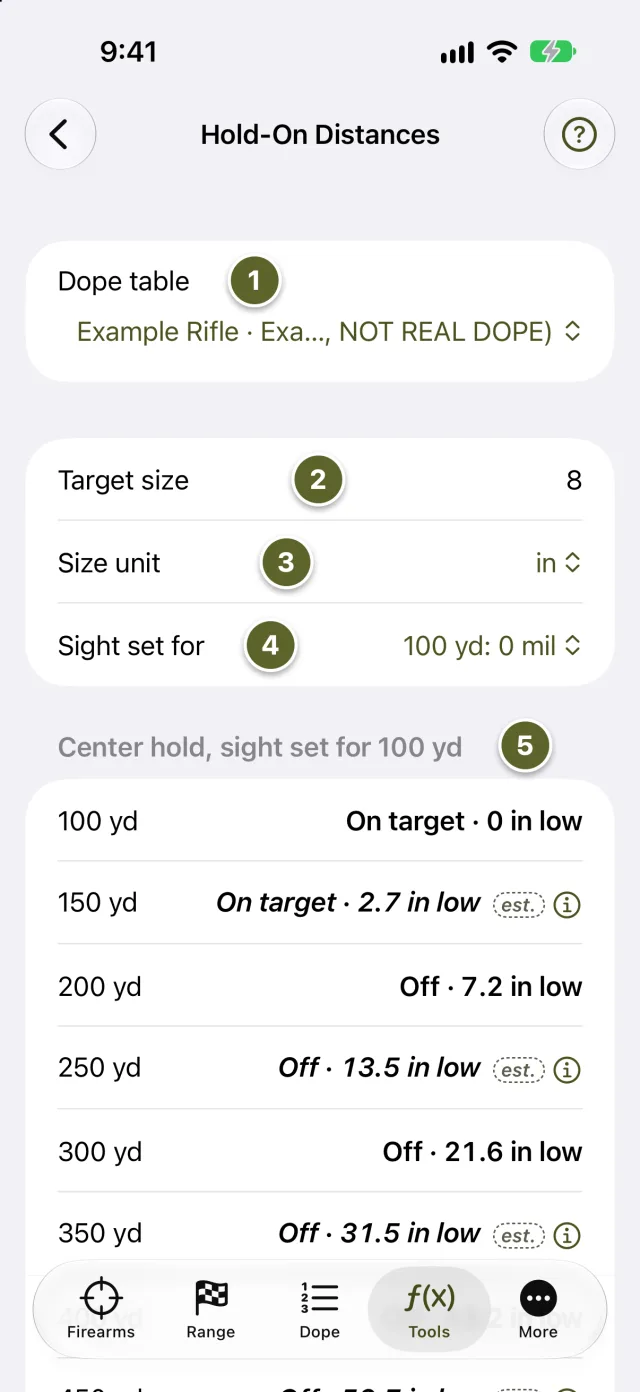
Numbers on the picture: 1 Dope table, 2 Target size, 3 Size unit, 4 Sight set for, 5 the list of distances.
-
Read the list under “Center hold, sight set for …”: each distance shows On target or “Off”, and how many inches low (or high) a center hold lands. In-between rows are in italics with est.
Nothing is saved.
Why it’s useful
Many shots in the field are taken without time to dial. If you know the distances where a center hold still lands inside the target, you can shoot quickly and stay ethical, and you know exactly where you must dial or hold over. Working it out from your own proven come-ups means the answer fits your rifle, not a chart.
Who uses it, and how:
- Deer and big-game hunters: with an 8 in vital zone, see how far a center hold works with your zero. A common use: decide between a 100 yd and a 200 yd zero (check the new come-ups with Re-Zero Shift first).
- Predator and varmint hunters: a small target (a 3 or 4 in zone) shows how short the hold-on range really is.
- Steel shooters: type the plate size and see which plates you can engage without dialing.
- New shooters: see the idea of “point-blank range” with your own numbers instead of a rule of thumb.
What each option means
How it works: miss at a distance = |that row’s come-up – the set row’s come-up|, turned into inches at that distance. Inside = miss ≤ half the target size. On a table for an earlier setup, only proven rows are listed (no in-between rows).
The footnote is the honest limit: this is from your proven come-ups only. Your group’s spread, wind and range errors come on top, so the real hold-on distance is shorter. For the effect of your group size, see Hit Chance from Your Groups.
Example
On the Example table (proven 100 yd: 0, 200 yd: 1, 300 yd: 2, 400 yd: 3, 500 yd: 4 mil; zero 100 yd), Target size 8 in, Sight set for 100 yd: 0 mil:
- 100 yd: On target · 0 in low
- 150 yd: On target · 2.7 in low (est.)
- 200 yd: Off · 7.2 in low
- 250 yd: Off · 13.5 in low (est.), and so on.
So with this zero, a center hold works to about 150 yd on an 8 in target.
Your Mountain Rifle table with 100 yd: 0, 200 yd: 0.3, 300 yd: 1.0 mil (the app’s tested example), 8 in target, set for 100 yd: 150 yd: On target · 0.8 in low (est.), 200 yd: On target · 2.2 in low, 250 yd: Off · 5.8 in low (est.), 300 yd: Off · 10.8 in low. A center hold works to 200 yd; beyond that, dial or hold over.
Tips
- Use the vital zone, not the whole animal. For most deer, hunters use 6 to 8 in.
- Leave a margin. Group spread and wind come on top; treat the last On target row as the limit, not a goal.
- Prove the in-between distances you care about so they’re no longer est.
- Try another Sight set for. Setting for 200 yd can put both 100 and 250 on target where a 100 yd setting can’t.
- Write the answer on your card: “Hold center to 200 yd”. See Make a dope card.
What it affects
Nothing. The dope table is only read.
If something goes wrong
- “Pick a dope table above. Tables are on the Dope tab.” No table is picked or you have none yet.
- No list shows. Type a Target size.
- No est. rows appear. The table is for an earlier setup, or its proven rows are more than 200 apart (in-between rows are only drawn between rows at most 200 yd or 200 m apart).
- The set distance shows “0 in low”. That’s the distance your sight is set for: the hold is exactly on.
- Distances closer than the set one show “high”. With the sight set farther out, close shots land above the aim; that’s correct.
Related
- Next: Hit Chance from Your Groups.
- A dope table, In-Between Rows calculator, Re-Zero Shift.
- Hit Chance from Your Groups, Holdover from Your Dope.
- About estimates, What confirmed dope is, The Tools tab.
- Learning path: Before and after the hunt.
- Words used here: come-up, hold, zero, in-between row, point-blank range.
Gun Diary keeps records you enter and does arithmetic on them. It never predicts a trajectory; confirm every hold by shooting it at the range, and always know your target and what is beyond it.
Still stuck? In the app, open More > Help > Contact Support, or More > Settings > Support, which also has Send Error Log (the error log helps us find the problem), or email contact@setriksoftware.com. You can also browse the Help Center or the messages the app can show.