
"Calculator #5: Range Estimate"
Work out the distance to a target of known size from how many mils or MOA it covers in your reticle (mil-ranging).
Range Estimate (calculator #5) works out how far away something is from its known size and how many mil or MOA it covers in your reticle. This is called mil-ranging. It’s plain geometry, and only as good as the size you know and the reading you take.
Steps
-
On the Tools tab, under Angles and movement, tap Range Estimate.
-
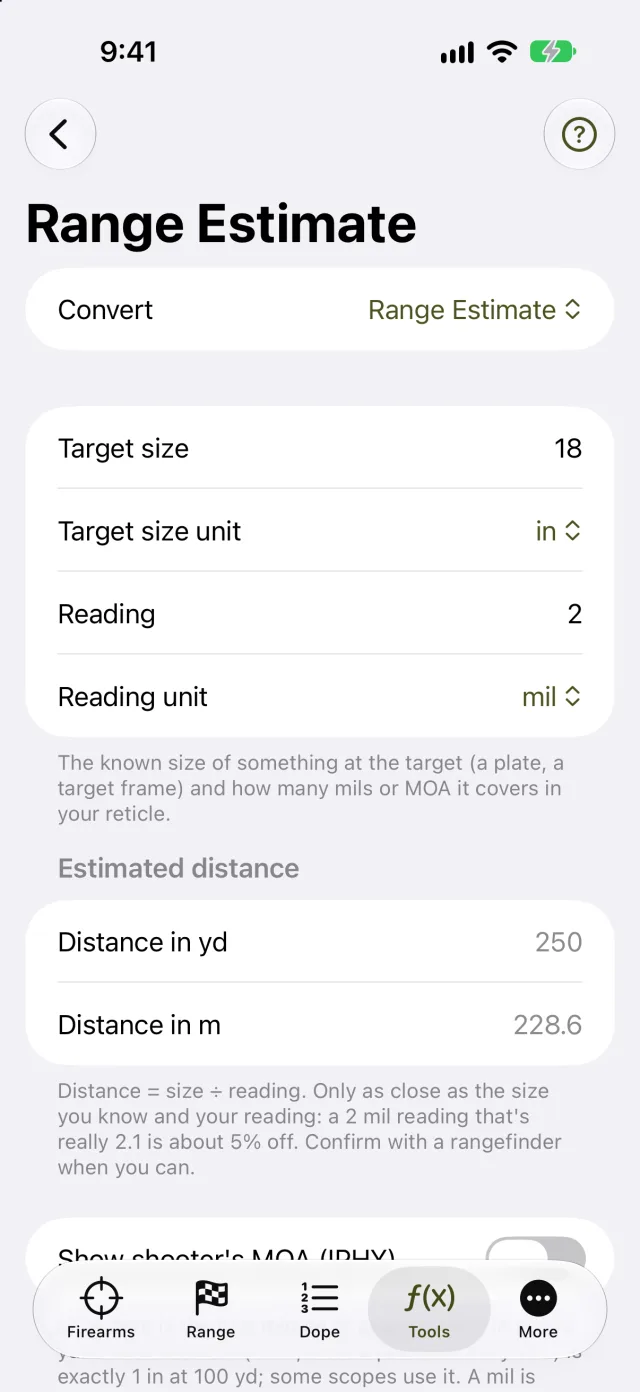
Type the Target size: the real size of something at the target (a steel plate, a target frame, a fence post) and pick the Target size unit (in, cm, mm, ft or m).
- Type the Reading: how many marks it covers in your reticle, and pick the Reading unit (mil or MOA).
- Read Estimated distance: Distance in yd and Distance in m, to one decimal.
Why it’s useful
Laser rangefinders are the best way to get a distance, but batteries die, lasers miss on small or shiny targets, and some matches don’t allow them. A reticle with marks plus something of known size gives you a distance with no electronics.
Who uses it, and how:
- Precision and PRS-style competitors: stages that require ranging plates with the reticle.
- Hunters as a backup: a known-size object near the animal, or the reticle on a fence post, when the rangefinder won’t read.
- Students learning their reticle: practice reading targets at known distances and check how close your readings are.
- Anyone checking a rangefinder: a second opinion on a doubtful reading.
What each option means
The formula, in plain words: distance = size ÷ (reading x the size of one unit as a share of distance). With mils that’s the classic “size x 1000 ÷ mils”: 18 in x 1000 ÷ 2 = 9,000 in = 250 yd.
Example
At a match, a plate known to be 18 inches tall reads 2 mil in your Mountain Rifle’s reticle.
- Target size 18, in. Reading 2, mil.
- Estimated distance: Distance in yd 250, Distance in m 228.6.
With an MOA reticle: a 10 inch plate reading 2 MOA is 477.5 yd (436.6 m).
Tips
- A small reading error is a big distance error. The footer says it: a 2 mil reading that’s really 2.1 is about 5% off. Read to the tenth of a mil if you can, and brace the rifle.
- Know the size for real. “About 18 inches” gives “about 250 yards”. Measure your plates and write their sizes down.
- On a second focal plane scope, read at the magnification where the marks are true (usually the highest), or the reading will be wrong. See Reticle Subtension.
- Confirm with a rangefinder when you can.
What it affects
Nothing is saved. The IPHY switch is remembered for all angle tools.
If something goes wrong
- “Type a target size and a reading above 0.” One of the two is blank or 0.
- The distance is way off. Check the size unit (cm vs in) and that the reading unit matches your reticle.
Related
- Next: Holdover from Your Dope, to turn the distance into a hold.
- Angle to Size, Reticle Subtension, Uphill, Downhill and Cant.
- Words used here: mil-ranging, reticle, mil, MOA, second focal plane.
Gun Diary keeps records you enter and does arithmetic on them. It never predicts a trajectory; confirm every hold by shooting it at the range, and always know your target and what is beyond it.
Guides on this topic
Still stuck? In the app, open More > Help > Contact Support, or More > Settings > Support, which also has Send Error Log (the error log helps us find the problem), or email contact@setriksoftware.com. You can also browse the Help Center or the messages the app can show.