
What a group of shots is (and isn't)
A shot group is the pattern of holes from several shots fired at one aiming point, with the firearm, the ammunition and your position kept the same. It tells you two separate things. Its size shows precision: how tightly the shots gathered. Its center, compared with where you aimed, shows where the firearm is pointing, which is what a scope adjustment moves. A tiny group 3 inches from the aim point is precise but off, and a wide group around the dot is centered but loose. Keeping those two ideas apart makes every measurement below easier to read.
How many shots make a shot group?
There's no single rule, and three counts are common. Three-shot groups are quick and use little ammunition, but they tend to flatter: the more shots you fire, the larger a group tends to measure, simply because there are more chances for a wide one. Five shots is the count most shooters use to compare. Ten or more say the most, and that's where a measure like mean radius really settles down. Whichever you choose, use the same count every time you want to compare, and write it down, because a three-shot and a five-shot result can't be compared fairly.
How to shoot a group you can measure
A group is only as useful as the conditions behind it. Nothing here is about technique or safety; it's about making sure the holes on the paper can be measured and trusted later. These steps work the same for a rifle at 100 yards or a pistol at 7.
Five steps for a group worth recording
Pick a target with a clear aim point
A small dot or square on a grid makes it easier to aim at the same spot every shot and to measure each hole later.
Set a known distance
Write it down before the first shot. Any distance works as long as it's recorded.
Keep everything the same
Same ammunition and lot, same rest, same position and the same aim point for every shot.
Fire the string and count it
Note a shot you know you pulled when it happens, not later when the paper tempts you.
Mark it before the next one
Number the group on the paper or move to a fresh aim point, so holes from two groups never mix.
How to measure a shot group
The usual number is extreme spread, center to center: the distance between the centers of the two holes farthest apart. Holes are hard to center a ruler on, so the common way is to measure edge to edge across the outside of those two holes with calipers and subtract one bullet diameter. For example, 1.21 inches outside to outside with a 0.308-inch bullet gives 0.90 inch center to center. Extreme spread is what statisticians call the range, the largest value minus the smallest, and like any range it rests on only the two most extreme points, so one wild shot changes it a lot.
Mean radius: the measure that uses every shot
Mean radius finds the group's center, the average position of all the shots, then averages how far each shot sits from it. By hand it takes more work, because you need each hole's position, but it uses every shot, so one stray hole moves it far less. Our guide on mean radius vs extreme spread shows why with two groups of the same size. Either number can also be written as an angle, so groups shot at different distances compare: the 0.90-inch group above is 0.86 MOA at 100 yards, as our page on how big 1 MOA is at 100 yards explains.
Those pieces are the heart of shot group analysis: a size, a center and a shape. Vertical spread, the highest hole minus the lowest, and horizontal spread, the farthest right minus the farthest left, show whether a group is round or stretched one way. What causes a stretched group is something only your own testing over many groups can answer, and one group proves very little. The record's job is simpler: capture the shape every time, so you can see whether it repeats.
What to write down for each shot group
What every group record needs
Date and firearm
Which rifle or pistol, and its setup if the scope or barrel has changed since the last group.
Ammunition and lot
The product name as it's printed on the box, plus the lot number.
Distance and shots
How far, and how many shots went into the group.
Size and method
The number, its unit (inches, MOA or mil) and whether it's center to center or edge to edge.
Where it hit
How far the group's center sat from your aim point, up or down and left or right.
Conditions and notes
Weather, the rest you used, a shot you called, and anything you'd want to know later.
That list is the core of a good shooting log template for the bench, and each line earns its place when you compare later. The lot matters more than most people expect, which is why our guide on recording the ammo lot number covers where to find it. Write the details at the bench while they're fresh, and the measuring can wait until you're home.
Paper targets or photos: keeping the record
Paper targets are the original record, and they're easy to keep: write the date, firearm, ammunition, distance and shot count on the sheet and file it. The trouble is that paper tears, fades, gets rained on and piles up, and a stack of old targets is hard to search. A phone photo keeps forever and takes seconds, but a picture can't tell you a group's size by itself, and a photo with no notes is just one more image in the camera roll. Most shooters end up doing both: measure the paper, photograph it with a ruler or a known grid square in the frame, and keep the numbers with the picture.
Your records, never held hostage.
Keeping each shot group in Gun Diary
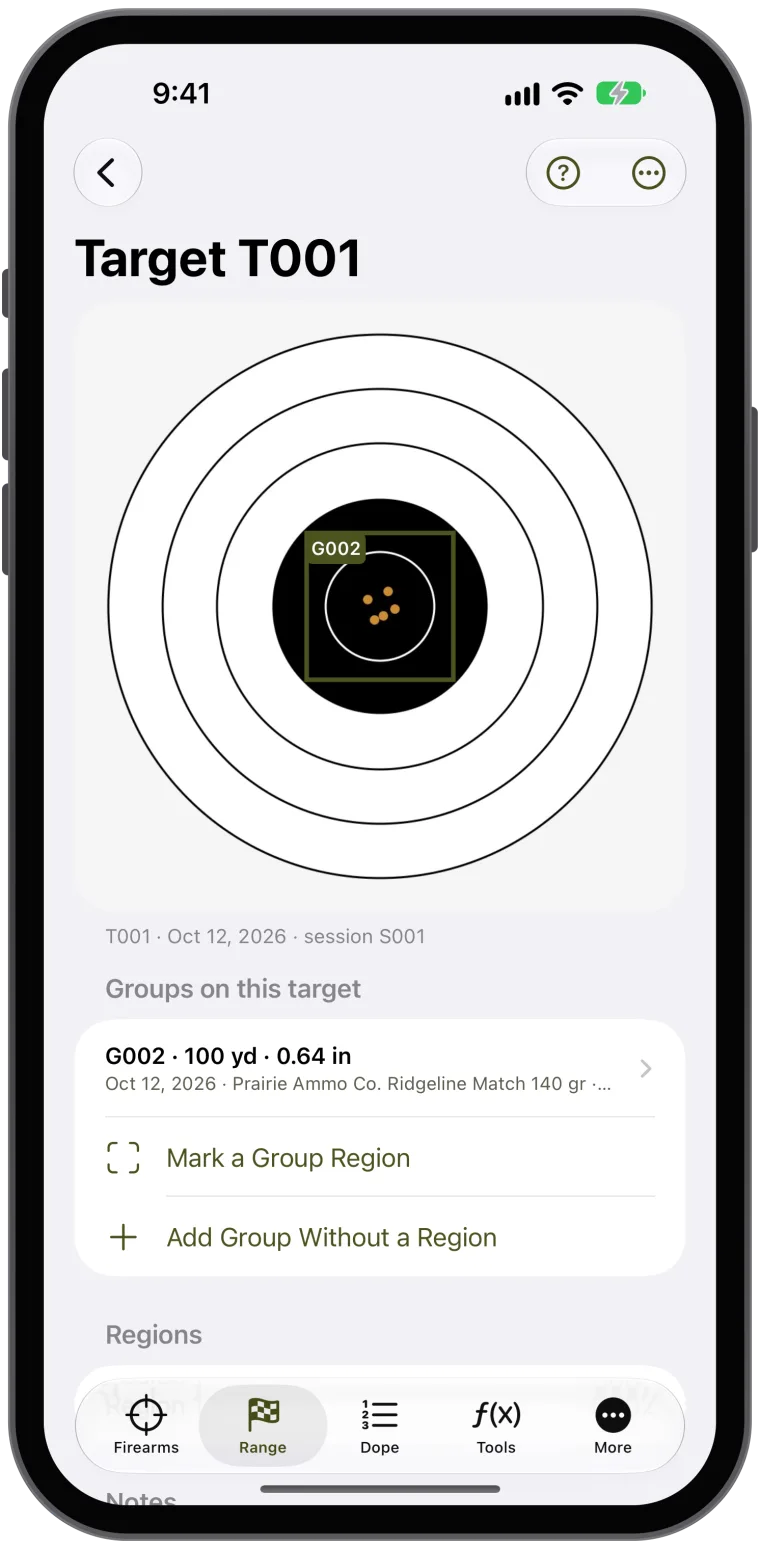
Gun Diary is an iPhone and iPad logbook for people who shoot factory ammunition, and the group is one of its core records. Each group you record in the app keeps the firearm, date, ammunition and lot, distance, size with its unit and how you measured it, the shot count, where it landed against your aim, chronograph readings, weather, notes and photos. Recording groups is free and unlimited, works with no signal, and a group can wait as a draft until you measure at home. Several groups can sit on one target photo, each in its own record, as the targets and groups feature shows.
Measuring a group from its photo
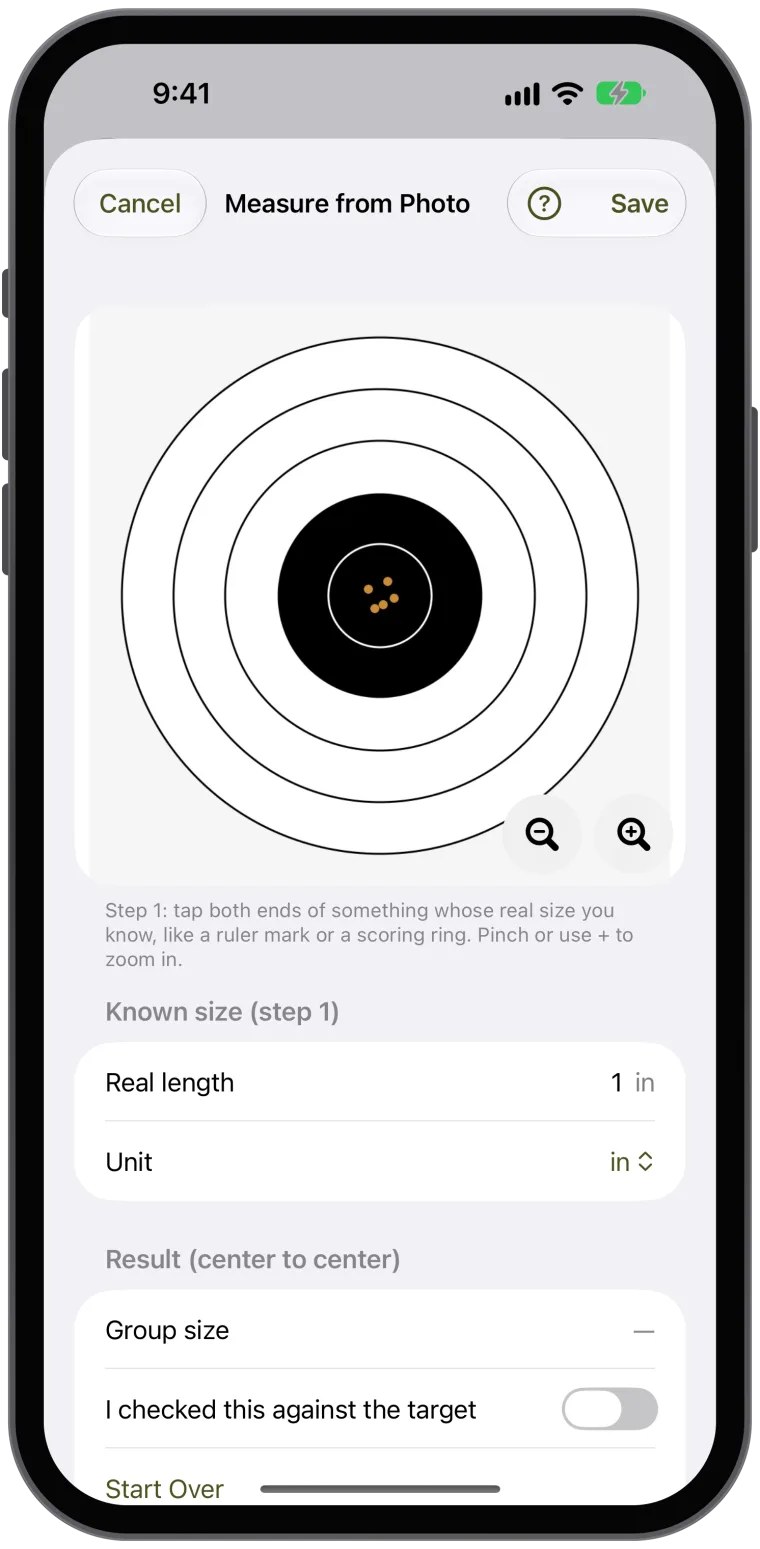
With Gun Diary Pro, Measure from Photo turns a target picture into a measurement. Tap both ends of something of known size, like a ruler mark or a grid square, then the centers of the two shots farthest apart, and it works out the center-to-center size. A size from a photo is kept apart from one you typed and stays marked unverified until you turn on I checked this against the target. The steps are in the help article on measuring a group from a photo. The screens shown come from the app's demo diary, with made-up numbers.
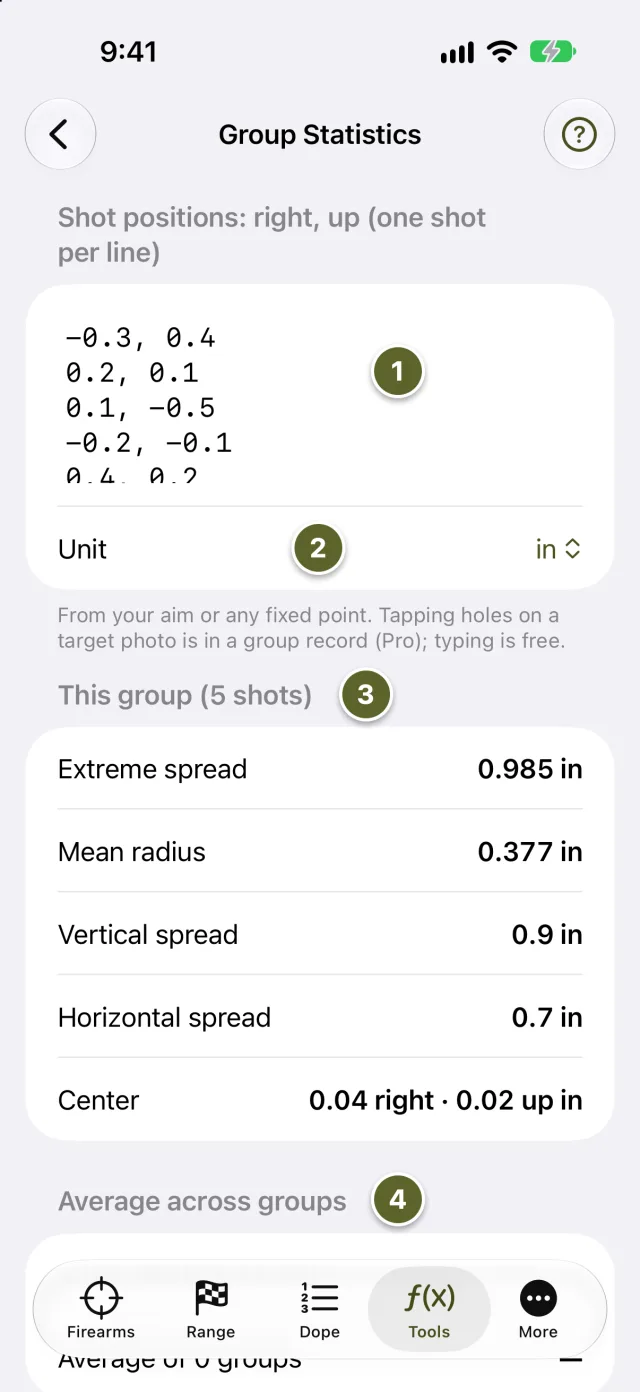
For mean radius, a group's Shot statistics section takes each hole's position, typed for free or tapped on the photo with Pro, and gives extreme spread, mean radius and the vertical and horizontal spread. The free Group Statistics calculator does the same arithmetic without saving anything. Hit Chance from Your Groups goes a step further, using your mean radius to work out a best-case share of shots inside a round target of a size you type. It rests on an assumption, so its result says: Est. = estimated, not proven. Confirm at the range. The page about estimates explains it. Your records stay on your device and in your own iCloud, with no account.
The bottom line
So, what makes a shot group worth keeping?
Several shots at one aim point, measured center to center for the familiar size and by mean radius for the steadier one, with the count, distance and method written beside the number. As for what counts as a good group, no single number fits every firearm, distance and shooter; the comparison that tells you something is with your own earlier groups, shot and measured the same way. Write those details down with every shot group, keep the paper or a photo, and the record will still answer your questions years from now.
Gun Diary keeps the records you enter. It never predicts bullet drop, wind or a trajectory; your dope is what you proved on paper. Always follow safe firearm handling.
Which ammo does your rifle like?
Ammo Comparison puts every factory ammunition and lot side by side from your own groups: average size, mean radius, velocity and SD. Free for one firearm.
See ammo comparisonComing soon to the App Store