
Is a gun collection covered by a homeowner's policy?
Usually, firearms count as personal property under a homeowner's or renter's policy, the same as furniture or tools. The catch is in the fine print. Many policies set special, lower limits for certain kinds of valuables, and firearms are often one of them, most commonly for theft. Damage from a fire may be handled one way and a burglary another. Policies differ a great deal, so the only reliable answer is in yours: look for a section called something like "special limits of liability" and read what it says about firearms.
Say your policy renews and you finally read that section. You find a theft limit for firearms that's well under what your guns would cost to replace. That's the moment most owners start asking about gun collection insurance, and it's the right question to take to your agent. Ask what the limit is for theft and for other losses, whether it applies per gun or to all of them together, and what they'd need from you to raise it. Write the answers down with the date.
Why collectors look at a rider or separate gun collection insurance
When the built-in limit is too low, there are usually two routes. One is a rider or floater added to the existing policy, where each gun is listed, or scheduled, with its own value. The other is a separate policy written just for a collection. The Triple-I, an insurance industry group, explains how special limits and scheduled valuables work for things like jewelry, and the idea is the same for many collections: list the item, agree on its value, and it's covered beyond the general limit.
Which route fits you, and what it costs, is a question for your agent, not for us. What both routes have in common is paperwork. Scheduling a gun usually means describing it, giving its serial number and backing up its value, sometimes with an appraisal. A separate collection policy asks for much the same, often as a full list. So whatever you decide about gun collection insurance, the work starts at home, with a record of every firearm you own.
The records that prove what you own
An insurer settling a claim, whether under a homeowner's policy or separate gun collection insurance, wants to know what you had, that it was yours and what it was worth. The same details help the police if a gun is ever stolen. None of them are hard to keep, but most are hard to find after the fact, when the receipts are in a drawer that's no longer there. Here's what a good record holds for each gun.
Six records for every gun in the collection
An inventory line
Maker, model, kind, cartridge or gauge and finish, as stamped on the gun.
The serial number
Copied from the gun itself, character by character, never from memory.
Photos
The whole gun from both sides, the serial number, and any engraving, repairs or marks that set it apart.
Receipts
A photo or scan of the bill of sale, with the date, price and seller.
Appraisals and values
An appraisal letter for anything valuable, and the insured value, updated when it changes.
Copies kept somewhere else
At least one copy of all of it away from the guns.
If you're starting from nothing, our guide on making a gun inventory sheet walks through each detail, and the one on a firearm inventory spreadsheet covers keeping the list in columns. Start with serial numbers and photos, since nobody can look them up for you later. Values and receipts can come a gun at a time.
Gun collection photos that actually help
A photo of the safe with the door open shows that guns were there, but not which ones. Good gun collection photos are taken one gun at a time, on a plain background, in good light: the left side, the right side, a close-up of the serial number that you can read on screen, and close-ups of anything unusual. Add a photo of each receipt and appraisal while you're at it. Then check that the files are named or filed so you can tell which gun is which a year from now.
If the worst happens, the report is one tap away.
Keeping a home gun collection's records off-site
The records that prove a loss shouldn't be lost with it. A list kept in the same safe as a home gun collection can go in the same fire or the same burglary. Keep one copy at home where you'll update it and another somewhere else: a cloud folder, a safe-deposit box, or a family member you trust. Serial numbers are sensitive, so be thoughtful about who gets a copy. Our guide to the records to have ready if a gun is stolen covers what the police and your insurer ask for after a theft.
Keeping the records in Gun Diary
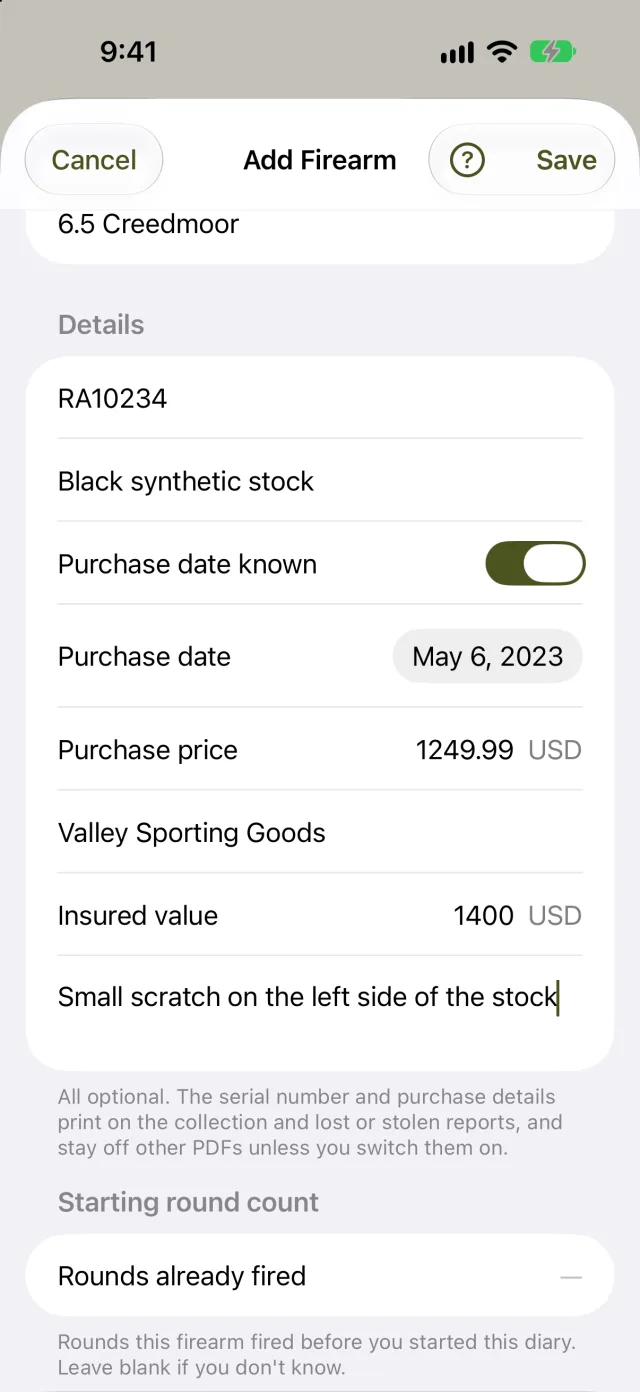
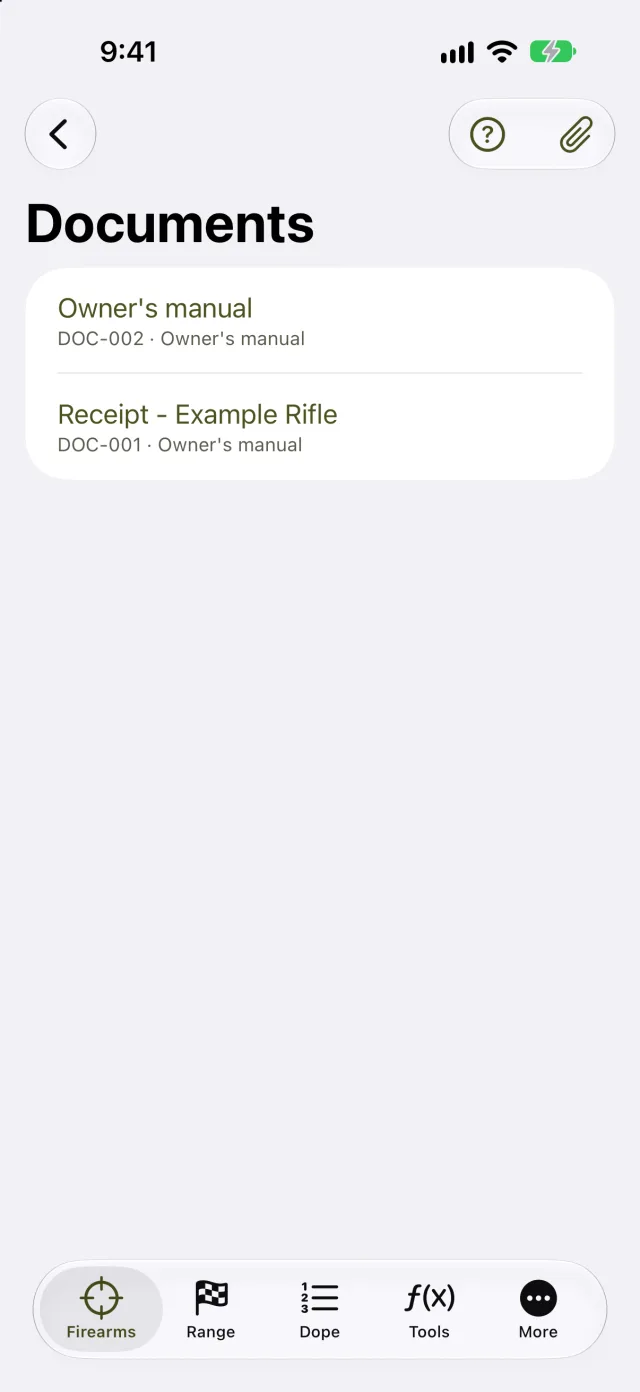
Gun Diary is one easy way to keep all six records together on an iPhone or iPad. Each firearm holds its serial number, finish, purchase date and price, seller, insured value, distinguishing marks and a photo, and the help article on adding a firearm with its details shows each field. Receipts and appraisals attach to the gun as firearm documents. The screens here show the app's demo diary, with made-up firearms and makers.
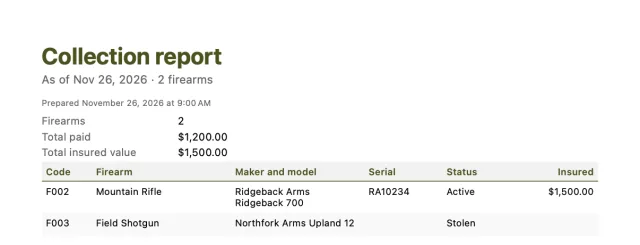
When the agent asks for a list for your gun collection insurance, the collection and reports page shows the collection report: totals for what you paid and what each gun is insured for, a table of every firearm, then a page section per gun with its photo, details and the documents on file. It's part of Gun Diary Pro, as a PDF and a spreadsheet; on the free version the same details come out in Export All Data. The lost or stolen report, one page per gun, is free. Your records stay on your own devices and in your own iCloud, with no account and nothing sent to us.
The bottom line
So, what does gun collection insurance need from you?
First, a careful read of your own policy and a conversation with your agent about firearm limits, riders and separate policies; that decision is theirs and yours. Second, and whatever you choose, records: an inventory, serial numbers, photos, receipts, appraisals and current values, with copies kept away from the guns. Gun collection insurance only pays well when you can show what you had. Update the records after every purchase or sale, and once a year when the policy renews.
Gun Diary keeps the records you enter. It never predicts bullet drop, wind or a trajectory; your dope is what you proved on paper. Always follow safe firearm handling.
Worried about losing years of records?
No account and no server: your diary lives in your own iCloud, and Export All Data gives you every record and photo, free, any time.
See your dataComing soon to the App Store