
What a shot timer records
A shot timer starts a run with a signal, usually a beep, and then notes the moment of every shot it picks up. From those moments it works out the draw, the seconds from the start signal to your first shot, and the splits, the gap between each shot and the next. Add the draw to every split and you get the run's total time. Most timers also let you set a par time, the time you're trying to beat. The app screens in this guide are from Gun Diary's demo diary, so the firearm and times on them are made up.
How does a shot timer work on a drill?
Picture a simple drill: six shots on one target from the start signal. The timer beeps, you shoot, and it records six moments. When you look at its review screen afterward, the first number is the draw, and the next five are the splits, one for each shot after the first. The timer doesn't know about points, misses or penalties; it only knows time. That's why a run on paper always needs two halves: what the timer saw, and what the target shows.
The four numbers worth writing down
Draw (first shot)
Seconds from the start signal to the first shot.
Splits
Seconds between each later shot and the one before it, in order.
Total time
The draw plus every split, the run's whole time.
Par time
The time to beat, so the run is either under par or over par.
Reading splits without fooling yourself
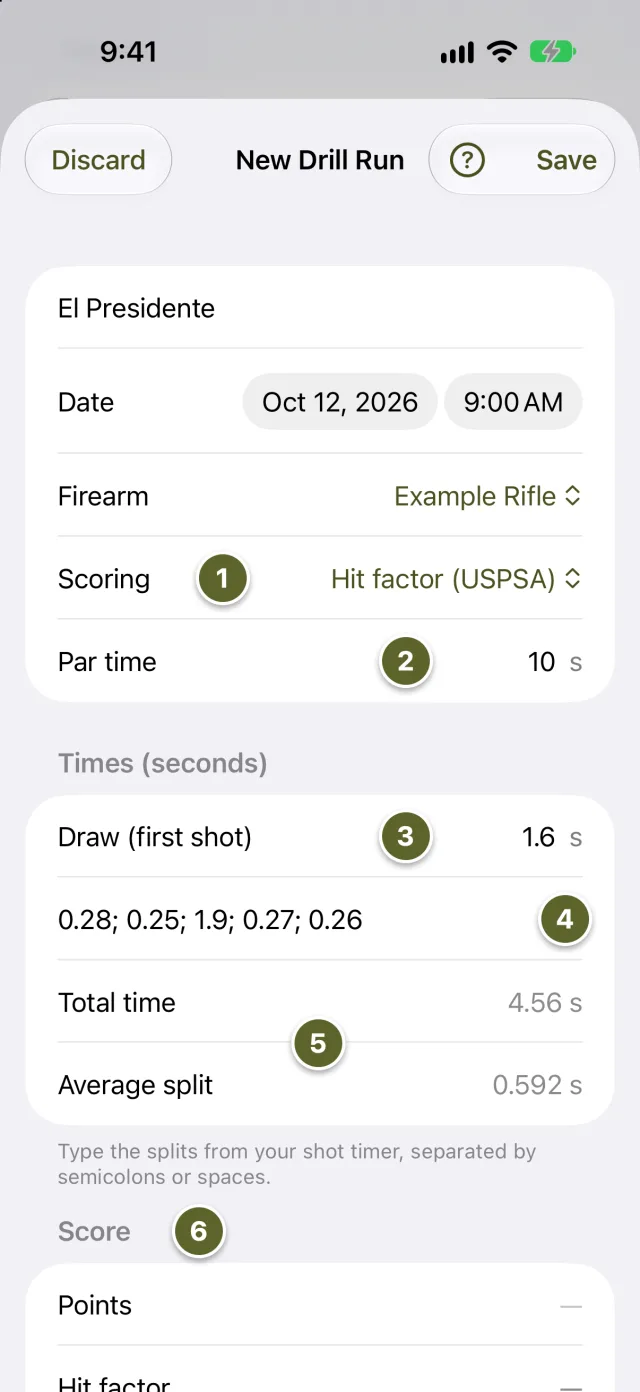
The common mistake is treating a split as the time since the start. It isn't: each split is only the gap between two shots, so a run of 0.25 second splits is a steady run, not a run that ended a quarter second in. The other mistake is folding the draw into the splits. The draw is its own number, and the average split leaves it out, so mixing them makes the average look slower than it was. Copy the splits from the review screen in the order the timer shows them, and keep the draw on its own line.
Then look at the splits as a set, not just the total. Take the run in the screenshot, an El Presidente with a 1.6 second draw and splits of 0.28, 0.25, 1.9, 0.27 and 0.26. The total is 4.56 seconds and the average split is 0.592 seconds, but four of the splits sit under 0.3 seconds. The 1.9 stands out on its own, which usually means a reload or a transition between targets, and that's the part of the run the numbers point to.
Works with no signal at the range.
Adding points, hits and penalties
Ask "how does a shot timer work?" and the honest answer covers only half a score, because time is all it measures. In USPSA style, the points are divided by the total time to give a hit factor, and a higher number is better. IDPA's time plus works the other way, adding a second for every point down plus any penalty seconds, and a lower final time wins. Plenty of practice is just time and hits, especially on steel. Whatever you use, write the hits out of the shots fired honestly, because a fast run with misses isn't a better run. Our guides to hit factor and IDPA's time plus scoring work through both with examples.
Keeping drill times and splits for a season
A timer shows the last run and then moves on, which is fine for the next run and no help in three months. Gun Diary keeps each one as a drill run inside a session: the drill name, the date and firearm, how it's scored (time only, USPSA hit factor, IDPA time plus, or points and time), the par time, the draw and splits, and the hits of the shots fired. The total time and average split appear as you type, and the run shows under par or over par. The help article on recording drill runs has the steps.
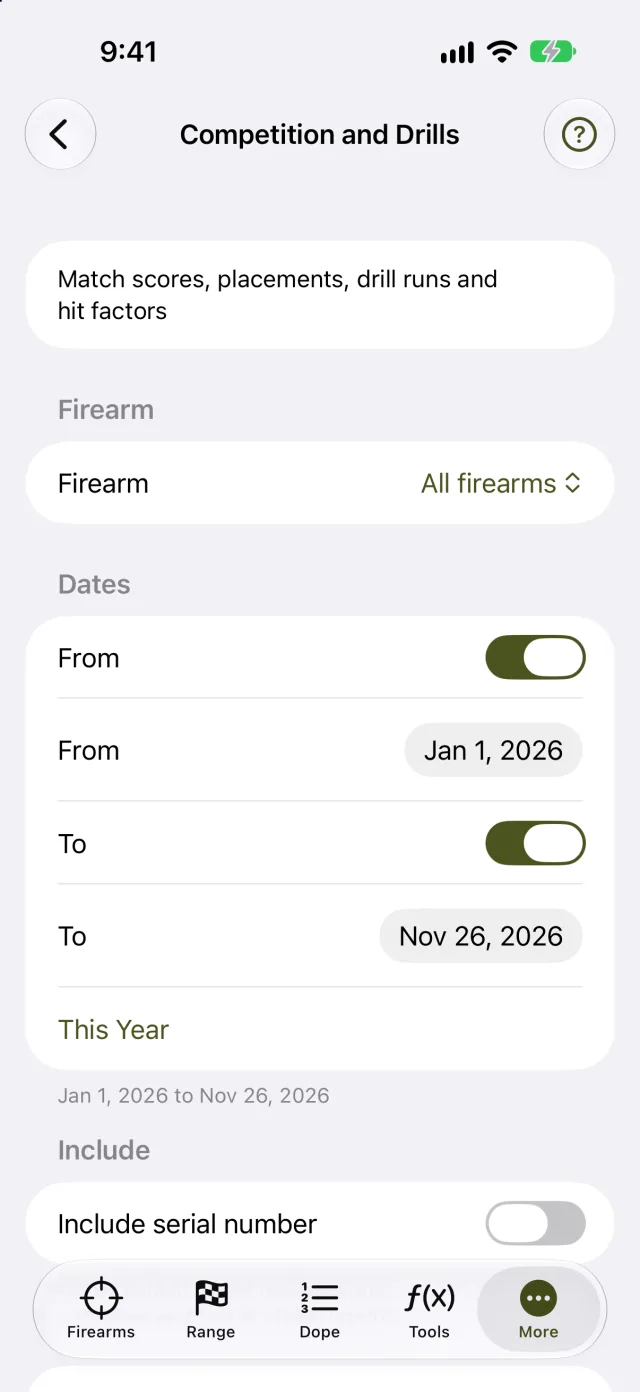
Use the same drill name every time, so a Bill Drill in March lines up with the one in October. A button named for the drill opens the next run with the same name, firearm, scoring and par, so you only type the new times. Drill runs don't add rounds to a firearm's counters; the session's rounds fired does that once. At the end of the season, the competition and drills report lists every match and run, and its spreadsheet is free for charting your times. The patterning, matches and drills page shows the rest. Your records stay on your iPhone or iPad and in your own iCloud, with no account and nothing sent to us.
The bottom line
So, how does a shot timer work for you?
It gives a start signal, notes the time of each shot it picks up, and hands you a draw, a set of splits and a total, measured against a par time if you set one. Read the splits as gaps between shots, keep the draw separate, and look for the one split that stands apart from the rest. Then add what the timer can't see: points, hits and penalties. A timer remembers one run at a time; a record of every run, under the same drill names, is what shows whether a season of practice moved your times.
Gun Diary keeps the records you enter. It never predicts bullet drop, wind or a trajectory; your dope is what you proved on paper. Always follow safe firearm handling.
27 calculators that start from your own numbers
Clicks, mil and MOA, mil-ranging, holdover from your dope, re-zero shift, hit factor, pattern % and more; anything estimated says est.
See the calculatorsComing soon to the App Store