
How IDPA scoring works
IDPA, the International Defensive Pistol Association, scores a stage by time plus. Your raw time is what the timer recorded. Every point down, the points lost for hits outside the best scoring zone, adds a second, and penalty seconds for procedural errors and the like are added on top. The result is your final time, and lower is better. The screens in this guide are from Gun Diary's demo diary, so the firearm and numbers on them are made up.
The time plus formula, step by step
The arithmetic is all addition, which makes IDPA scoring easy to check by hand. Start with the raw time: the draw, the seconds from the start signal to the first shot, plus every split after it. Then add the points down as seconds, then the penalty seconds exactly as they were given. The one rule worth checking now and then is the value of a point down; the app uses one second each, the current rule, and IDPA publishes its rulebook on its official documents page.
What adds up to a final time
Raw time
The draw plus every split, as the timer recorded the run.
Points down
One second for each point lost on the targets.
Penalties
Penalty seconds, added just as they appear on the scoresheet.
Final time
The total of all three. The lowest final time wins.
Here's a worked example from the app's help. The raw time is 4.8 seconds, the targets show 3 points down, and there are 3 penalty seconds. That's 4.8 plus 3 plus 3, for a final time of 10.8 seconds. Notice that more than half of that number never came from the timer at all. A run that looked quick on the review screen can end up slow on the results, and the record should show you which part did it.
IDPA vs USPSA: one run, scored two ways
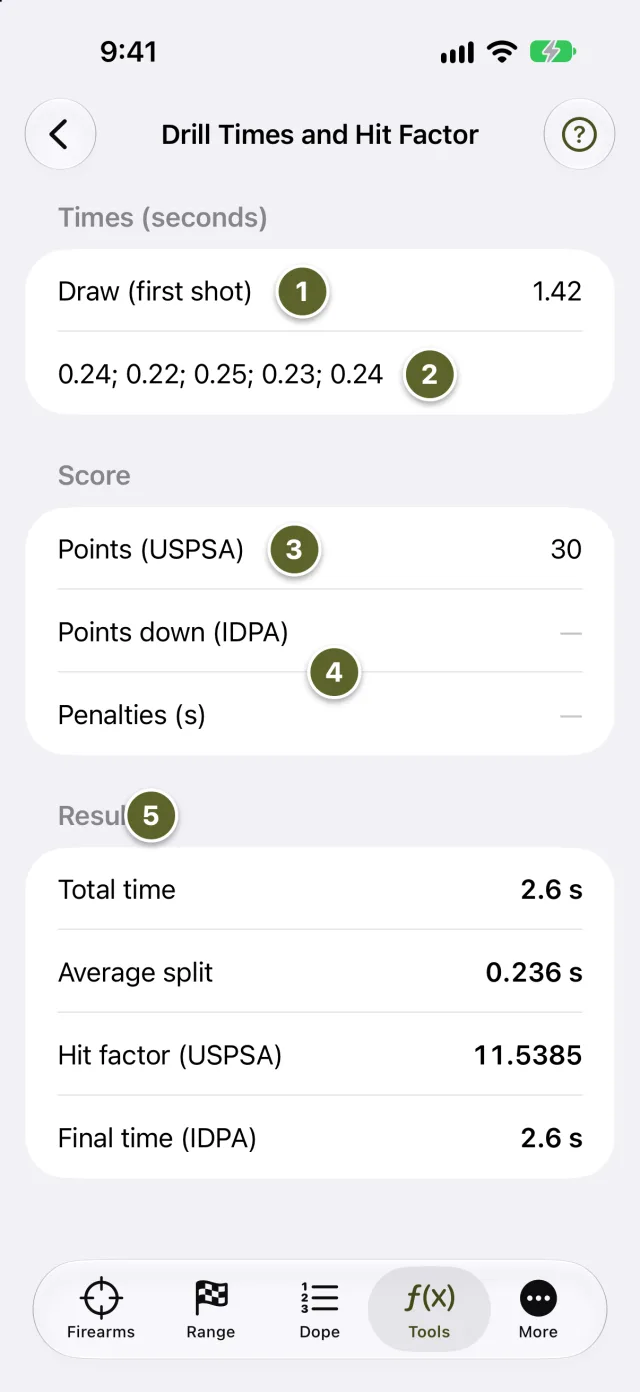
The two sports score the same shots differently. USPSA divides the points earned by the time, giving a hit factor where a higher number wins. IDPA scoring adds accuracy to the time instead, and the lower number wins. Take one run with a 1.42 second draw and five splits for a 2.6 second raw time. Scored USPSA style with 30 points, it's a hit factor of 11.5385. Scored IDPA style with 3 points down, its final time is 5.6 seconds. Our guide to USPSA's hit factor covers that side in detail, and the one on USPSA target sizes measures the zones it scores.
Why keep them apart? Because the final time hides where it came from. Two runs can both finish at 9 seconds, one with a slow draw and clean hits and one with a fast draw and four points down, and only the separate numbers tell you which one you shot. Kept apart, they also show a trend over a season: whether your raw times are dropping, or whether your points down are climbing as you push for speed.
Every firearm, every range day, every distance you've proven. One firearm free.
Mistakes that make a time plus score wrong
Most wrong scores come from the paperwork rather than the shooting. The arithmetic is simple enough that an error usually means one of the numbers went into the wrong place, and it's worth a quick check before a run goes into your records for good. Checking IDPA scoring on paper takes a few seconds, and these three mix-ups cover most of what goes wrong.
Three common mix-ups
The draw counted as a split
Each split is the gap between two shots; the draw is its own number, and adding it twice makes the raw time too long.
Points down left off
A raw time on its own isn't a final time. Write the points down even when they're zero.
Penalty seconds typed as points
Penalties are already seconds, so they're added as they are, not converted.
Keeping your IDPA scoring in one place
Gun Diary's calculators for shooters include Drill Times and Hit Factor, under Competition on the Tools tab. Type the draw, the splits, the points down and any penalties, and it shows the raw total and the IDPA final time as you type. It's plain arithmetic with nothing estimated, and it saves nothing, so the drill times calculator help points you to drill runs for the runs you want to keep.
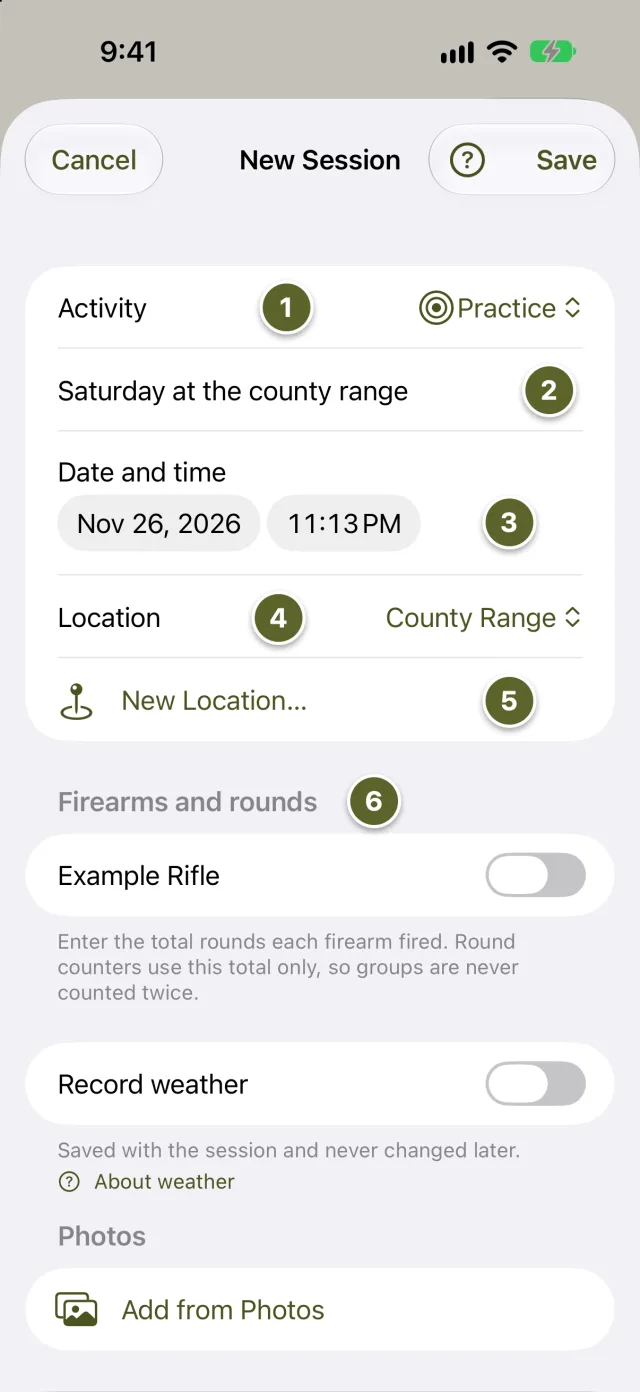
To keep a match, log it as a session with the activity set to Competition and type the score and placement as your results show them. Each stage or practice drill goes in as a drill run with Time plus (IDPA) scoring: the name, firearm and par time, the draw and splits from your timer, then the points down and penalties, and the final time appears. The help article on logging match results and drill runs has the steps. Your records stay on your iPhone or iPad and in your own iCloud, with no account and nothing sent to us.
The bottom line
So, how does IDPA scoring work?
It's time plus: the raw time from the timer, one second for each point down, and any penalty seconds, added up into a final time where lower wins. Accuracy shows up as seconds rather than points, which is the real difference from USPSA's hit factor. Keep the three parts separate in your records and the final time stops being a mystery, because you can see what each run cost you and where. For the rules behind the numbers, IDPA's own rulebook is the place to check.
Gun Diary keeps the records you enter. It never predicts bullet drop, wind or a trajectory; your dope is what you proved on paper. Always follow safe firearm handling.
Pro, once
Unlimited firearms, every dope card size, Range Mode and PDF reports: $69.99 once, never renews.
See pricingComing soon to the App Store