
What is a cold bore shot?
A cold bore shot is the first shot from a cold barrel, often a clean one, before any other round has warmed it or left fouling behind. Shooters also call it the first round hit, or CBS for short. It gets its own name because for a hunter it's often the most important shot of the trip: the rifle has ridden in the truck all morning, nothing has been fired, and the first shot may be the only one. A long-range shooter who has to make a first-round hit on a match stage cares about it for the same reason.
Why the first shot can land somewhere else
A barrel that hasn't been fired yet that day isn't in the same state as one that has fired three or four rounds. For some rifles that makes no visible difference, and the first shot lands right with the group. For others, the first shot lands a little apart from the shots that follow, and often in roughly the same place each time. You can't tell which kind of rifle you have from one range trip, and you can't tell from someone else's rifle either. The only way to know about yours is to record where its first shot goes across many cold starts.
That's where most records fall short. The first shot goes onto the same paper as the next four, the group gets measured, and the first shot disappears into an average. A month later, nobody remembers which hole came first. The fix is simple: mark it, measure it on its own, and keep it with the date and the conditions. Over a season, a handful of marked first shots says more about your rifle than any single group can.
Should you log your cold bore shot?
If you hunt, or if your shooting ever depends on one first shot for record, yes. The record costs a few seconds per trip, and what you get back is a real picture of where your rifle puts that shot instead of a guess. Even if you only shoot at the bench, a marked first shot keeps your groups honest, since you'll know whether a wide group was the rifle or just the cold first round. What you do with the pattern is your own call; the record's job is only to make it visible.
Range Mode for one hand.
Worth writing down with every first shot
Where it hit
Up or down and right or left of your aim, with the unit: inches, MOA or mil.
Distance
Usually your zero distance, written down even when it never changes.
Ammunition and lot
What was in the rifle, down to the lot number on the box.
The setup
Which scope and mount the rifle had that day.
Anything unusual
A rifle that just travelled, was just cleaned, or sat in the cold all night.
How Gun Diary keeps the first shot apart
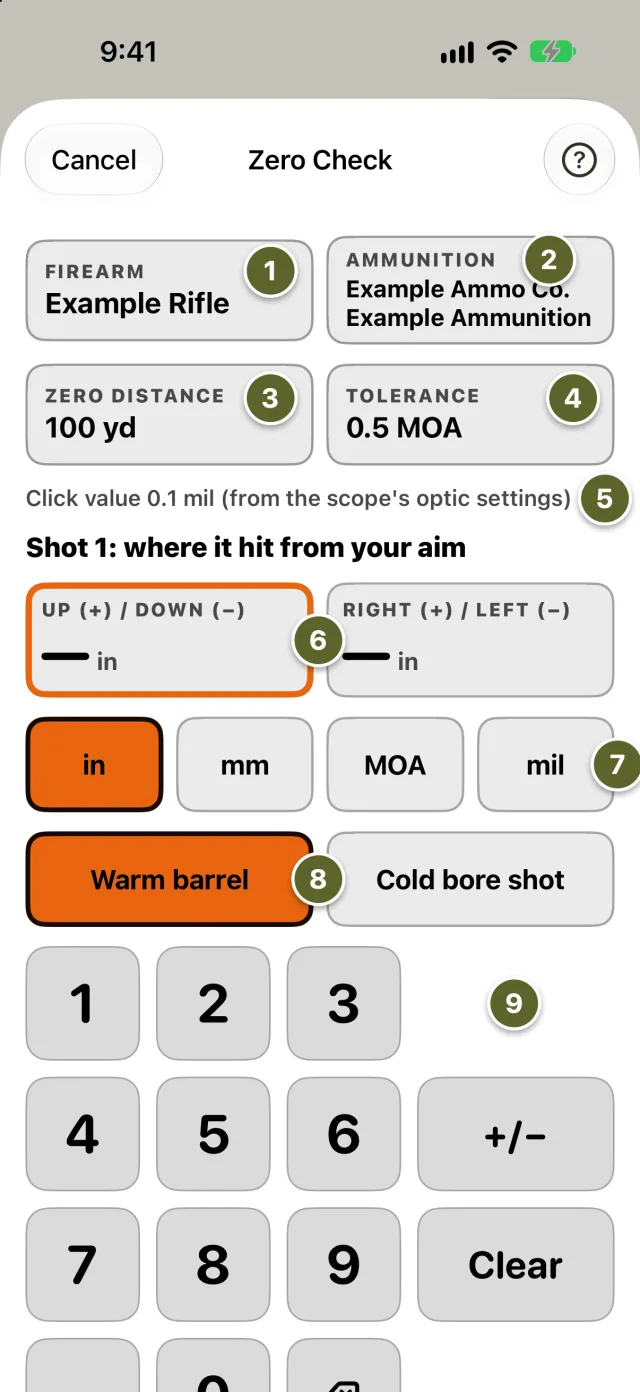
In Gun Diary, the first shot has a switch of its own. Before the first shot of a Zero Check before the hunt, you pick Cold bore shot instead of Warm barrel, and that first shot is marked. The result card shows that shot on its own, next to the group's center, which still averages every shot so nothing is hidden. The saved zero record lists each shot with "(cold bore)" beside the first. Zero Check is free; tapping the shots on a target photo instead of typing them is part of Pro.
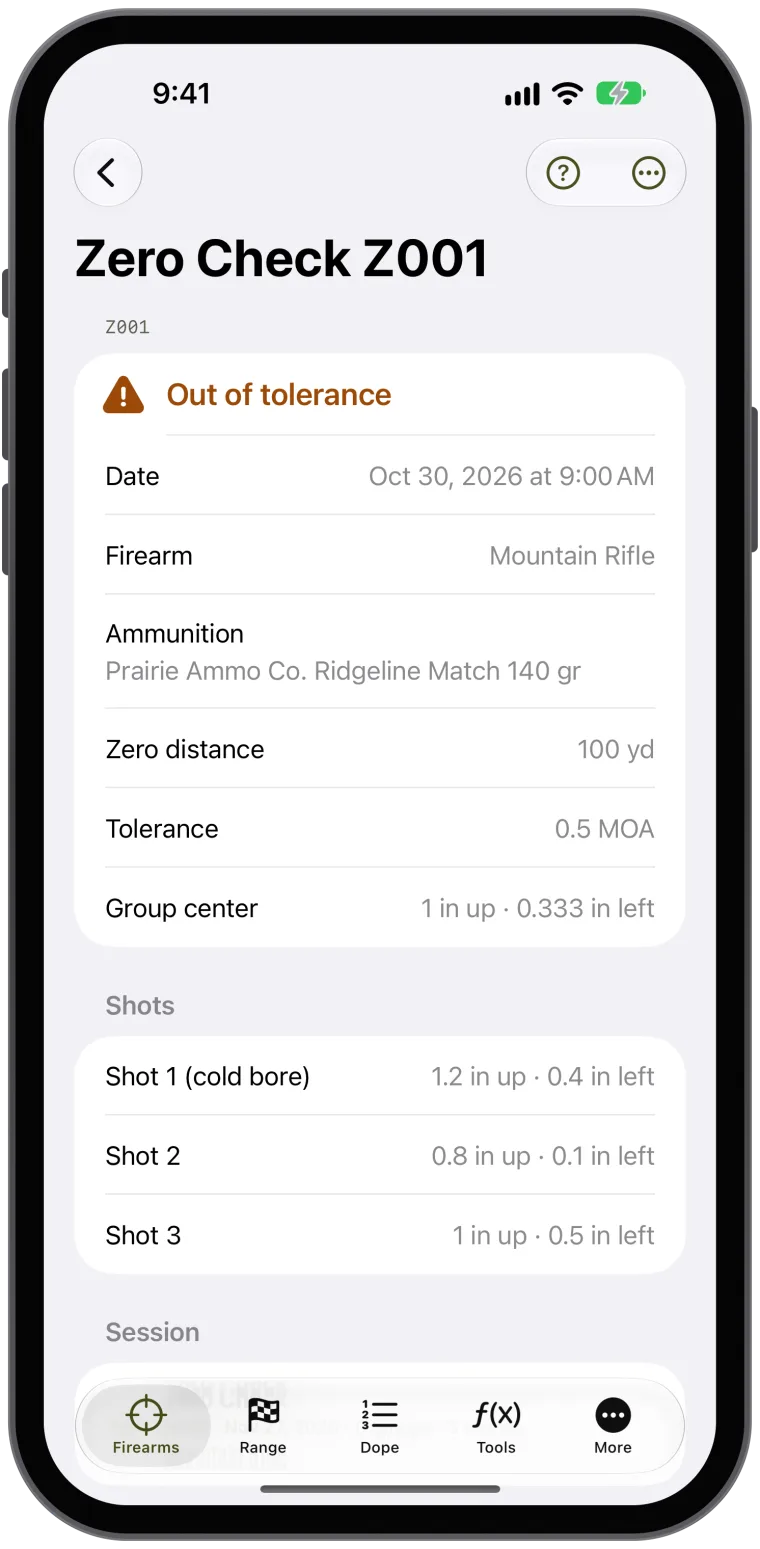
Here's how it looks with the app's demo diary, whose rifle and numbers are made up. The Mountain Rifle's check before deer season starts with a cold bore shot typed as 1 inch up and 0.4 inches right at 100 yards, then two warm shots, and the record keeps that first shot labelled for good. If you'd rather measure in the reticle's units, the shots can be typed in MOA or mil instead; a mil is 3.6 inches at 100 yards, as this explainer on the milliradian shows. During a range session in Range Mode, a one-tap Cold bore quick note does the same job for an ordinary group.
Reading your cold bore shot record over a season
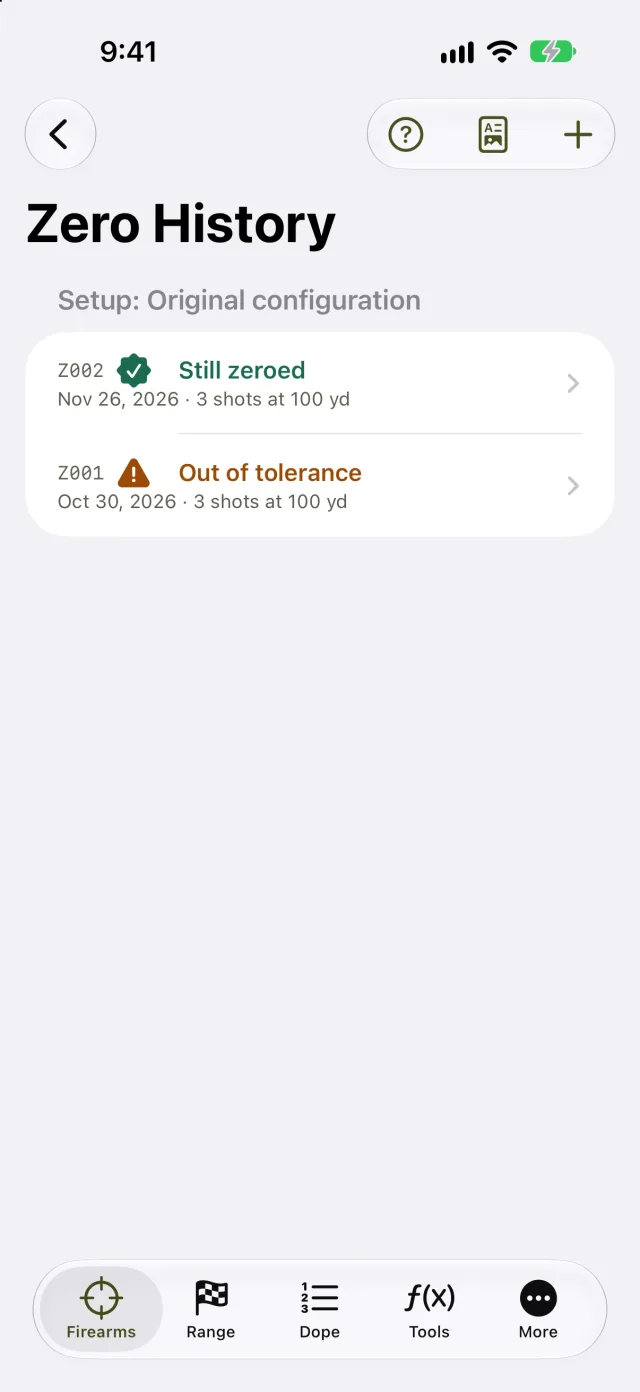
Each check lands in the firearm's zero history, newest first and grouped by the setup the rifle had on the day. That grouping matters for first shots: after a scope swap, the new first shots start their own list instead of mixing with the old scope's. Say you hunt elk and fly to camp. You check the rifle on arrival, mark the first shot cold bore, and next year you can look back at where it went after the last flight. Your records stay on your iPhone or iPad and in your own iCloud, with no account and nothing sent to us.
The bottom line
So, should you log every cold bore shot?
If the first shot ever matters to you, log it, and log it apart from the group. Mark it before you fire, write down where it hit with its unit and distance, and keep the ammunition lot and the setup with it. One first shot won't tell you much; a season of them will tell you whether your rifle's first round goes with the rest or somewhere of its own. That's an answer you can only get from your own records, and the earlier you start keeping them, the sooner you'll have it.
Gun Diary keeps the records you enter. It never predicts bullet drop, wind or a trajectory; your dope is what you proved on paper. Always follow safe firearm handling.
One firearm free, forever
Every diary unlimited, all 27 calculators, the pocket dope card and free export. Add Pro when you add a firearm.
See pricingComing soon to the App Store