
What group size measures, and what it leaves out
Group size, also called extreme spread, is the distance between the two shots farthest apart, usually measured center to center. Many shooters measure edge to edge across the outside of those two holes with calipers and subtract one bullet diameter to get the center-to-center figure. It's fast, it's familiar, and it's the number people quote when they talk about a group. The catch is that it only looks at two holes. Every other shot in the group could sit anywhere inside that distance and the number wouldn't change at all.
Picture two five-shot groups that both measure one inch. In the first, four shots touch in one ragged hole and a single shot sits an inch away. In the second, all five are spread evenly across the same inch. On paper they look nothing alike, yet group size calls them identical. That's not a flaw in the measurement; it's simply what the number was built to describe. It answers one question well: how wide is the worst pair of shots?
What mean radius measures
Mean radius starts by finding the center of the group, the average position of all the shots. Then it measures how far each shot sits from that center and averages those distances. The center itself is just an average of positions, the same idea statisticians call a measure of location. Because every shot counts toward the result, mean radius describes the whole group, not just its edges. In the example above, the tight cluster with one stray hole has a smaller mean radius than the evenly spread group, which matches what your eye sees on the paper.
Mean radius vs group size, side by side
The clearest way to settle mean radius vs group size is to see what each one does with the same target. Neither is right or wrong, and serious shooters often keep both. They just answer different questions, and they react differently when a group has one shot that doesn't belong.
How the two numbers differ
Shots used
Group size uses the two shots farthest apart. Mean radius uses every shot in the group.
One stray shot
A single wide shot can change group size a lot. It moves mean radius much less, because it's only one shot in the average.
Effort to measure
Group size needs a ruler or calipers across two holes. Mean radius needs each shot's position, which is easier with a grid target or a photo.
What people quote
Group size is the familiar number. Mean radius is the steadier one when you compare a handful of groups.
Shot count matters for both. A three-shot group and a five-shot group can't be compared fairly on either number, and mean radius in particular settles down as more shots are added. Whatever you measure, write the shot count and distance right beside it, along with how you measured. That's what lets a group from this spring sit honestly next to one from last fall. Our shot group guide covers how many shots to fire and how to shoot a group you can measure.
How to get mean radius without the math
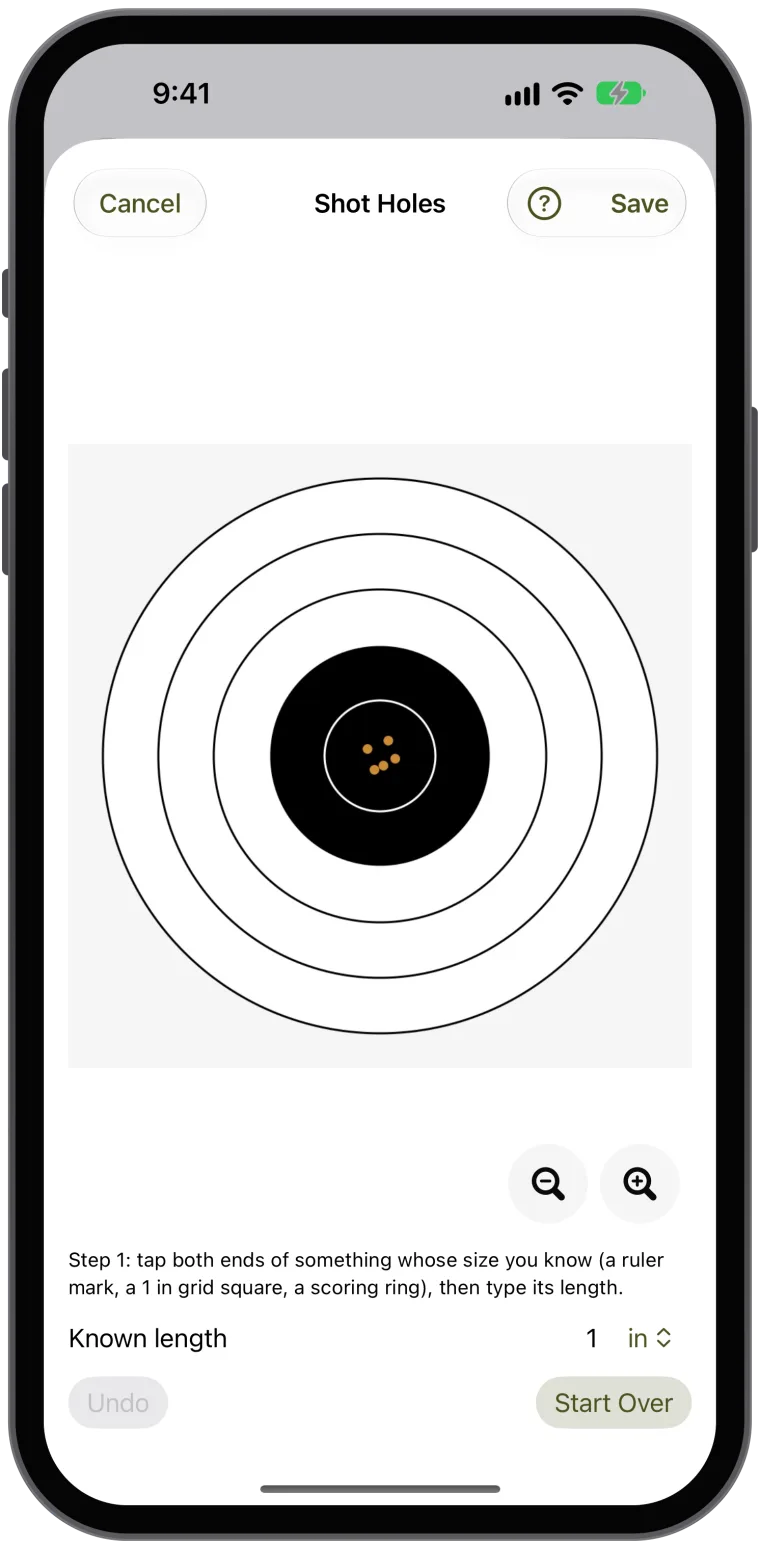
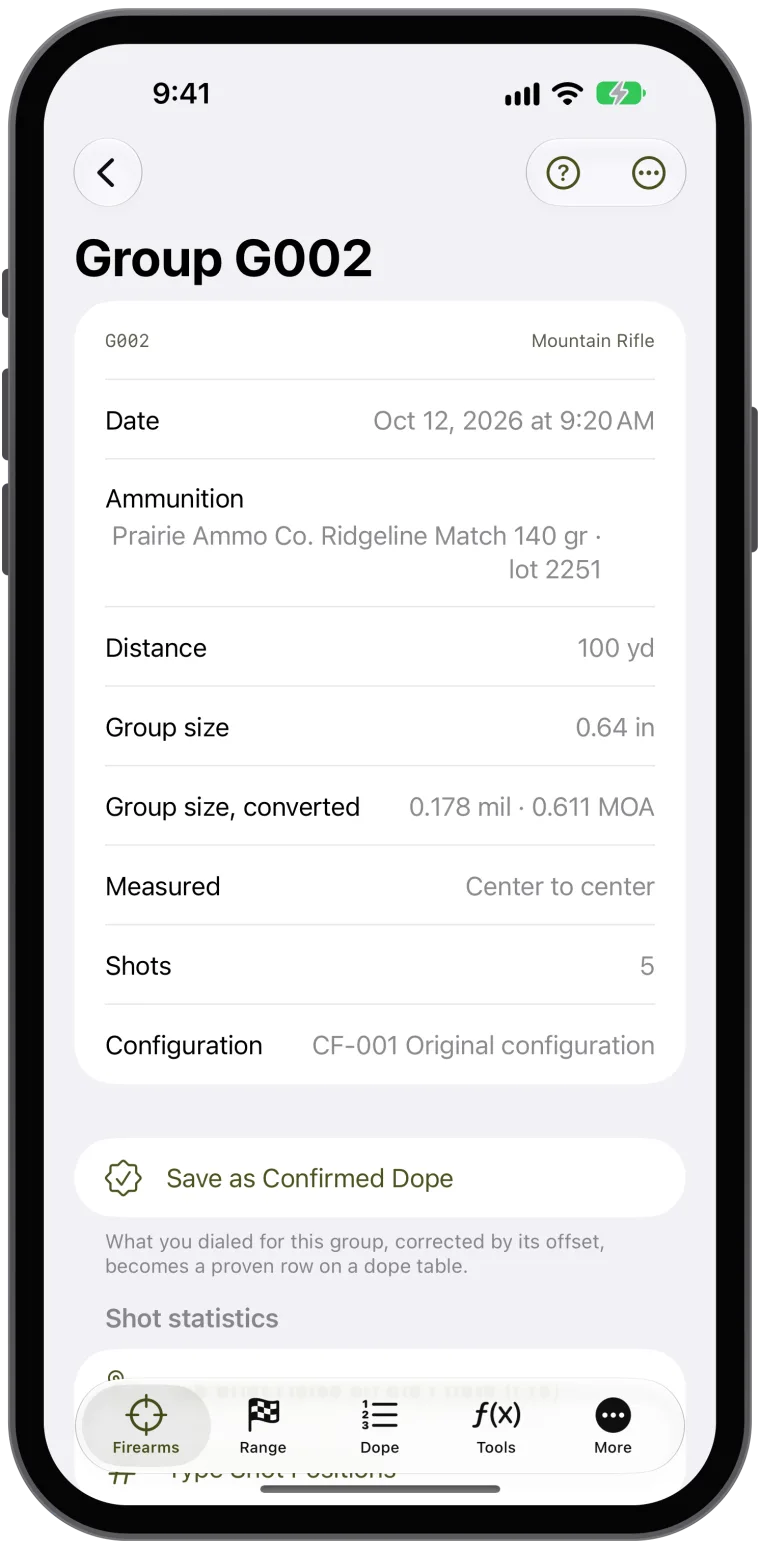
Working out mean radius by hand means measuring every shot's position and doing a page of arithmetic. In Gun Diary, a group record has a Shot statistics section that does it for you. The free way is to type each shot's position, how far right and up it sits from a fixed point such as the aiming dot or a grid corner. With Gun Diary Pro, you can instead tap each hole on the target photo after setting a scale. Either way you get extreme spread, mean radius, and the vertical and horizontal spread. The help article on shot holes and shot positions has the steps.
Here's the kit's own example from the app's demo diary. Five shots on a one-inch grid, typed in inches from the aiming point, give an extreme spread of 0.86 in and a mean radius of 0.361 in. Leave the switch on that uses the extreme spread as the group size, and the group's size becomes 0.86 in, center to center, with the four shot statistics saved beside it. A shot you know you pulled can be marked as a flyer when you tap holes, so it stays on the record without spoiling the numbers. If you only want the arithmetic without saving anything, the group statistics calculator on the Tools tab does the same math on shot positions you type.
Groups on target photos.
Using mean radius to compare factory ammunition
Mean radius earns its keep when you compare several groups, for example two or three kinds of factory ammunition shot on the same day. One lucky or unlucky group swings group size around, while mean radius stays steadier across a small number of groups. Each group you record in your diary keeps its ammunition and lot, so Ammo Comparison on the ammunition and comparison page can line up the averages side by side: groups, average size as MOA, mean radius, velocity and SD. It shows your own numbers; it doesn't rank or recommend anything. Your records stay on your iPhone or iPad and in your own iCloud, with no account and nothing sent to us.
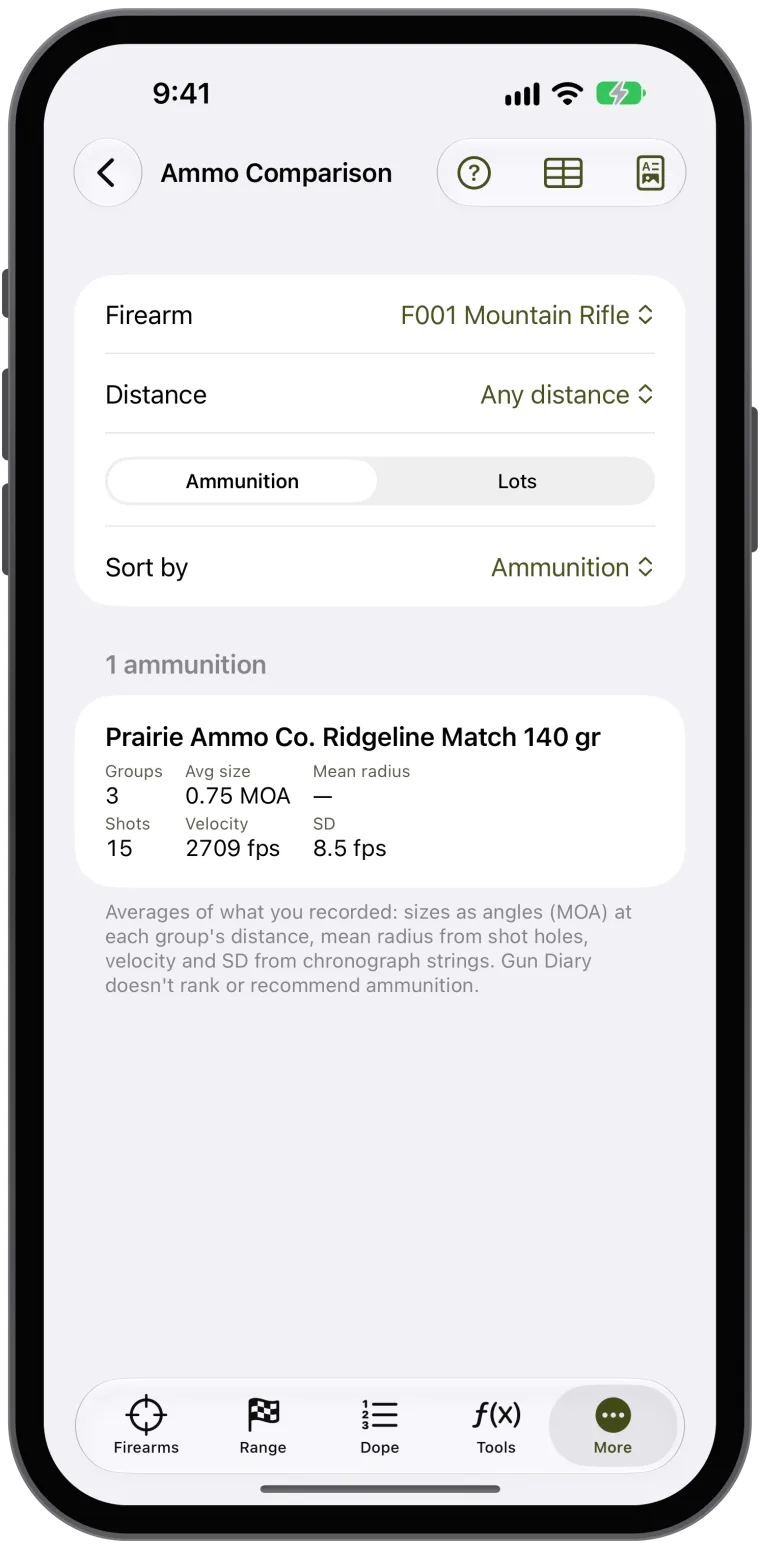
The screenshots here show the app's demo diary, with a made-up rifle and made-up ammunition, so the numbers are examples, not anyone's real results. What a set of groups says about your firearm and your ammunition is your call to make. The record's job is to make sure each number was measured the same way and carries its shot count, distance and method, so the comparison you're making is a fair one.
The bottom line
So, mean radius vs group size: which should you record?
Record both when you can. Group size is quick, familiar, and fine for a single group or a quick note at the bench. Mean radius uses every shot, so it's the better number when you're comparing groups, ammunition or lots over time. The real answer to mean radius vs group size is that the two work as a pair: one tells you the width of the worst pair of shots, the other tells you how tightly the whole group gathered. Keep the shot count, distance and method with each, and either number will still mean something a year from now.
Gun Diary keeps the records you enter. It never predicts bullet drop, wind or a trajectory; your dope is what you proved on paper. Always follow safe firearm handling.
27 calculators that start from your own numbers
Clicks, mil and MOA, mil-ranging, holdover from your dope, re-zero shift, hit factor, pattern % and more; anything estimated says est.
See the calculatorsComing soon to the App Store