
What patterning tells you that the choke's name can't
A choke is the narrowing at the end of the barrel, often a screw-in tube, that controls how wide the shot spreads. The name stamped on it, like Improved Cylinder or Modified, is the maker's intention. Patterning shows what actually happens: you fire one shell at a big sheet of paper from a set distance, draw a circle around the thickest part of the spread, and count the pellet holes inside it. The same tube can pattern quite differently with two kinds of shells, which is why the answer only comes from your own gun and your own paper. Our guide on what tightens a shotgun shot pattern goes through the choke, the shells and the distance one at a time.
The number that comes out of it is the pattern percentage: the pellets inside the circle as a share of all the pellets in the shell. If 287 of a shell's 410 pellets land inside the circle, that's 70%. It's plain arithmetic, nothing estimated, and it's the usual way shotgunners compare one choke and shell with another. A single sheet tells you a little; a few sheets per choke and shell, written down the same way each time, tell you a lot more.
How to pattern a shotgun, step by step
So, how do you pattern a shotgun the way most shooters do it? The common convention is a 30 inch circle at 40 yards, and that's what the steps below use. You'll want a stack of large paper sheets, a marker, something to draw a 30 inch circle with, and somewhere to hang them: a pattern board shotgun shooters can staple paper to, or any sturdy frame that holds a sheet flat. Write the date, the choke and the shells on each sheet before you start, because they all look alike once they're full of holes.
Six steps, start to finish
One choke, one shell
Test a single choke with a single kind of shell at a time, and write both on the sheet before you shoot.
Paper at 40 yards
Measure the distance from the muzzle to the sheet rather than guessing it.
One shell per fresh sheet
Fire one shot at an aiming mark, then hang a clean sheet and number the next one.
Draw the 30 inch circle
Center it on the densest part of the pattern, not on your aiming mark.
Count and divide
Count the holes inside the line, then divide by the pellets in one shell.
Repeat and average
Shoot at least three sheets per choke and shell, and compare the averages.
Count every hole that touches the inside of the line the same way each time, whichever rule you choose. For the pellets in one shell, you can cut a shell open and count, or work it out from the shot weight and size printed on the box. Note where the center of the pattern sat compared with your aiming mark, too. A shotgun that prints high or off to one side is worth knowing about, and that's easy to forget by the time you're home.
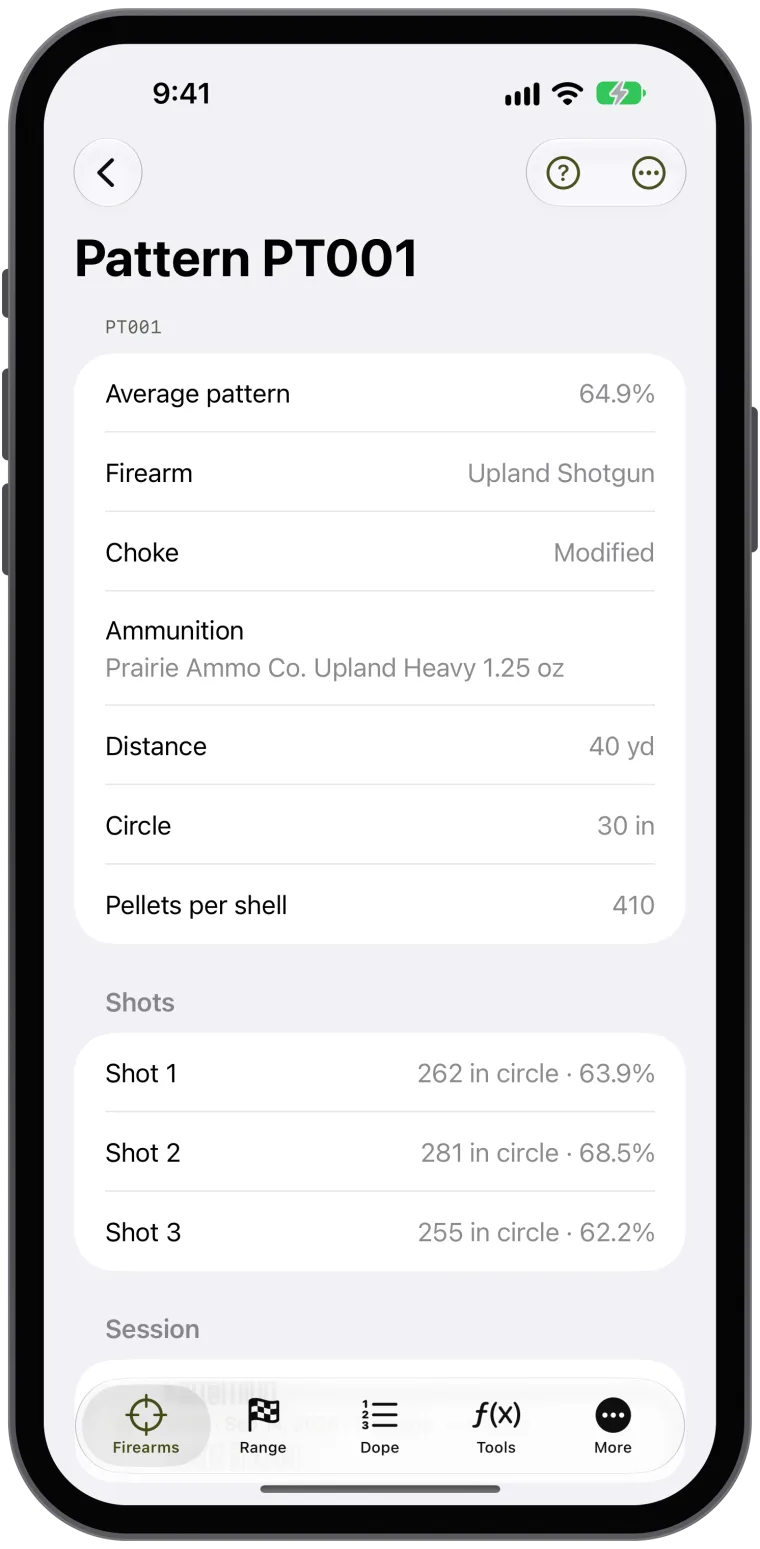
Recording a shotgun pattern test in Gun Diary
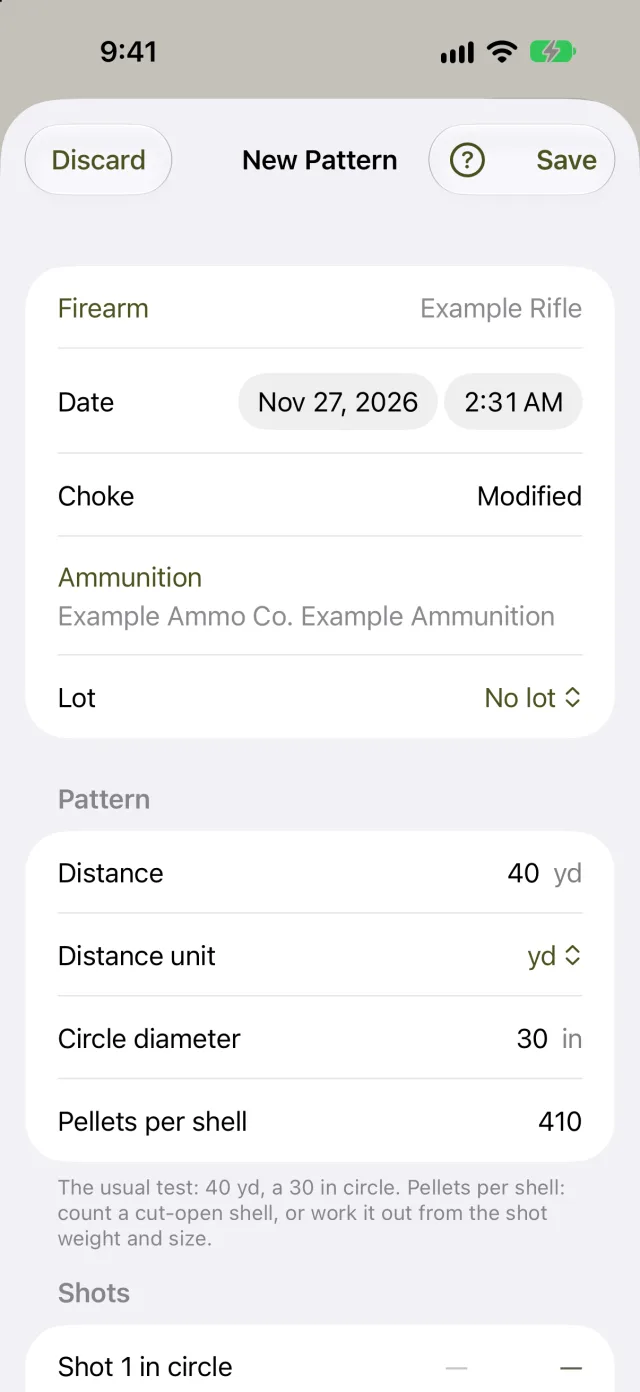
Gun Diary keeps each shotgun pattern test as its own record, with the choke, the shells and their lot, the distance, the circle, the pellets per shell and the count for every shot. It works out each shot's percentage and the average as you type, and keeps up to ten photos of the sheets with it. The shotgun patterning feature page shows the whole picture, and these screens are from the app's demo diary, with made-up firearms and makers. Pattern records are free, and they live on your iPhone or iPad and in your own iCloud, with no account and nothing sent to us.
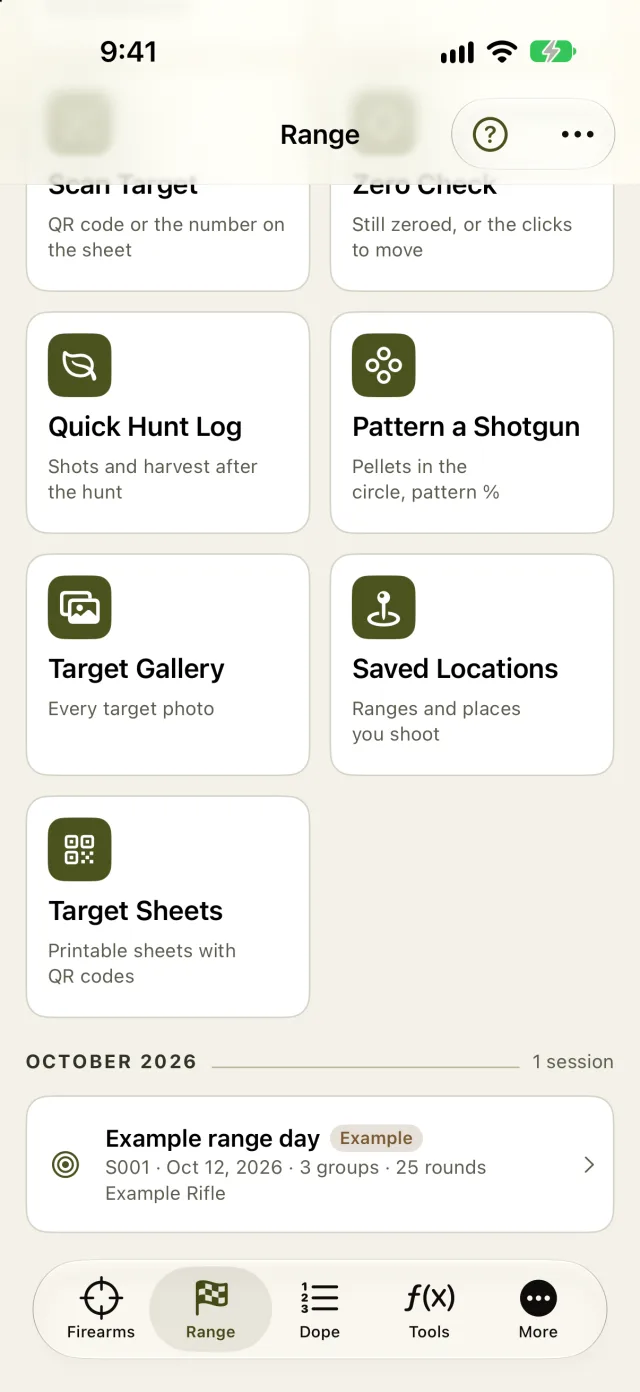
To start one, tap Pattern a Shotgun on the Range tab, pick the shotgun, and the form opens with 40 yd and a 30 in circle already filled in. Type the choke, pick the shells, enter the pellets per shell, then add a row for each sheet you counted. The help article on how to record a pattern in the app walks through every field. Each saved pattern gets a permanent number like PT004, and the app files it in a patterning session for that day.
Questions? See the Help Center.
Testing the next choke in a few seconds
Once you know how to pattern a shotgun, you'll probably want to test more than one choke in an afternoon. On a saved pattern, Duplicate for the Next Choke starts a new test with the same shells, lot, distance, circle and pellet count, so you only type the new choke and the new counts. Type each choke the same way every time, "Modified" and never "Mod" one day and "modified" the next, because the app groups tests by the choke's exact words. Each saved shot also adds one round to the shotgun's round count, so nothing has to be counted twice.
Comparing your results season after season
A shotgun's Patterns screen lists every test under its choke and shells, with each test's average and the average of all the tests in that group, so a comparison that used to mean shuffling through paper is one screen. Our guide on which shotgun choke has the tightest shot pattern goes further into comparing chokes from your own numbers. Keep the distance and circle the same within a comparison, since a 30 yard test can sit right next to a 40 yard one. Ducks Unlimited's article on why patterning matters is a good read on the same method.
If you want the results on one page, the Pattern Report lines up every choke and shell you tried, averaged, then every test with its counts. The PDF is part of Gun Diary Pro, and the spreadsheet is free. If you're wondering whether 40 yards is the right distance for what you shoot, our guide on what distance should be used to pattern a shotgun covers the convention and when shooters change it. Either way, the record is what lets you see whether a gun, a tube or a box of shells has changed over the years.
The bottom line
So, how to pattern a shotgun in one sentence?
Shoot one shell per fresh sheet at a measured 40 yards, draw a 30 inch circle around the densest part, count the holes inside it and divide by the pellets in the shell, then do it at least three times for each choke and shell and compare the averages. That's how to pattern a shotgun in a way you can still read a year later. What you do with the results is your call; the record's job is to make sure every number means what you think it does, with the choke, the shells and the distance written right beside it.
Gun Diary keeps the records you enter. It never predicts bullet drop, wind or a trajectory; your dope is what you proved on paper. Always follow safe firearm handling.
Your firearms. Your range days. Your proven dope.
Log every range trip, group and target photo for each firearm, prove your dope and print it as a dope card, all yours in iCloud. One firearm free, forever.
See how to get startedComing soon to the App Store