
What the choke names tell you
A choke is the narrowing at the end of a shotgun barrel, often a screw-in tube, that controls how wide the shot spreads. The common names run from widest to tightest: Cylinder, Improved Cylinder (often written IC), Light Modified, Modified and Full, with a few others beyond those. So if the question is only about the names, Full sits at the tight end of the common ones. That order is the maker's intention, though, and it's where a lot of shooters stop, even though it's only half the answer.
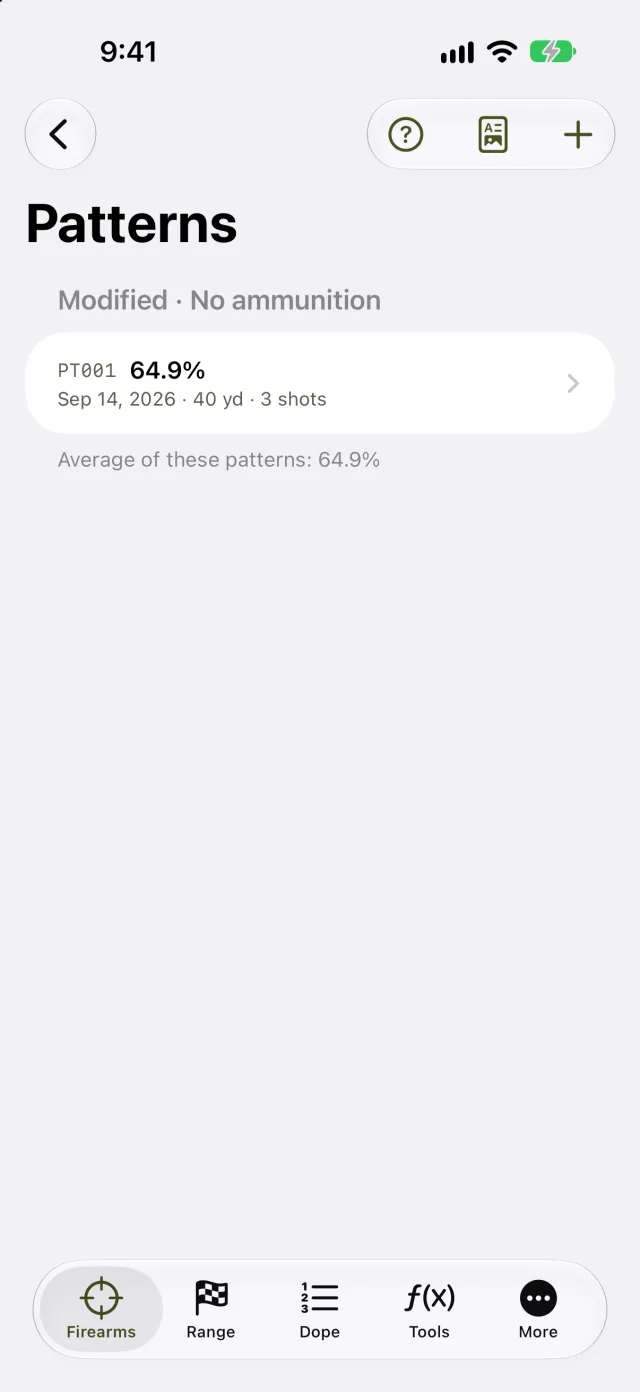
The other half is what the tube actually does in your barrel. Two "Modified" tubes from different makers can put noticeably different shares of the shot in the circle, and the same tube can do the same with two kinds of shells. Shot size and the shell itself play their part as well, and our guide on what changes shotgun pattern spread goes through each of them. That's why asking which shotgun choke has the tightest shot pattern for your gun is really a question your own pattern board answers, one test at a time.
A choke pattern chart versus your own patterns
A printed choke pattern chart gives the usual expectation for each name, and it's a fine starting point for understanding the order. What it can't know is your barrel, your tube and your shells. Your own chart is the one built from your sheets: each choke and shell, the distance, the circle, the pellets counted, and the pattern percentage worked out from them. If you haven't patterned before, our guide on how to pattern a shotgun covers the counting and the math.
Keep these the same for a fair comparison
Distance
Every test at the same measured distance, usually 40 yards.
Circle size
The same circle every time, usually 30 inches.
Shells and lot
One kind of shell through every choke, so the choke is the only change.
Several shots each
At least three sheets per choke, then compare the averages.
Choke names typed one way
"Modified" every time, never "Mod" one day and "modified" the next.
When you're working out which shotgun choke has the tightest shot pattern, remember that single patterns vary a lot from shot to shot, so one good sheet proves very little on its own. The average of three or more is what you compare, and a gap of a percent or two between chokes may be nothing more than that ordinary variation. Count the holes the same way on every sheet, including the ones that touch the line. Notes help too: holes in the pattern, where it centered against your aiming mark, and the weather that day all explain numbers later.
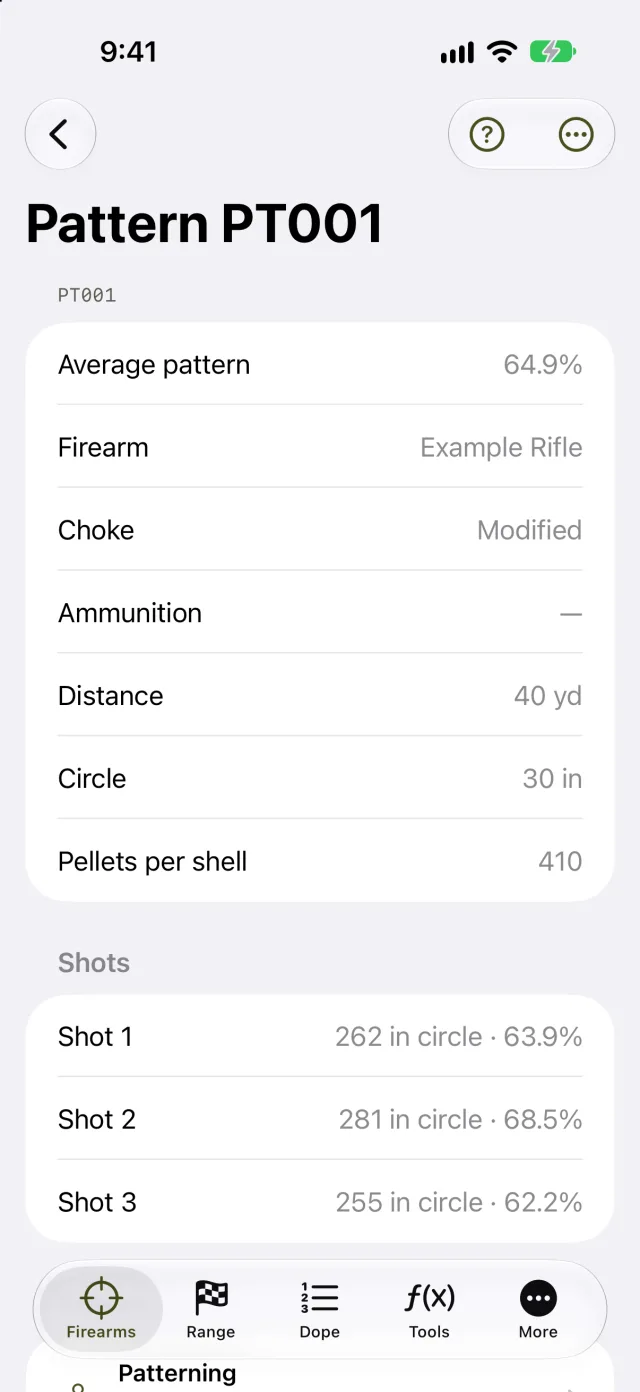
How Gun Diary lines up your chokes
Gun Diary keeps every pattern as its own record, and a shotgun's Patterns screen lists them under each choke and shells, with each test's average and the average of all the tests in that group. The shotgun pattern records page shows the whole feature, and the help article on comparing chokes on the Patterns screen covers every row and menu. These screens show the app's demo diary, with made-up firearms and makers. Your records stay on your iPhone or iPad and in your own iCloud, with no account and nothing sent to us.
In the demo diary, the Modified choke pattern tests read 70.2% and 68.8% with one target shell, for an average of 69.5%, and the Improved Cylinder test reads 59.6% with the same shell. Those are made-up numbers, but they show how the comparison reads once it's in one place. On a saved pattern, Duplicate for the Next Choke starts the next test with the same shells, lot, distance and circle, so trying another tube takes seconds. The app shows the averages side by side; it doesn't rank chokes or pick one for you.
One firearm free. See pricing.
What shotgun choke has the tightest shot pattern in your records?
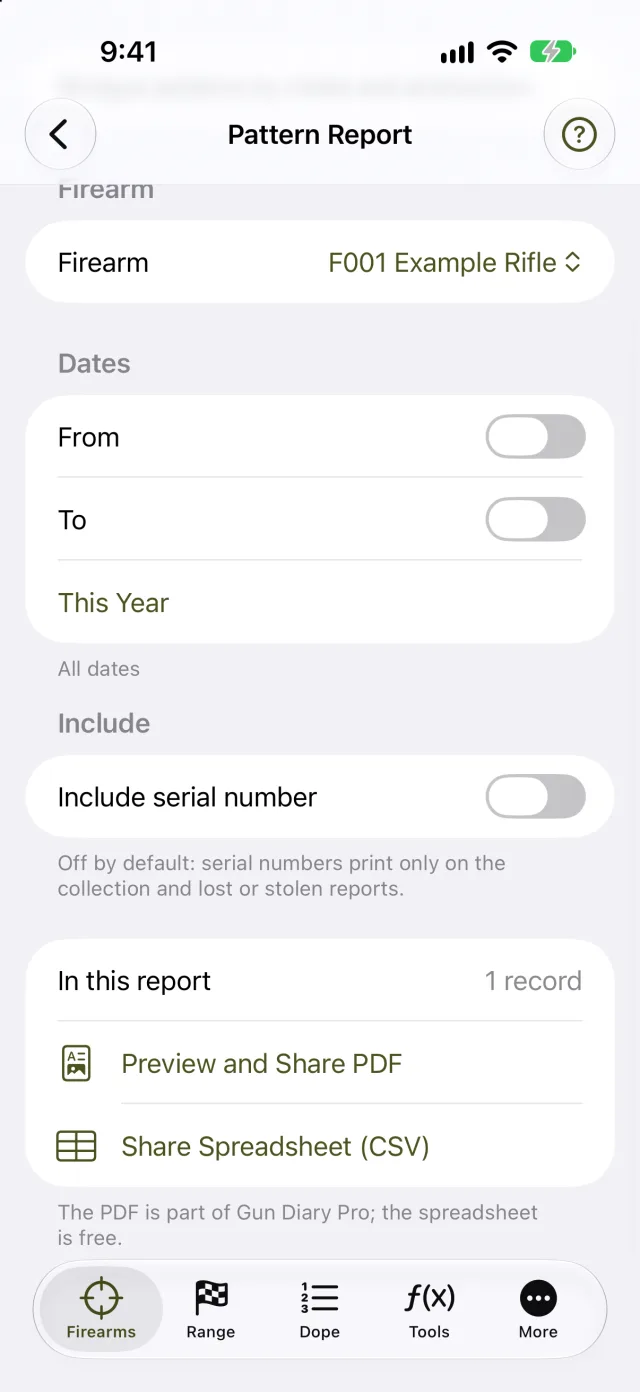
After a season or two, the answer is sitting in your records rather than in your memory. The Pattern Report sums up one shotgun's tests by choke and shells, with the number of patterns and the average percentage, then lists every pattern with its distance and counts. The help article on the shotgun pattern report explains the options. The PDF is part of Gun Diary Pro, while the spreadsheet and the pattern records themselves are free.
Keeping old tests matters as much as the new ones. A tube, a gun or a box of shells can change over the years, and a dated record is how you notice. The Missouri Department of Conservation's turkey pattern target makes the same point, with spaces for the gun, choke and shot and a nudge to keep a patterning logbook. If you're unsure whether to test at 40 yards or closer, our guide on pattern distance and circle size covers the usual convention and when shooters change it.
The bottom line
So, which shotgun choke has the tightest shot pattern?
By name, Full is the tightest of the common chokes, and the names run in order from Cylinder up through Improved Cylinder, Light Modified and Modified. For your gun and your shells, though, which shotgun choke has the tightest shot pattern is something only your own averages can tell you, tested at the same distance and circle with at least three sheets each. Whether the tightest pattern is the one you want for what you shoot is your call to make. The record's job is to make sure the comparison is fair and still readable next season.
Gun Diary keeps the records you enter. It never predicts bullet drop, wind or a trajectory; your dope is what you proved on paper. Always follow safe firearm handling.
Worried about losing years of records?
No account and no server: your diary lives in your own iCloud, and Export All Data gives you every record and photo, free, any time.
See your dataComing soon to the App Store