
Why shooters want their log in a spreadsheet
A notebook is good at holding one day. A spreadsheet is good at holding a hundred of them side by side. Sort every group a rifle has shot by distance, filter out the days you were testing a new scope, chart velocity across a season, or keep a master list of serial numbers and insured values for your files. Those are your own questions, asked of your own numbers, and a spreadsheet answers them in a few clicks. That's why so many shooters start a shooting log book Excel file at some point.
The trouble usually shows up a year in. The sheet that started neat now has three ways of writing the distance, groups in inches mixed with groups in MOA, and rows typed from memory a week after the range trip. It isn't anyone's fault: a spreadsheet will take whatever you type, and nothing checks it. The spreadsheet itself isn't the weak point, though. The weak point is using it as the place where the record starts.
What a shooting log book Excel file needs to stay useful
Four rules for a spreadsheet log you can still trust in five years
One row per record
One group, one session or one firearm per row, never two days squeezed into one.
A unit beside every value
Size in one column, its unit in the next, so inches and MOA never get averaged together.
Blank means not recorded
An empty cell is never zero; a zero you didn't measure quietly bends every average.
An ID that never changes
A code for each firearm and session, so rows in different sheets can find each other.
Follow those four and a shooting log book Excel file stays readable for years. Keeping them by hand, at the bench, with cold fingers, is the hard part. It's also why the better order is to record each range trip once, in a place built for recording, and let the spreadsheet be a copy you can make whenever you want one.
Getting your range records out of Gun Diary
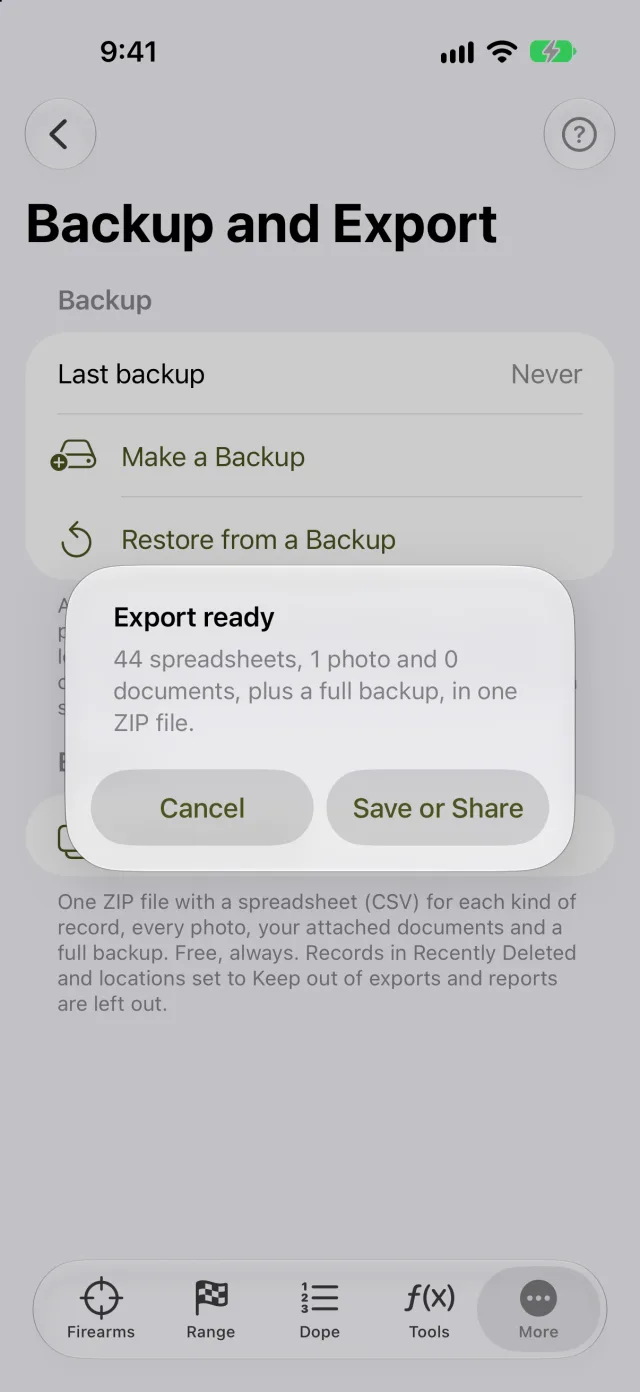
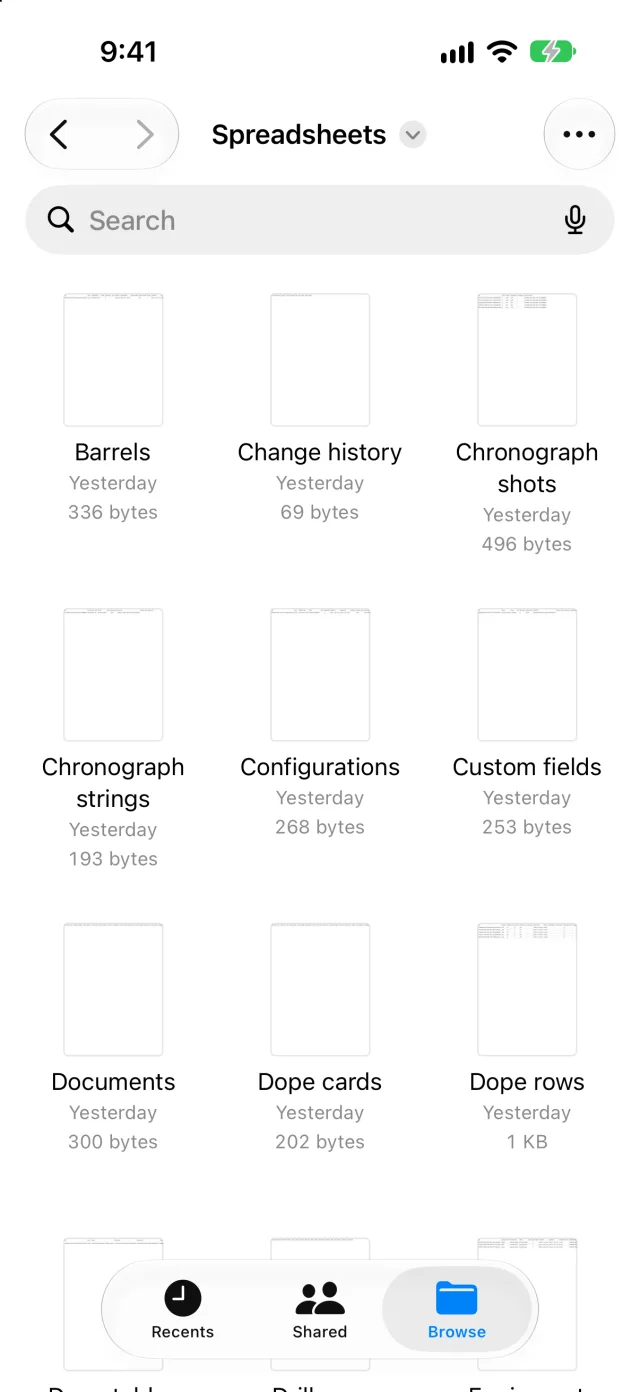
In Gun Diary, every range trip, group, dope row, zero check and firearm is already stored the way those four rules ask. Export All Data, under More and then Backup and Export, makes one ZIP file with a spreadsheet (CSV) for each kind of record: 44 files, from Firearms.csv and Sessions.csv to Groups.csv and Dope rows.csv. Every photo comes along at full size, with your attached documents, a full backup and a short READ ME. It's free on every plan, and it's part of keeping your data yours. The steps are in the help article on exporting all your data.
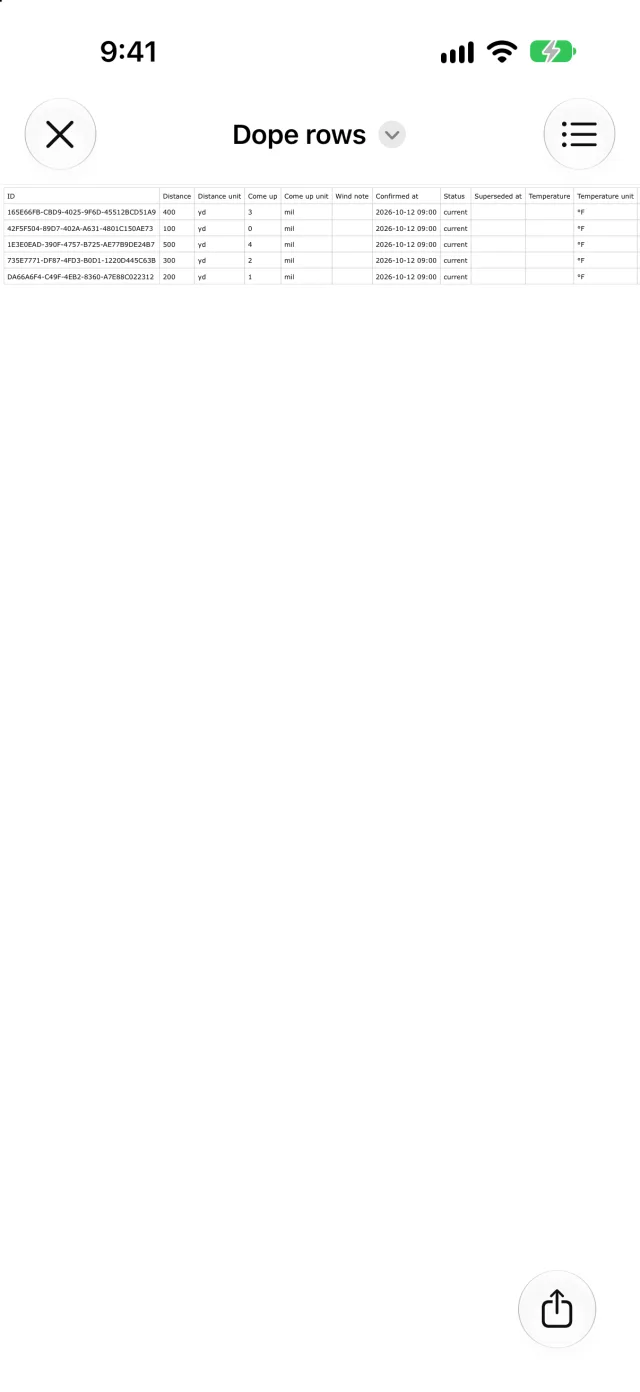
A CSV is plain text, so Excel, Numbers and Google Sheets all open it. Values keep the unit you entered, in the column next to them. Dates read like 2026-10-12 09:00, yes and no columns read yes or no, and a blank cell means you didn't record that value. If you only need one report, the Reports screen can also share a ready-made spreadsheet with names instead of IDs; every one of those is free except the collection report.
Groups on target photos.
Turning the export into your own shooting log book Excel workbook
In Excel, open a CSV from Data, then From Text/CSV, and pick comma and UTF-8 so names and the degree sign read correctly; Microsoft's page on importing text and CSV files covers the options. Freeze the top row, then filter out the rows marked Example, which belong to the built-in Example Rifle. Save your work as an .xlsx workbook so formulas and charts stick, and keep the original CSVs as they came.
Here's the kind of question it answers. Open Groups.csv and Products.csv in one workbook, filter to one rifle (the demo diary's Mountain Rifle in the help example), and use XLOOKUP on the product ID to put each group's ammunition name beside it. Keep only groups in the same unit at 100 yards, then build a pivot table of average size per ammunition and chart it. The chart is your reading of your own groups; the app itself shows values as recorded and never ranks one ammunition over another. The help article on working with your exported spreadsheets explains every file and column.
What the spreadsheet can't do
The spreadsheets are copies, so editing them changes nothing in the app. Sessions and dope can't be imported back from a spreadsheet; the one import is a gun list of firearms, a Pro feature. To put a whole diary back on a phone, you restore the backup file that comes inside the export, as our guide to keeping a gun log book that lasts explains. One more thing: Firearm details.csv holds serial numbers, purchase prices and insured values, so keep the export somewhere private and think twice before emailing it.
The bottom line
So, should your shooting log book be an Excel file?
As a copy, yes: a shooting log book Excel workbook is a great way to ask your own questions of years of range days. As the place where you first write things down, it's harder to keep honest, because nothing checks the units, the blanks or the IDs. Record each trip once in a diary built for it, export whenever you want a fresh spreadsheet, and keep the original files untouched. The screenshots here show the app's demo diary, with made-up firearms and numbers.
Gun Diary keeps the records you enter. It never predicts bullet drop, wind or a trajectory; your dope is what you proved on paper. Always follow safe firearm handling.
Need a hand?
Step-by-step help for every screen, or email contact@setriksoftware.com.
Open the Help CenterComing soon to the App Store